📅 Last updated: 27.10.2026
Early Christian art did not emerge in a cultural vacuum, and the earliest surviving Christian paintings, mosaics, and carved sarcophagi are filled with images borrowed from the pagan world around them. The Good Shepherd resembles earlier Greek kriophoros figures; the orant (praying figure) echoes Roman piety imagery; the fish, anchor, and vine appear on pagan tombstones long before they appear in the catacombs. Understanding why requires more than aesthetic history—it requires grasping how the first believers communicated a scandalous, illegal faith in a visual language their neighbors already understood.
The earliest Christian artists deliberately adopted and transformed pagan visual vocabulary—shepherd, orant, philosopher, vine, sun, and fish—because these symbols were already legible in Greco-Roman culture. Rather than importing pagan religion, they repurposed familiar forms as vehicles for distinctively Christian meaning, a practice consistent with Paul’s approach of becoming “all things to all people” (1 Corinthians 9:22).
- Why Did Early Christian Art Borrow from Pagan Imagery?
- The Catacombs: Where Early Christian Art First Flourished
- How Did Specific Pagan Symbols Become Christian?
- Comparative Table: Pagan Motif, Christian Meaning, and Scriptural Anchor
- Did the Church Fathers Approve or Resist This Borrowing?
- What Does This Mean for the Church Today?
- Why "Early Christian Art Used Pagan Symbols"—and Why It Still Matters
- A Lasting Perspective: Images That Point Beyond Themselves
Why Did Early Christian Art Borrow from Pagan Imagery?
The short answer is communication, not compromise. Christianity was born into a world saturated with images. Roman homes, baths, forums, tombs, and coins carried a dense visual grammar that everyone—slave, merchant, senator—could read. When the gospel spread first among Greek-speaking Jews and then among Gentiles (Acts 11:20–21), converts brought their visual instincts with them. The church did not baptize pagan religion; it baptized pagan forms.
Three pressures shaped this borrowing:
- Legibility: A symbol nobody recognized communicated nothing. The shepherd, the banquet, and the praying figure were instantly meaningful across the empire.
- Safety: In periods of persecution, ambiguous images could conceal Christian meaning from hostile eyes. A ship, a fish, or a shepherd raised no alarm.
- Theological confidence: Early apologists like Justin Martyr (First Apology, c. 155) argued that truth belonged to Christ wherever it was found—that pagan philosophers had glimpsed fragments of the Logos. This gave believers freedom to reclaim visual motifs for the gospel.
The result was not syncretism but translation. The same artistic skill that carved a pagan myth on a sarcophagus could carve Jonah emerging from the sea monster—a sign of resurrection hope (Matthew 12:40).
The Catacombs: Where Early Christian Art First Flourished
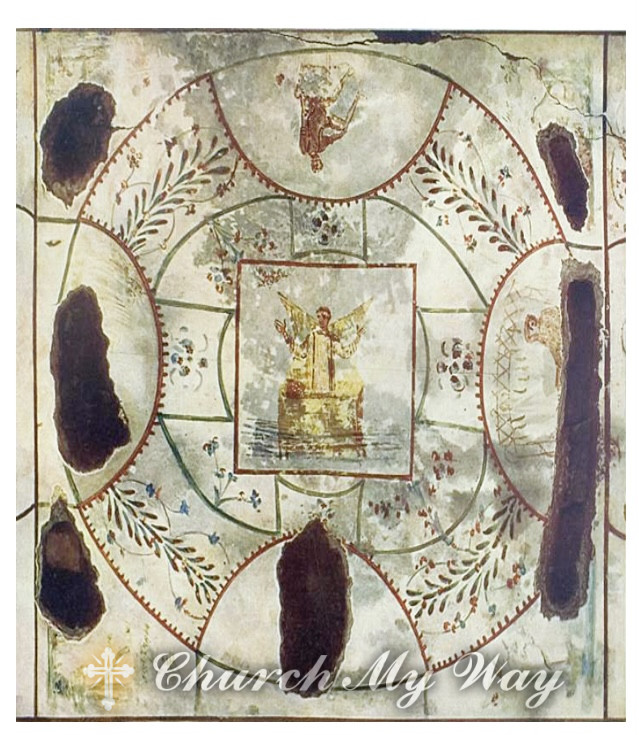
The earliest substantial body of Christian imagery comes from the Roman catacombs, underground burial corridors carved from soft tufa beginning in the late second century. The oldest painted chambers, such as the Capella Greca and the Crypt of the Lucina in the Catacomb of Callixtus, date to roughly 200–250 AD. These were not secret worship spaces so much as decorated family tombs, and their art served the dead and the mourning.
What appears on those walls is striking for what it is not: there are no crucifixes, no scenes of the Passion, no images of Christ’s suffering. Instead, the catacombs present deliverance: Noah’s ark, Daniel in the lions’ den, the three youths in the furnace, Lazarus raised, Jonah swallowed and spat out. Each scene is a visual sermon on God’s rescue of the faithful—drawn from Scripture but rendered in the pictorial conventions of Roman funerary art.
The orant figure is a telling example. In pagan Rome, a veiled woman with raised arms appeared on tombstones as a symbol of pietas, familial devotion. In the catacombs, the same posture becomes a portrait of the praying soul, often with the deceased’s name inscribed—a Christian claim that death had not severed the person from the community of prayer. Clement of Alexandria, writing around 200 in Paedagogus 3.11, even advised Christians to engrave their signet rings with a dove, a fish, a ship, or a lyre—ordinary motifs with new meaning.
How Did Specific Pagan Symbols Become Christian?
The Good Shepherd
No image dominates early Christian art more than the shepherd carrying a sheep. Greek and Roman art had long depicted Hermes Kriophoros (“ram-bearer”) and pastoral figures on sarcophagi. Christians seized the type because Jesus had claimed the title: “I am the good shepherd. The good shepherd lays down his life for the sheep” (John 10:11). The earliest known depiction appears in the Catacomb of Domitilla, and the motif recurs on sarcophagi, lamps, and house-church frescoes at Dura-Europos (c. 235). The pagan form carried a pastoral, benevolent connotation; the Christian content carried the atonement.
The Orant and the Philosopher
The seated, bearded teacher in a tunic—often with a scroll—was a stock figure of Greek philosophy. Christians adapted it to portray Christ as the divine teacher, sometimes seated among apostles like Socrates among students. This visual choice made a theological claim: the gospel is wisdom, and Christ is its source. Justin Martyr’s argument that the Logos had spoken partially through the philosophers gave this imagery its intellectual footing.
The Vine, the Fish, and the Anchor
The vine had decorated Dionysiac art for centuries. Jesus claimed it directly: “I am the true vine” (John 15:1). The fish (ichthys) worked as an acrostic for Iēsous Christos Theou Huios Sōtēr—”Jesus Christ, Son of God, Savior”—and appeared both as a symbol and as a pictorial pun in scenes of the Last Supper. The anchor, common on pagan tombstones as a symbol of stability, became a sign of hope: “We have this hope as an anchor for the soul, firm and secure” (Hebrews 6:19).
The Sun and the Banquet
Solar imagery was everywhere in Roman religion—Sol Invictus on coins, Mithraic reliefs, imperial iconography. A third-century mosaic under St. Peter’s Basilica depicts Christ as the sun driving a chariot, a direct visual quotation of Sol. The meaning is transformed: Malachi 4:2 had promised “the sun of righteousness” rising with healing, and Christ is the “light of the world” (John 8:12). Likewise, the banquet scene—borrowed from pagan funerary meals—became a picture of the messianic feast (Isaiah 25:6; Revelation 19:9).
Comparative Table: Pagan Motif, Christian Meaning, and Scriptural Anchor
| Pagan Motif | Original Context | Christian Reinterpretation | Scriptural Anchor |
|---|---|---|---|
| Kriophoros (ram-bearer) | Hermes, pastoral deities on sarcophagi | Christ the Good Shepherd who lays down his life | John 10:11; Psalm 23 |
| Orant figure | Roman piety and funerary devotion | The praying soul; intercession and hope | 1 Timothy 2:1; Philippians 4:6 |
| Seated philosopher | Greek intellectual tradition | Christ as divine Teacher and Logos | John 1:1; Colossians 2:3 |
| Vine and grapes | Dionysus and fertility cults | Christ the true vine; Eucharist | John 15:1–5; Matthew 26:27–29 |
| Fish (ichthys) | General Roman decorative motif | Acrostic for Jesus Christ, Son of God, Savior | Matthew 4:19; John 21:9–13 |
| Sol / sun chariot | Sol Invictus, imperial coinage | Christ the light and sun of righteousness | Malachi 4:2; John 8:12 |
Did the Church Fathers Approve or Resist This Borrowing?
Both, and the tension is instructive. Tertullian, writing in De Idololatria (c. 211), worried that Christians who made idols for pagan temples were complicit in idolatry. Yet Tertullian himself used the fish symbol and defended Christian art’s freedom from superstition. Clement of Alexandria encouraged believers to use recognizable symbols on seals, provided the meaning was Christian. The Council of Elvira (c. 306) in Spain issued a canon forbidding images in churches—a sign that some leaders feared visual distraction or pagan association—yet the catacombs kept painting.
Augustine, a century later, articulated the mature position in De Doctrina Christiana (2.40): signs are useful when they point beyond themselves to the thing signified. The danger is not the image but the heart that stops at the image. This is essentially the logic of the second commandment (Exodus 20:4–6): the prohibition targets idolatrous worship, not all representation. The early church read the commandment through that lens and felt free to use images as teaching tools for an often illiterate flock.
By the fourth century, with persecution ended under Constantine, Christian art moved into public view. The mosaics of Santa Maria Maggiore in Rome (c. 432–440) and the Ravenna baptisteries show a mature visual theology—still using classical forms, now unmistakably Christian in subject. The borrowing had become so thorough that it no longer looked like borrowing.
What Does This Mean for the Church Today?
The early Christian approach to art offers a working model for engaging culture without capitulating to it. Believers in the second and third centuries did not retreat into a visual ghetto, nor did they adopt pagan worship. They practiced what missiologists now call critical contextualization: receiving a culture’s forms, testing them against Scripture, and filling them with new meaning.
- Form is not the same as meaning. A shepherd image can serve Hermes or Christ; the form is neutral, the meaning is not.
- Familiarity is a bridge, not a destination. The church used recognizable symbols to draw people toward the unfamiliar gospel.
- Scripture sets the boundaries. Every borrowed motif was anchored in a text—John 10, John 15, Hebrews 6—so that the image served the Word rather than replacing it.
Paul’s missionary method in Acts 17 illustrates the same principle. Standing before the Areopagus, he quoted pagan poets (“For we are his offspring,” Acts 17:28) not to endorse Stoic theology but to build a bridge to the resurrection. The catacomb painters did the same with images.
Why “Early Christian Art Used Pagan Symbols”—and Why It Still Matters
The phrase “early Christian art used pagan symbols” can sound like an accusation. In context, it is a description of faithful witness. The first Christians lived in a world of temples, coins, and tombs, and they refused to let the visual world belong entirely to the gods of Rome. They took the shepherd from Hermes and gave him to Christ. They took the philosopher’s chair and seated the Word made flesh in it (John 1:14). They took the vine of Dionysus and made it the branches of the true vine.
This was not a dilution of the faith but an act of theological imagination rooted in the conviction that all truth is God’s. Justin Martyr’s doctrine of the Logos—that the divine Word had scattered seeds of truth throughout the nations—gave the early church confidence to claim beauty wherever it found it. The catacombs are the visual record of that confidence: ordinary Roman forms, extraordinary Christian hope.
A Lasting Perspective: Images That Point Beyond Themselves
Walk through the Catacomb of Priscilla today and you stand before a third-century fresco of the Good Shepherd, painted in the same style as the pagan tombs nearby. The difference is not the brushwork but the promise. The shepherd on the pagan tomb carried a ram; the shepherd in the catacomb carries a sheep and lays down his life for it (John 10:11). The orant on the pagan stone raised her arms to household gods; the orant in the catacomb raises her arms to the God of the resurrection.
That is the enduring lesson of early Christian art. Symbols are servants, not masters. They carry meaning when they are filled with Scripture and directed toward Christ. The church that borrowed the shepherd, the vine, and the fish did not lose the gospel in the exchange—it made the gospel visible to a watching world. In an age as image-saturated as our own, that instinct remains worth recovering: not to sanctify every cultural form uncritically, but to claim every good form for the One who is the image of the invisible God (Colossians 1:15).
