📅 Last updated: 03.11.2026
The sign of the cross is one of the oldest gestures in Christian worship, older than the creeds, older even than the New Testament canon itself. Long before a believer could own a Bible or hear a sermon in their native tongue, they could trace the shape of Calvary on their own forehead. This article examines why early Christians made the sign of the cross, what they believed it accomplished, how the practice developed across the first five centuries, and what it still offers the modern disciple who wants to take up the cross daily (Luke 9:23).
The sign of the cross is an ancient Christian gesture in which a believer traces the shape of Christ’s cross over the body, usually the forehead or the chest, often while invoking the Trinity. Early Christians made it as a mark of belonging, a plea for divine protection, a confession of faith in the crucified and risen Lord, and a daily renewal of their baptismal identity. Written evidence appears by the early third century in Tertullian and the Apostolic Tradition, and the practice is universally attested across the ancient church by the fourth century.
- What Is the Sign of the Cross, and Where Did It Come From?
- Why Did Early Christians Make the Sign of the Cross? Five Historical Reasons
- How Did the Sign of the Cross Develop Across the First Five Centuries?
- What Did the Sign of the Cross Mean in Daily Christian Life?
- Is the Sign of the Cross Biblical?
- Why Did the Practice Vary, and What Do the Differences Mean?
- How Should Christians Today Understand and Use the Sign of the Cross?
- The Sign of the Cross as a Lasting Confession
What Is the Sign of the Cross, and Where Did It Come From?
The gesture itself is simple: the hand moves from forehead to chest, or from forehead to chest and shoulder to shoulder, tracing the outline of the instrument on which Jesus died. What makes it more than a motion is what it signifies—the whole gospel compressed into a physical act. Paul summarized that gospel in 1 Corinthians 1:22–24, where he called the message of the cross “foolishness to those who are perishing, but to us who are being saved it is the power of God.” The sign of the cross is that sentence made visible on the body.
The practice did not emerge from a single decree or council. It grew organically from the apostolic age, passed along by practice rather than by written instruction—which is precisely why the earliest literary references appear later than the practice itself. Christians marked themselves before praying, before meals, before sleep, before battle, before martyrdom. The gesture was so ordinary that ancient writers mention it almost in passing, assuming their readers already did it.
The Old Testament Background: Marked on the Forehead
Early Christians read their Bibles through the lens of the cross, and they found precursors to the sign in the Hebrew Scriptures. In Ezekiel 9:4, God commands an angel to “put a mark on the foreheads” of those who grieve over the abominations of Jerusalem—a protective seal distinguishing the faithful from the judgment to come. In Exodus 12:7, the blood of the Passover lamb is applied to the doorposts, marking the household for deliverance. Revelation 7:3 and 14:1 pick up the same imagery: the servants of God are sealed “on their foreheads” with the name of the Lamb. For the early church, tracing the cross on the forehead was a living participation in that sealing—a sign that you belonged to the Lamb who was slain.
Why Did Early Christians Make the Sign of the Cross? Five Historical Reasons
The question of motive matters more than the question of mechanics. The church fathers did not treat the sign as a lucky charm or an empty ritual. They gave it theological weight, and their explanations cluster around five purposes that recur across the ancient sources.
- Sealing and belonging: The cross marked the believer as Christ’s own, a visible counterpart to the invisible seal of baptism.
- Protection and exorcism: Ancient Christians invoked the sign against demonic power, danger, and temptation, treating the name of Christ as a fortress.
- Confession of faith: The gesture proclaimed the crucifixion and resurrection in an age when those claims were scandalous and often illegal.
- Baptismal identity: The sign renewed the meaning of the baptismal washing, in which the candidate had been sealed with the cross.
- Sanctifying daily life: Ordinary moments—rising, eating, working, sleeping—were framed by the sign, turning routine into prayer.
Tertullian: The Earliest Detailed Witness
The first sustained description comes from Tertullian of Carthage, writing around AD 200–206 in De Corona (On the Crown), a treatise defending a Christian soldier who refused to wear a military crown. In chapter 3, Tertullian lists practices the church observed by tradition rather than by written command:
“At every forward step and movement, at every going in and out, when we put on our clothes and shoes, when we bathe, when we sit at table, when we light the lamps, on couch, on seat, in all the ordinary actions of daily life, we trace upon the forehead the sign.” (De Corona 3)
Two details stand out. First, Tertullian calls the practice a tradition received and handed down—not an innovation of his own generation. Second, he describes it as a habit woven into the fabric of ordinary life, not a rare ceremonial act. Writing a few decades later, his fellow North African Cyprian of Carthage (d. 258) referred to the sign as a regular part of the believer’s spiritual armor.
The Apostolic Tradition and the Sign at Baptism
The church order known as the Apostolic Tradition, traditionally attributed to Hippolytus of Rome and dated to the early third century, prescribes the sign at several points in the baptismal rite. The candidate renounces Satan and is “sealed” on the forehead with the cross before entering the water; after the washing and anointing, the bishop again signs the newly baptized on the forehead. The sign of the cross thus functioned as a boundary marker at the threshold of the Christian life—a seal that said, in effect, “this one belongs to Christ, not to the powers of darkness.”
How Did the Sign of the Cross Develop Across the First Five Centuries?
The gesture’s history shows remarkable continuity in meaning alongside real variation in form. The earliest evidence points overwhelmingly to a small cross traced on the forehead, often with the thumb. The large, sweeping gesture across the whole body—forehead, breast, and shoulders—appears later and becomes standard in the medieval West. Eastern churches developed the practice of signing with the right hand from forehead to chest and then shoulder to shoulder, while Western practice moved from left shoulder to right. These are differences of custom, not of doctrine.
| Period | Key Witness or Event | Significance for the Practice |
|---|---|---|
| c. AD 200–206 | Tertullian, De Corona 3 | First detailed description; the sign is an inherited tradition traced on the forehead in daily life. |
| Early 3rd century | Apostolic Tradition (attrib. Hippolytus) | Sign used as a seal at baptism and in the renunciation of Satan. |
| c. 250–258 | Cyprian of Carthage; persecution under Decius and Valerian | Sign invoked as protection in a time of martyrdom. |
| c. 350 | Cyril of Jerusalem, Mystagogical Catecheses | Instructs catechumens to sign the forehead boldly as a shield against the enemy. |
| 4th–5th century | Basil, Augustine, John Chrysostom, Jerome | Practice universally attested; Augustine calls it a sign of Christ’s passion and a seal of faith. |
| Medieval period | Western and Eastern liturgical development | Large full-body gesture becomes standard; minor variations in direction emerge. |
From the Catacombs to the Catechumenate
Archaeology corroborates the written record. In the Roman catacombs, Christian inscriptions and frescoes from the second and third centuries depict the cross and the chrismon (the monogram of Christ), and early Christian art frequently shows figures in the orans posture with the hand raised to the forehead. The sign belonged to a world in which Christians gathered in house churches and burial chambers, where a small physical gesture carried enormous meaning for a community under suspicion.
By the fourth century, with the peace of Constantine (AD 313), the sign emerged from the shadows into the catechumenate and the public liturgy. Cyril of Jerusalem, instructing candidates for baptism around AD 350, urged them to “make the sign of the cross boldly” on the forehead, teaching that the gesture was a public confession and a defense against the evil one. His catechetical lectures show the sign as a standard part of Christian formation, not an optional devotion.
The Fathers on the Meaning of the Gesture
Augustine of Hippo (354–430) wove the sign into his theology of the sacraments and the Christian life. In his writings he speaks of the cross as the sign by which the believer is marked, and he treats the gesture as a confession of the passion of Christ and a seal of faith. Basil the Great (c. 330–379), in On the Holy Spirit (chapter 27), cites the sign of the cross among the traditions handed down “unwritten” from the apostles—alongside the invocation of the Trinity at baptism—arguing that such customs carry apostolic authority even without explicit scriptural command. John Chrysostom (c. 347–407) repeatedly exhorts his congregations to sign themselves, describing the gesture as a spiritual weapon and a memorial of the cross.
These fathers did not claim the sign was a sacrament or a substitute for faith. They treated it as a signum—a sign that presupposes the reality it points to. Its power lay not in the motion of the hand but in the name invoked and the cross confessed.
What Did the Sign of the Cross Mean in Daily Christian Life?
The most striking feature of the early evidence is how ordinary the sign was. It was not reserved for Sunday worship. It accompanied the believer from waking to sleeping, from the table to the street. This is the heart of the answer to why early Christians made the sign of the cross: they wanted their whole lives oriented toward the crucified Lord.
A Seal of Protection and a Weapon Against Evil
The ancient church lived in a world it believed to be populated by spiritual powers. The sign of the cross was understood as a real defense. Cyril of Jerusalem told catechumens to sign the forehead at meals, at rising, at going out, and to do so “not for show, but sincerely.” The gesture was a prayer in motion, an appeal to Christ’s victory over the powers (Colossians 2:15). In the age of the martyrs, when Christians faced arrest and execution, the sign took on an added edge: it was a public declaration of allegiance to a crucified Lord in a society that considered crucifixion shameful (1 Corinthians 1:23).
A Renewal of Baptismal Identity
Because the sign was first given at baptism, every subsequent tracing of it recalled the believer’s incorporation into Christ’s death and resurrection. Romans 6:3–4 grounds this theology: baptism is a burial with Christ and a rising to new life. The sign of the cross was the daily re-appropriation of that reality—a way of saying, again and again, “I have been crucified with Christ; and it is no longer I who live, but it is Christ who lives in me” (Galatians 2:19–20).
A Confession in a Hostile World
In a culture where Christians were a minority and often a suspect one, the sign functioned as a discreet but unmistakable confession. It identified the believer to fellow Christians and, at times, to persecutors. Tertullian’s treatise on the military crown shows how seriously the early church took visible signs of allegiance: a soldier who refused to compromise on a matter of Christian conscience was upheld as a model. The sign of the cross was part of that same logic—a small, daily act of faithfulness that formed courage for larger ones.
Is the Sign of the Cross Biblical?
The sign itself is not commanded in Scripture, and honest historical inquiry should say so plainly. But the practice is deeply rooted in biblical themes, and the early church understood it as a faithful extension of apostolic teaching rather than an addition to it. Basil’s argument in On the Holy Spirit 27 is instructive: he distinguishes between doctrines written in Scripture and customs handed down in practice, and he defends the latter as part of the church’s apostolic inheritance.
Several scriptural threads converge in the gesture:
- Marking and sealing: Ezekiel 9:4, Revelation 7:3, and Ephesians 1:13 speak of a seal on God’s people—the sign makes that seal visible.
- Taking up the cross: Luke 9:23 calls every disciple to take up the cross daily; the gesture is a bodily enactment of that call.
- Confessing Christ: Romans 10:9–10 ties salvation to confession with the mouth and belief in the heart; the sign joins the body to that confession.
- Praying without ceasing: 1 Thessalonians 5:17 finds a practical expression in a gesture that can accompany every moment of the day.
What the sign of the cross does is make the gospel tangible. It takes abstract doctrine—atonement, resurrection, baptismal union, spiritual warfare—and presses it into the hands and forehead of the believer. That is a thoroughly biblical instinct, even where the specific form is a matter of tradition.
Why Did the Practice Vary, and What Do the Differences Mean?
Travelers in the ancient church noticed that Christians signed themselves differently in different regions. Augustine, writing to a correspondent named Januarius around AD 400, addressed exactly this kind of liturgical variation, advising that differences in custom should not become grounds for division. The church has historically distinguished between the substance of the faith and the forms of its expression, and the sign of the cross belongs to the latter while pointing to the former.
The main variations are matters of custom rather than doctrine:
- Forehead versus full body: The earliest practice was a small cross on the forehead; the large gesture across the torso developed later.
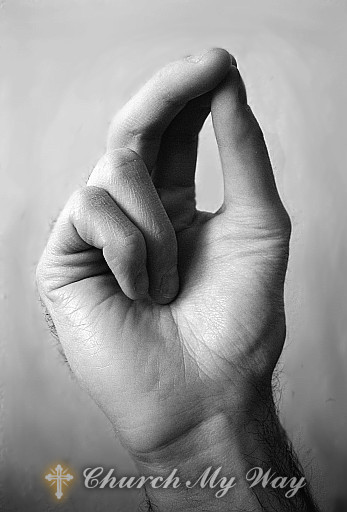
- One finger versus several: Some traditions sign with a single finger to emphasize the unity of God; others use three fingers joined to confess the Trinity, or two to confess the two natures of Christ.
- Left-to-right versus right-to-left: Western churches move from the left shoulder to the right; many Eastern churches reverse the direction.
None of these differences touches the meaning of the gesture. A believer in third-century Carthage, fourth-century Jerusalem, and twenty-first-century anywhere is making the same confession: Christ crucified, Christ risen, Christ present.
How Should Christians Today Understand and Use the Sign of the Cross?
For many contemporary believers—especially those in traditions that do not customarily use the sign—the gesture raises honest questions. Is it superstition? Is it a Roman or Eastern distinctive? Does it add anything to faith? The historical record offers a measured answer.
The sign of the cross is not a charm. The church fathers were clear that its efficacy rests on the faith of the one making it and the name invoked, not on the motion of the hand. Used thoughtlessly, it can become empty ritual; used prayerfully, it is a compact act of worship. The gesture is also not the property of any single tradition. It predates the divisions of the church by centuries and belongs to the common inheritance of all who confess the crucified Lord.
For those who wish to recover or deepen the practice, a few principles from the ancient church remain useful:
- Make it a prayer, not a habit: Let the gesture carry an intention—thanksgiving, petition, repentance, or trust.
- Tie it to baptism: Remember the washing in which you were sealed, and let the sign renew that identity.
- Use it at the thresholds of the day: Rising, sleeping, eating, traveling, and facing temptation are all moments the early Christians marked.
- Keep it rooted in Scripture: Let the sign point beyond itself to the cross and resurrection it confesses.
Whether a believer crosses themselves a hundred times a day or never does, the theology the sign embodies is not optional. Every Christian is called to live under the shadow of the cross and in the power of the resurrection. The sign of the cross is one ancient, humble way of making that calling visible.
The Sign of the Cross as a Lasting Confession
The sign of the cross has survived persecution, empire, schism, and centuries of cultural change. It endured because it does something no sermon can do as efficiently: it puts the gospel on the body. When Tertullian’s Christians traced the cross on their foreheads before leaving the house, they were declaring that the crucified Lord went with them. When Cyril’s catechumens signed themselves boldly, they were claiming a victory already won. When Augustine’s congregations made the gesture, they were sealing a faith received at the font.
The practice asks a simple question of every generation: will you let the cross shape not only what you believe but how you live, move, and speak? The early Christians answered with their hands. Their witness invites us to do the same—not as a relic of a distant past, but as a living confession that Jesus Christ, and him crucified, is Lord (1 Corinthians 2:2; Philippians 2:11).
