📅 Last updated: 07.11.2026
Catacomb art offers a rare window into the faith of Christians living in the first four centuries, when the church was often misunderstood, periodically persecuted, and still defining its visual language. Painted on the walls of Roman burial chambers and carved into sarcophagi, these images were not decoration for its own sake; they were theology in pigment and stone, shaped by Scripture, hope, and the daily reality of living as a minority faith in a pagan empire.
The catacomb art of early Christians reveals a faith centered on resurrection, salvation through Christ, and the hope of eternal life. Through biblical scenes like Jonah, Daniel, and the Good Shepherd, believers expressed trust in God’s deliverance, confidence in Christ’s victory over death, and a communal identity formed by Scripture, baptism, and the Eucharist—long before church councils codified doctrine or imperial patronage shaped Christian architecture.
- What Are the Roman Catacombs, and Why Does Their Art Matter?
- How Did Catacomb Art Speak in Symbols Before Doctrine Was Codified?
- Which Biblical Scenes Dominate Catacomb Art, and Why?
- What Does the Good Shepherd Reveal About Early Christian Belief?
- What Do Catacomb Art and the Eucharist and Baptism Have in Common?
- A Timeline of Catacomb Art and Early Christian Belief
- What Catacomb Art Reveals About Death, Resurrection, and the Communion of Saints
- What Can Modern Believers Learn from Catacomb Art?
- How Catacomb Art Speaks to the Church Today
- The Lasting Perspective: A Faith Painted in Hope
What Are the Roman Catacombs, and Why Does Their Art Matter?
The catacombs are underground burial networks cut into the soft volcanic tufa beneath and around Rome. They began in the late second century and expanded over the next three hundred years into a vast system of galleries, cubicula (small chambers), and loculi (burial niches) stacked in walls. The oldest and most famous include the Catacombs of Callixtus, Domitilla, Priscilla, and Sebastian. These were not hiding places for worship during persecution, as popular legend often claims; they were cemeteries, legally protected as burial grounds even under hostile emperors. Christians gathered there for funeral meals and memorial services on the anniversaries of martyrs, but the catacombs were primarily cities of the dead awaiting resurrection.
Their art matters because it is among the earliest surviving Christian visual evidence we possess. Before Constantine’s conversion in the early fourth century and the great basilicas that followed, Christians had almost no monumental architecture of their own. What they had were house churches, simple sarcophagi, and painted tomb chambers. The frescoes in those chambers—dating roughly from the late second through the fourth century—show us what ordinary believers chose to picture when they thought about God, death, and salvation. That makes catacomb art a kind of grassroots creed, a visual testimony from the pew rather than the pulpit.
Much of this art survives from the third and fourth centuries, with the earliest Christian frescoes appearing around AD 200 in the Catacomb of Callixtus and related sites. Earlier than that, Christians in Rome largely buried their dead in mixed pagan cemeteries without distinctive imagery, sometimes using neutral motifs like the anchor or the vine. The sudden emergence of explicitly biblical scenes in the early third century marks a turning point: a community confident enough in its identity to claim the language of art for its own hope.
How Did Catacomb Art Speak in Symbols Before Doctrine Was Codified?
Before the creeds of Nicaea (325) and Constantinople (381), Christian belief existed in liturgy, preaching, Scripture reading, and shared practice. Visual symbols carried that belief into the burial chamber, where words were scarce and grief was near. The symbols were not secret codes in the Dan Brown sense; they were widely understood shorthand, drawn from Scripture and from everyday life, that communicated hope to those who knew the faith and signaled identity to those who shared it.
The Anchor, the Fish, and the Vine
The anchor appears frequently in the earliest Christian art, drawn from Hebrews 6:19: “We have this hope as an anchor for the soul, firm and secure.” For a community facing the storms of persecution and the final storm of death, the anchor was a statement of stability in Christ. The fish, often formed from the Greek word ichthys (Jesus Christ, Son of God, Savior), connected to the Gospel accounts of Jesus calling fishermen and feeding the multitudes. The vine and grapes evoked John 15:5, “I am the vine; you are the branches,” and also pointed toward the Eucharist. The dove recalled the Spirit descending at Jesus’ baptism (Matthew 3:16) and the peace of Noah’s dove returning with an olive branch (Genesis 8:11).
The Orans: Praying Hands of Hope
The orans figure—a person standing with arms outstretched in prayer—appears constantly in catacomb art, often in the cubicula of the Roman nobility and frequently female. The posture was familiar from pagan art, but Christians gave it new meaning: the soul at prayer, the believer interceding, the martyr awaiting vindication. Some scholars see in the orans a depiction of the deceased now at peace in God’s presence, arms lifted in the posture of the Psalms: “Hear my prayer, O Lord; let my cry for help come to you” (Psalm 102:1). The orans is not a magic charm; it is a portrait of trust.
Which Biblical Scenes Dominate Catacomb Art, and Why?
If you walk through the catacombs with a Bible in hand, you will recognize the scenes almost immediately. They cluster around a clear theme: God rescues his people from death. The early Christians chose narratives of deliverance, not because they were avoiding harder doctrines, but because death was the immediate enemy they faced daily, and the resurrection was the answer they were counting on.
Jonah: The Sign of Resurrection
Jonah appears more often than almost any other Old Testament figure in catacomb art. You will see him swallowed by the great fish, then vomited onto dry land, then resting under the withered gourd vine. The catacomb of Saints Peter and Marcellinus, the Catacomb of Callixtus, and numerous sarcophagi repeat the sequence. Why Jonah? Jesus himself made the connection: “For as Jonah was three days and three nights in the belly of a huge fish, so the Son of Man will be three days and three nights in the heart of the earth” (Matthew 12:40). Jonah’s deliverance was a preview of Christ’s resurrection and, by extension, the believer’s. In a burial chamber, that was the message grieving families needed.
Daniel in the Lions’ Den
Daniel, calm among lions, appears in catacomb art as a picture of divine protection in the face of mortal threat. The story in Daniel 6—the faithful servant preserved by an angel—resonated with Christians who knew what it was to face hostile authorities. The image said: God shuts the mouths of lions; he can shut the mouths of your enemies too. In the Catacomb of Callixtus and elsewhere, Daniel often stands with arms raised in prayer, a living orans, linking the Old Testament deliverance to the Christian’s own prayer for rescue.
The Three Young Men in the Fiery Furnace
Shadrach, Meshach, and Abednego (Daniel 3) appear with hands lifted in the furnace while a fourth figure—often interpreted as the angel of the Lord or a pre-incarnate appearance of Christ—stands among them. The scene was a favorite in catacomb art because it depicted faithfulness under persecution and divine presence in suffering. The flames did not consume them; the fire became a place of fellowship with God. For Christians facing the possibility of martyrdom, that was not abstract theology but a promise to hold onto.
Lazarus, the Raising of the Dead
The raising of Lazarus (John 11) appears in catacomb art with striking frequency, often in abbreviated form: Jesus extending a rod or hand toward a small, mummified figure emerging from a tomb. The scene is resurrection made visible. Martha’s confession in John 11:27—”I believe that you are the Messiah, the Son of God”—anchors the miracle in faith, and Jesus’ words “I am the resurrection and the life” (John 11:25) give the image its meaning. In a cemetery, the message was unmistakable: the one who called Lazarus out of the tomb will call us out too.
What Does the Good Shepherd Reveal About Early Christian Belief?
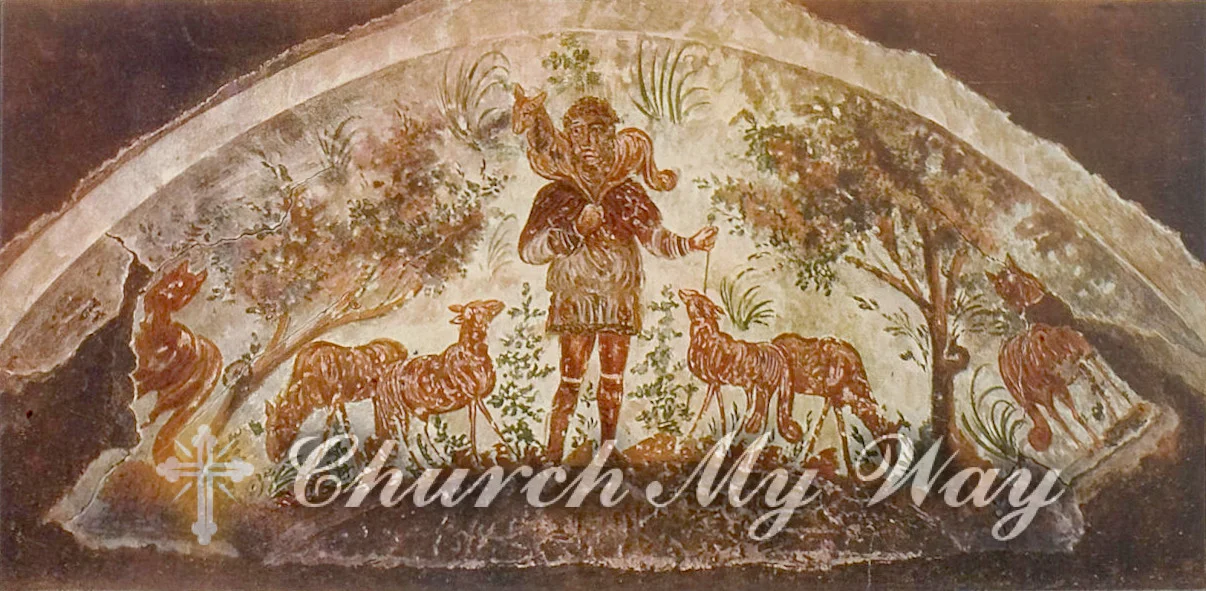
The Good Shepherd is the single most common image in catacomb art. A young, beardless man in a short tunic carries a lamb across his shoulders, often with a staff or a bucket of milk nearby. He appears in the Catacomb of Callixtus, Domitilla, Priscilla, and on countless sarcophagi. The image draws directly from John 10:11—”I am the good shepherd. The good shepherd lays down his life for the sheep”—and from the parable of the lost sheep in Luke 15:3-7.
The choice of this image tells us a great deal about early Christian belief. It shows a Christ who is personal, compassionate, and sacrificial. It shows a Savior who seeks the lost and carries the weak. It shows a faith centered not on abstract principles but on a relationship with a living Lord who knows his sheep by name (John 10:3). In a burial setting, the Good Shepherd is the one who leads the soul through the valley of the shadow of death (Psalm 23:4) into green pastures. The image is gentle, but its theology is robust: the shepherd’s authority rests on his willingness to die for the flock.
Christ as Healer and Teacher
Other images of Christ appear in catacomb art as well. He heals the blind man (John 9) and the paralytic (Mark 2), and he teaches his disciples. These scenes emphasize his power over sickness and sin and his role as authoritative teacher. The healing of the paralytic, for instance, ties physical restoration to the forgiveness of sins—”Son, your sins are forgiven” (Mark 2:5)—a doctrine the early Christians held with conviction and depicted without embarrassment.
What Do Catacomb Art and the Eucharist and Baptism Have in Common?
Catacomb art is not only about death; it is also about the sacraments that sustained believers through life. Two images stand out: the banquet and the baptism.
The Banquet and the Eucharist
Scenes of a communal meal—figures reclining around a table with bread and fish or a cup—appear in catacomb art and on sarcophagi. Some of these depict the feeding of the five thousand (Matthew 14:13-21), others the Last Supper, and still others the heavenly banquet of Revelation 19:9. The early Christians saw in all of them a foretaste of the Eucharist. The bread and fish on the table evoke the multiplication of loaves and the meal on the shore after the resurrection (John 21:9-13). The banquet image told the bereaved that their loved one had passed from the earthly table to the heavenly one, and that they themselves would join that feast. The Eucharist was not a symbol of a distant hope; it was participation in the risen Christ, and the catacomb paintings treated it that way.
Baptism and the Waters of Life
Baptismal imagery appears in catacomb art through scenes of water: Moses striking the rock (Exodus 17:6, interpreted by Paul in 1 Corinthians 10:4 as pointing to Christ), the baptism of Jesus in the Jordan, and the healing of the paralytic at the pool of Bethesda (John 5). Peter’s baptism of his jailer (Acts 16:33) and the rivers of living water from John 7:38 also appear in related early Christian art. Baptism was understood as burial and resurrection with Christ (Romans 6:4), which made it a natural theme for a burial chamber. The same water that washed away sin also promised passage through death into life.
A Timeline of Catacomb Art and Early Christian Belief
| Period | Developments in Catacomb Art | Theological Emphasis |
|---|---|---|
| Late 2nd century (c. 180–200) | Earliest Christian frescoes appear in Roman catacombs; symbols like the anchor, fish, and orans predominate | Hope, identity, and trust in God’s protection |
| Early 3rd century (c. 200–250) | Biblical scenes emerge: Jonah, Daniel, the Good Shepherd, Lazarus | Resurrection, deliverance, and Christ as Savior |
| Mid-3rd century (c. 250–300) | Persecutions under Decius and Diocletian intensify; martyr imagery and deliverance scenes increase | Faithfulness under suffering; divine rescue |
| Early 4th century (c. 300–313) | Art flourishes; banquet and baptismal scenes become more elaborate | Eucharist, baptism, and eternal life |
| Post-313 (after the Edict of Milan) | Catacomb decoration continues but declines as Christians build basilicas above ground | Shift toward public, monumental Christian art |
What Catacomb Art Reveals About Death, Resurrection, and the Communion of Saints
The most striking feature of catacomb art is its confidence about death. There is grief in the catacombs—inscriptions like “Rest in peace” and “May you live in God” express real sorrow—but there is no despair. The images consistently point beyond the grave. The resurrection of Lazarus, the deliverance of Jonah, the protection of Daniel, the shepherd carrying the lamb: every scene says that death is not the end.
This confidence rested on the resurrection of Jesus. Paul’s argument in 1 Corinthians 15—”If Christ has not been raised, your faith is futile” (1 Corinthians 15:17)—was the foundation of everything the catacombs depicted. The early Christians did not believe in a vague afterlife; they believed in the bodily resurrection of Christ and the promised resurrection of his people. The catacomb art reflects that belief in its choice of scenes, in its symbols, and in its inscriptions. The dead were not gone; they were asleep in Christ, awaiting the trumpet call.
The Communion of Saints and Prayer for the Dead
Catacomb art also reveals an early belief in the communion of saints. The martyrs were honored in the catacombs, and their anniversaries were celebrated with meals and prayers. Inscriptions and frescoes sometimes depict the deceased among the saints, suggesting a belief that the faithful departed are united with Christ and with one another. This does not settle later theological debates about the precise nature of prayer for the dead, but it does show that early Christians prayed for and with their departed brothers and sisters, trusting in the mercy of God and the fellowship of the church across the boundary of death.
Christ as Victor
Some catacomb art shows Christ as a victor—sometimes in the guise of a youthful figure, sometimes in scenes of triumph over death and the powers of evil. The image of Christ trampling on the serpent or the lion reflects the promise of Genesis 3:15 and the victory described in Colossians 2:15: “Having disarmed the powers and authorities, he made a public spectacle of them, triumphing over them by the cross.” For Christians who had seen friends and family die in persecution, the victorious Christ was not triumphalism; it was hope.
What Can Modern Believers Learn from Catacomb Art?
Catacomb art is not merely an archaeological curiosity. It is a pastoral resource and a theological mirror. Here are several lessons it offers to Christians today:
- Faith is meant to be seen. The early Christians did not separate belief from daily life. Their hope shaped how they buried their dead, how they prayed, and how they pictured God. Our faith, too, is meant to shape our homes, our habits, and our witness.
- Resurrection is the center of the gospel. The catacombs are a sustained meditation on the resurrection of Christ and the resurrection of the believer. Any presentation of the gospel that stops at the cross and ignores the empty tomb is incomplete.
- Scripture shapes imagination. The early Christians knew their Bibles well enough to paint them from memory. Jonah, Daniel, Lazarus, and the Good Shepherd were not obscure references to them; they were familiar stories that formed their hope.
- Suffering is not a sign of God’s absence. The three young men in the furnace and Daniel in the lions’ den were painted by people who knew persecution. They believed God was present in the fire and in the den, and they were right.
- The sacraments sustain the church. The banquet and baptismal scenes in catacomb art remind us that the Eucharist and baptism are not add-ons to the Christian life; they are means by which Christ feeds and seals his people.
There is also a caution here. Catacomb art should not be treated as a secret codebook for hidden doctrines. It is not a complete systematic theology; it is the visual testimony of a suffering, hoping, worshiping community. It reflects the faith of the church in its early centuries, and it does so with clarity on the essentials: Christ is Lord, death is defeated, and the saints await resurrection. On secondary matters, the art is often silent, and we should be careful not to read later controversies back into it.
How Catacomb Art Speaks to the Church Today
Walk into the Catacomb of Priscilla and you will find one of the earliest known depictions of the Annunciation, a fresco of Mary and the angel, dating from the second or third century. Walk into the Catacomb of Callixtus and you will see the Good Shepherd surrounded by the orans figures of the faithful. Walk into the Catacomb of Domitilla and you will find scenes of the vine and the harvest. These are not the works of professional court artists; they are the works of ordinary believers who wanted their hope on the walls where their families would grieve.
That is the enduring power of catacomb art. It shows us a church that had no state sponsorship, no grand cathedrals, and no cultural privilege, yet it had a hope strong enough to paint. It shows us a faith that took the resurrection literally, the Scriptures seriously, and the sacraments gratefully. And it shows us that the gospel is not an abstraction to be argued about in councils alone; it is a living hope to be painted on the walls of the places where we bury our dead and await the morning.
The Lasting Perspective: A Faith Painted in Hope
The catacomb art of the early Christians is a visual sermon preached in the dark. It tells us that the church’s earliest believers were not confused about the essentials: Jesus Christ is the Good Shepherd who lays down his life for the sheep; he is the resurrection and the life; he delivers his people from the lion’s mouth and the fiery furnace; and he will raise them from the dead. The images on those ancient walls were not meant to entertain or impress. They were meant to strengthen the faith of the dying and comfort the faith of the grieving.
That is a message the church still needs. In every generation, believers face the reality of death, the pressure of a hostile culture, and the temptation to reduce the gospel to something less than resurrection hope. The catacombs call us back to the center. They remind us that the same Christ who called Lazarus out of the tomb, who shut the mouths of lions, and who walked with the three young men in the fire is the Christ who walks with us. The art on those walls is faded, but the hope it proclaims is not. It is the hope of the resurrection, and it is as alive today as it was when a grieving Roman family first painted a shepherd carrying a lamb on the wall of a tomb.
