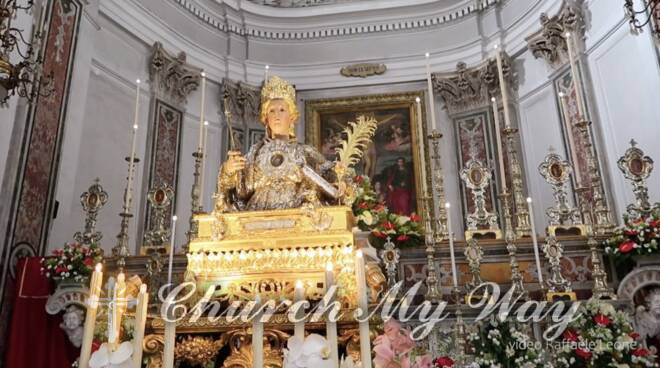
Minori today celebrates its patron saint, St. Trofimena
Today Wednesday 13 July Minori, a tourist village in the center of the Amalfi coast, celebrates its patron saint, Trofimena Ve M, a damsel from Patti / Messina.
This date recalls the day of arrival – the return to Minori of the saints remains, coming from Benevento, after a stop in a church in the historic center of Salerno, returned because stolen by the Benevento prince, Ricardo.
Welcomed with great jubilation of the people who wanted to keep them, then, in an arch-safe place to preserve them from other unscrupulous acts of the usual malicious “nobles”.
Centuries ago, the minor newborn girls bore the name Trofimena in honor of the saint of whom the Minorese, and not only, were faithful, respectful, and fearful.
Then the habit vanished for more “, EXOTIC” names until he returned for a few years: in fact, there are many newborn girls to whom the observant parents impose the name of the Virgin TROFIMENA. Wherever you go and meet a woman named Trofimena, she must necessarily have either a birth relationship or the affection of some relative in Minori. Of course still this year solemn celebrations but with parsimony and attention to the resurgent health problem which, even if not obsessively, still upsets the habits of many citizens.
Many, myself included, would like to allocate the funds raised for the celebrations to humanitarian works and to strengthen the lacking and worrying local health.
Deepening the Devotion: The Enduring Legacy of Saint Trofimena
While the historical narrative of Saint Trofimena’s journey—from Patti to Minori, via theft and triumphant return—forms the core of her story, the living traditions that have grown around her over centuries offer a richer, more textured understanding of her importance. The celebration on July 13th is not merely a historical reenactment but a vibrant, multi-sensory experience that engages the entire community and its visitors in a profound expression of faith and identity. Beyond the procession and solemn Mass, the day is imbued with symbols, flavors, and social rituals that transform the coastal town into a stage for shared memory.
The Sensory Tapestry of the Festa
To experience the *festa* of Santa Trofimena is to engage all senses. Visually, the town is adorned not just with standard lights, but with specific, traditional iconography. Images of the saint often depict her as a young woman holding a palm frond (symbolizing martyrdom) and sometimes a model of the town of Minori itself, a powerful visual claim of her patronage. The olfactory landscape shifts from the salty sea air to the sweet, dense aroma of zeppole and struffoli frying in local pastry shops, treats specifically prepared for the occasion. The auditory backdrop is a complex layering of the town band playing festive marches, the solemn hymns from the Basilica, and the constant, joyful din of reuniting families. This sensory overload is not chaos but a carefully curated, inherited environment that signals “festa” to every attendee on a visceral level.
Practical Tips for the Modern Pilgrim or Visitor
For those planning to witness the celebrations, a little local knowledge goes a long way. Firstly, manage your mobility expectations. The town center closes to most vehicular traffic hours before the main procession. Arrive early or be prepared to park in designated peripheral areas and walk. Secondly, respect the sacred core within the spectacle. While the atmosphere is joyful, the procession itself is a deeply religious act for participants. When the silver statue of the Saint passes, a respectful hush or soft applause is customary; loud commentary or obstructing the path of the bearers is considered a major faux pas. Finally, engage beyond the main day. The true flavor of the celebration can often be found in the smaller, neighborhood *quartiere* dinners or musical events that occur in the week leading up to the 13th. These offer a more intimate glimpse into the community bonds the festa reinforces.
Common Misconceptions and Clarifications
Several common mistakes arise when interpreting such a deep-rooted tradition. One is to view the celebration as a static, unchanging relic. In reality, the festa evolves. The musical selections, the auxiliary events, and even the route can see subtle shifts over decades, adapting to the community’s contemporary needs while holding the core sacred. Another error is to conflate it purely with tourism. While visitors are warmly welcomed, the primary audience is and has always been the Minoresi themselves, including the vast global diaspora that often returns home for this occasion. It is a powerful engine of cultural continuity for those far from home. Lastly, it’s a mistake to think devotion is shown only through grand gestures. For many locals, the truest act is the quiet visit to the Basilica’s crypt on an ordinary Tuesday, or the whispered prayer to “Mena” in a moment of personal trouble.
The Crypt and the Relics: A Point of Expert Insight
From a theological and historical perspective, the focus on Trofimena’s physical remains is quintessentially Mediterranean Catholic. The crypt beneath the Basilica, where her relics are enshrined, is not a morbid place but the spiritual heart of the celebration. As expert in Southern Italian religious traditions, Dr. Elena Rossi, notes: “The relics anchor the saint’s presence geographically and communally. The annual procession is, in essence, the saint taking possession of her town anew, blessing every street and alley. The return of the name ‘Trofimena’ for newborns is directly tied to this tangible proximity; parents are literally naming their children under the physical and spiritual protection of the saint’s remains housed in their hometown.” This intimate connection between place, body, and identity is a key to understanding the festa’s enduring power, far beyond a generic street fair.
A Celebration Looking to the Future
Today, the committee organizing the festivities navigates a complex path between tradition and modernity. The thoughtful debate about resource allocation, as mentioned in the existing article, is part of this evolution. How does a community honor its past while responsibly addressing present needs like healthcare? This tension is alive in Minori. Increasingly, elements like eco-friendly lighting, digital streaming of events for the diaspora, and incorporating charitable fundraising into the festa’s framework are being explored. The return of the name Trofimena is perhaps the most profound symbol of this forward-looking tradition. It represents a conscious choice by a new generation to root their children’s identity in a local heritage, suggesting that the story of the young martyr from Patti, against all odds, continues to be written in the lives of Minori’s future citizens.
📅 Last updated: 23.12.2025
❓ Frequently Asked Questions
💬 Who is the patron saint of Minori, Italy?
The patron saint of Minori is Saint Trofimena. She was a young woman from Patti, Messina, whose remains are venerated in the town after being returned from Benevento in the 8th century.
💬 Why is Saint Trofimena celebrated on July 13th?
July 13th commemorates the day the saint’s remains were returned to Minori after being stolen. The date marks her “return” and is celebrated with solemn festivities, though in recent years these have been moderated due to health concerns.
💬 What is the origin of the name Trofimena?
The name Trofimena originates from the patron saint of Minori. Traditionally given to newborn girls in the town, the name fell out of fashion but has seen a recent revival among observant families in the area.
This post is also available in:
 Español (Spanish)
