📅 Last updated: 09.11.2026
The sign of the cross is one of the oldest and most widespread gestures in Christian worship—a small motion of the hand that carries nearly two millennia of theology, memory, and devotion. Traced on the forehead at baptism, over the body in prayer, and in the air over people and objects, it has shaped how believers pray, bless, and identify themselves. This article examines where the gesture came from, what Scripture and the early Church say about it, how its forms developed, and why millions of Christians still make it today.
The sign of the cross is a Christian gesture in which a believer traces the shape of the cross—typically with the right hand, touching the forehead, chest, and shoulders—as a prayer, a blessing, or a public confession of faith. It dates to the earliest centuries of Christianity, rests on the New Testament’s teaching about the cross and about marking believers with the name of the triune God, and is practiced today by Catholics, Orthodox, Anglicans, Lutherans, and many others.
- What Is the Sign of the Cross, and Where Did It Come From?
- Why Do Christians Make the Sign of the Cross? The Biblical Logic
- How Did the Sign of the Cross Develop in Church History?
- What Does the Sign of the Cross Mean in Practice?
- Is the Sign of the Cross Biblical? Answering Common Objections
- How Do Different Christian Traditions Use the Sign of the Cross Today?
- How Can Believers Make the Sign of the Cross Meaningfully?
- What Does the Sign of the Cross Teach Us About the Christian Life?
What Is the Sign of the Cross, and Where Did It Come From?
The gesture’s ancestry runs deep into Scripture. In Ezekiel 9:4, God commands that a mark be set on the foreheads of those who grieve over the sins of Jerusalem—a seal of protection and belonging. The book of Revelation repeatedly describes the servants of God sealed on their foreheads (Revelation 7:3; 9:4; 14:1). Most directly, Jesus himself commands baptism “in the name of the Father and of the Son and of the Holy Spirit” (Matthew 28:19), and the earliest Christian baptisms involved marking the new believer with the sign of the cross on the forehead. The apostle Paul made the cross the center of his preaching—”I decided to know nothing among you except Jesus Christ and him crucified” (1 Corinthians 2:2)—and his letters celebrate believers being “crucified with Christ” (Galatians 2:20) and “sealed with the promised Holy Spirit” (Ephesians 1:13).
The earliest explicit description comes from Tertullian of Carthage, writing around AD 200 in De Corona (chapter 3). He reports that Christians “wear out the forehead” with the sign of the cross at every turn—when coming in, going out, dressing, bathing, eating, and lying down—and insists the practice rests on tradition rather than written command. A generation later, in De Corona‘s companion treatise De Oratione (chapter 11), Tertullian notes that Christians trace the cross on the forehead at prayer. Around AD 215, Hippolytus of Rome’s Apostolic Tradition describes the bishop signing the newly baptized on the forehead. By the fourth century, Cyril of Jerusalem (Catechetical Lectures 13.36) instructed catechumens to “make the sign of the cross” boldly on the forehead, and Augustine of Hippo (Tractates on John 118) and others treated the gesture as an established, universal Christian practice. The sign of the cross, in short, is older than the creeds, older than the canon of Scripture as we know it, and older than most church buildings still standing.
Why Do Christians Make the Sign of the Cross? The Biblical Logic
The gesture is not magic. It is a visible prayer, and its meaning flows from what the New Testament says about the cross and about God’s name.
The Cross as the Center of the Gospel
Paul calls the message of the cross “the power of God” (1 Corinthians 1:18) and boasts in nothing except “the cross of our Lord Jesus Christ” (Galatians 6:14). To trace a cross on one’s body is to declare, physically, that one’s identity and hope rest on Christ’s death and resurrection. It is a miniature sermon—an enacted confession that the believer belongs to the crucified and risen Lord.
Invoking the Triune Name
When Christians sign themselves “in the name of the Father, and of the Son, and of the Holy Spirit,” they are not adding a formula to the cross; they are obeying Matthew 28:19, where Jesus ties baptism to the divine name. The gesture is thus both christological (shaped like the cross) and trinitarian (spoken in three persons). It compresses the whole gospel into a motion and a sentence.
A Seal of Belonging and Protection
Ephesians 1:13–14 and 4:30 speak of believers being “sealed” with the Holy Spirit as a guarantee of redemption. The ancient Church understood the forehead-sign as the visible expression of that seal, echoing Ezekiel 9:4 and Revelation 7:3. Making the sign is a way of saying, “I am marked as Christ’s own.”
How Did the Sign of the Cross Develop in Church History?
The gesture’s form changed over time, and those changes explain why Christians today make it differently. The earliest evidence points to a small cross traced on the forehead with the thumb—a “minor” or “little” sign. This is still the form used at baptism in many traditions and in the imposition of ashes on Ash Wednesday. The larger gesture across the whole body developed later, in the early medieval West, and became standard practice by roughly the ninth to eleventh centuries.
| Period | Key Development | Primary Evidence |
|---|---|---|
| c. AD 200 | Christians sign the forehead habitually throughout daily life | Tertullian, De Corona 3 |
| c. AD 215 | Bishop signs the newly baptized on the forehead | Hippolytus, Apostolic Tradition |
| c. AD 350 | Catechumens instructed to sign the forehead boldly at prayer and temptation | Cyril of Jerusalem, Catechetical Lectures 13.36 |
| c. 9th–11th c. | Large full-body gesture (forehead, chest, shoulders) becomes common in the West | Medieval liturgical and catechetical texts |
| 1054 and after | East and West diverge in gesture: two fingers and right-to-left in the East; five fingers and left-to-right in the West | Post-schism liturgical manuals |
| 16th c. Reformation | Lutherans and Anglicans retain the gesture; many Reformed and Anabaptist bodies set it aside | Reformation-era service books and catechisms |
East and West: Two Ways of Tracing the Cross
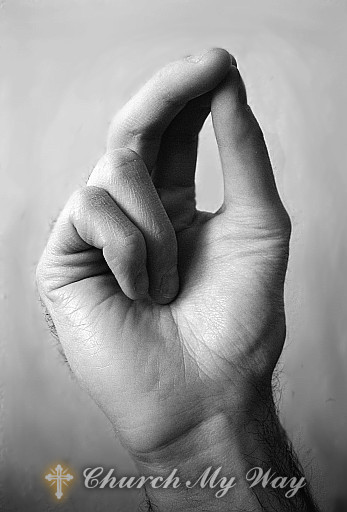
Eastern Orthodox and many Eastern Catholic Christians join the thumb, index, and middle fingers (symbolizing the Trinity) and press the ring and little fingers to the palm (symbolizing Christ’s two natures, divine and human), then touch forehead, chest, right shoulder, then left, and bow. Western Catholics and many Anglicans and Lutherans use an open hand or five fingers and move from left shoulder to right, touching forehead, chest, left, then right. Neither form is more “biblical” than the other; both confess the same Trinity and the same cross.
What Does the Sign of the Cross Mean in Practice?
For those who make it, the gesture carries several layers of meaning at once. It is a prayer of the body, joining the physical to the spiritual in the way Scripture commends—”present your bodies as a living sacrifice” (Romans 12:1). It is a confession of faith, a kind of creed in motion. It is a plea for protection, which is why Cyril of Jerusalem urged believers to sign themselves at night, in danger, and in temptation. And it is a mark of unity, linking the believer to the saints who have made the same sign for eighteen centuries.
Different traditions emphasize different aspects. Catholics often make the sign when entering a church, before and after prayer, at the reading of the Gospel, and when receiving a blessing. Orthodox Christians sign themselves frequently throughout the liturgy and at home, often with a bow. Anglicans and Lutherans commonly make it at baptism, at the absolution, at the Gospel, and at the benediction. Many Protestants in the Reformed and Baptist traditions do not use the gesture, though some are rediscovering it as a historic Christian practice.
- As prayer: Many believers begin and end personal prayer by signing themselves, framing the time with the name of God.
- As blessing: Parents sign a cross on a child’s forehead at bedtime; pastors trace it over the congregation at the benediction.
- As confession: Making the sign in public marks one’s identity as a Christian, especially in contexts where that costs something.
Is the Sign of the Cross Biblical? Answering Common Objections
Some Christians object that the gesture is not commanded in Scripture and therefore should be avoided. The objection deserves a careful answer. Scripture does not command the sign of the cross, but neither does it forbid it, and it commends the principles the gesture embodies: marking believers with God’s name (Matthew 28:19), confessing Christ crucified (1 Corinthians 1:18), and sealing the faithful (Ephesians 1:13). The early Church practiced the sign long before the New Testament canon was settled, which means it belongs to the same era as the church’s earliest worship. The Reformers who retained it—Luther, and the Anglican divines—did so precisely because it is a biblical confession in visible form, not a substitute for faith.
Another objection is that the gesture risks superstition. That concern is real and ancient; Cyril of Jerusalem himself warned that the sign is not a charm but an act of faith. The gesture’s power lies not in the motion but in the God it invokes. Made carelessly, it can become empty ritual; made in faith, it is a genuine prayer.
How Do Different Christian Traditions Use the Sign of the Cross Today?
The sign of the cross is not the property of one denomination. Its use varies widely, and the variation is instructive.
- Catholic: The large gesture with the right hand, left to right, is standard; the small forehead sign is used at baptism and in the imposition of ashes.
- Eastern Orthodox: The gesture is made frequently, often with a bow, using the three-finger form and right-to-left movement; it is woven into nearly every liturgical action.
- Anglican: Commonly made at baptism, the absolution, the Gospel, and the blessing; usage varies by parish and personal devotion.
- Lutheran: Retained from the Reformation; Luther’s Small Catechism teaches the sign at morning and evening prayer.
- Reformed, Baptist, and many evangelical: Generally not practiced, though some individuals and congregations are reclaiming it as a historic Christian gesture.
The differences are largely matters of custom and catechesis rather than doctrine. What unites these traditions is the conviction that the cross of Christ is the center of the faith and that the body has a role in prayer.
How Can Believers Make the Sign of the Cross Meaningfully?
For those who use the gesture, a few practical habits keep it from becoming rote.
- Slow down: Name the three persons of the Trinity as you trace the cross, letting each name be a prayer.
- Connect it to Scripture: Recall Matthew 28:19 or Galatians 6:14 as you make the sign.
- Use it at key moments: Begin and end prayer, receive a blessing, and mark a child’s forehead at night.
- Make it in faith, not fear: The sign is a confession of trust in Christ, not a talisman against misfortune.
For believers from traditions that do not practice the gesture, the sign of the cross can be a window into the church’s historic devotion, even if they choose not to adopt it. Understanding it enriches appreciation for the breadth of Christian worship.
What Does the Sign of the Cross Teach Us About the Christian Life?
The gesture is small, but it carries a large claim: that the cross is not merely a past event but a present reality, and that the believer’s life is lived under its sign. When a Christian traces the cross, they are saying with Paul that they have been crucified with Christ (Galatians 2:20), that they are sealed with the Spirit (Ephesians 1:13), and that they belong to the triune God. The sign of the cross turns an ordinary moment into a moment of worship, a body into a prayer, and a gesture into a confession. It has been made by martyrs in arenas, by monks in deserts, by parents over sleeping children, and by ordinary believers at kitchen tables for nearly two thousand years. To make it is to join that great cloud of witnesses—and to declare, with hand and heart, that the cross of Christ is the anchor of the soul.
