📅 Last updated: 08.11.2026
The Catacombs of Rome are the largest surviving archive of early Christian painting, carving, and inscription—roughly sixty underground burial complexes honeycombing the soft volcanic tufa beneath the city, holding the remains of hundreds of thousands of believers and, on their walls, the oldest substantial body of Christian art in existence. What those images and epitaphs reveal is not a religion of vague sentiment but a confident faith in bodily resurrection, the saving work of Christ, and the communion of the saints.
The Catacombs of Rome are ancient underground burial networks beneath and around the city, carved from the second through fifth centuries, chiefly by Christian communities. Their wall paintings, carved sarcophagi, and inscriptions preserve the earliest large body of Christian art, showing believers at prayer, biblical scenes of deliverance, and above all the hope of resurrection through Jesus Christ.
- What Are the Catacombs of Rome, and Why Were They Built Underground?
- Why Did Early Christians Paint the Darkness? The Theology Behind the Images
- What Do the Catacombs of Rome Reveal About the First Christians' Faith?
- The Earliest Christian Images: What the Paintings Actually Show
- A Timeline of the Catacombs of Rome
- Sarcophagi, Symbols, and the Language of Early Christian Art
- What the Catacombs of Rome Can Teach Believers Today
- Frequently Asked Questions About the Catacombs of Rome
- A Lasting Perspective: The Gospel Written in Plaster and Stone
What Are the Catacombs of Rome, and Why Were They Built Underground?
Rome forbade burial inside the city walls; the living kept the dead at a distance along the great roads—the Appian, the Ardeatine, the Salarian, the Nomentan. Above ground, land was expensive and scarce. Below ground, the same tufa that gave Rome its building stone could be cut into galleries with astonishing economy. A Christian community, or a wealthy patron, would acquire a plot and excavate downward: broad first-level galleries, then staircases to lower levels, with loculi—rectangular shelf-tombs—cut horizontally into the walls and sealed with tiles or marble slabs.
The scale is hard to overstate. The complex beneath the Via Appia known as San Callisto contains some twenty kilometers of galleries on multiple levels; the whole catacomb system of Rome has been estimated at between 150 and 170 kilometers of passages. The oldest Christian regions date to the late second and early third centuries, with the great period of expansion in the fourth century after Constantine’s peace with the church (313).
Popular imagination often frames the catacombs as hiding places from persecution. The evidence points elsewhere: they were cemeteries, public and well-known, whose entrances and staircases were visible landmarks. Christians gathered there for funerary meals and anniversary commemorations of the martyrs, but the idea of whole congregations living secretly underground belongs to later legend, not to the archaeology. Persecution was real and intermittent—the letters of Pliny the Younger to Trajan around 112, the martyrdoms at Rome under Nero in 64, and the great persecutions of Decius (250) and Diocletian (303) are historical facts—but the catacombs were built as cities of the dead, not fortresses of the living.
Why Did Early Christians Paint the Darkness? The Theology Behind the Images
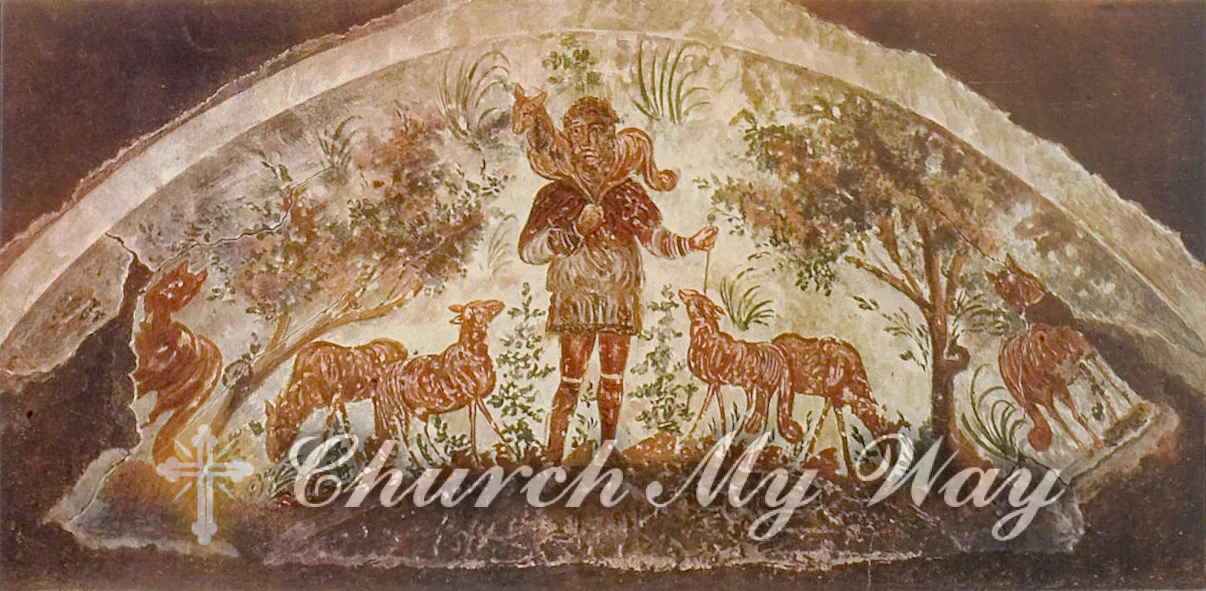
Walk into the Catacomb of Priscilla on the Via Salaria and the first thing that strikes you is how hopeful the imagery is. There is no depiction of the crucifixion before the fifth century; there is almost no hellfire. Instead: a shepherd carrying a lamb, a woman with arms lifted in prayer, a banquet table, Jonah spat out by the fish, three young men standing unharmed in flames.
This is deliberate. Early Christian art was not decorative realism but what art historians call signa—signs—compressed theological statements. The Roman world understood images as conveyors of meaning; a painted dove or anchor on a tomb said something specific to the grieving family and to the deceased’s hope. The art answers a question every mourner asks: Is death the end? The answer on the plaster is a consistent no.
Four themes dominate:
- Resurrection and deliverance. Jonah (Matthew 12:40—”as Jonah was three days and three nights in the belly of the great fish, so will the Son of Man be three days and three nights in the heart of the earth”) is the single most common Old Testament scene, painted dozens of times. The three youths in Daniel 3, Daniel in the lions’ den, Noah’s ark, Susanna vindicated—all are rescue stories, chosen because they prefigure God’s power over death.
- Christ as Good Shepherd. Drawn directly from John 10:11—”I am the good shepherd. The good shepherd lays down his life for the sheep”—the youthful shepherd with a lamb across his shoulders appears in the earliest painted cycles, including the ceiling of the Lucina cubiculum in San Callisto (early third century).
- Prayer and intercession. The orans figure—a person standing with arms outstretched—represents the soul at prayer, and appears for both men and women, including the famous veiled woman in the Cubiculum of the Velatio in Priscilla.
- The heavenly banquet. Scenes of reclining diners echo Jesus’ words in Matthew 8:11 about many coming “from east and west” to recline at table with Abraham, Isaac, and Jacob in the kingdom of heaven—and anticipate the marriage supper of the Lamb in Revelation 19:9.
Read the paintings as a first-century catechism and they cohere: God rescues; Christ shepherds; the dead pray; the faithful feast. That is the gospel in pigments.
What Do the Catacombs of Rome Reveal About the First Christians’ Faith?
The most direct evidence is textual. Tens of thousands of inscriptions survive, many in Greek (the language of the Roman church until the third century), then increasingly in Latin. Their formulas are astonishingly consistent: in pace (“in peace”), vivas in Deo (“may you live in God”), depositus (“laid down,” as one lays down a deposit for safekeeping—echoing 2 Timothy 1:12, “I know whom I have believed, and I am convinced that he is able to guard until that day what has been entrusted to me”).
Notice what the inscriptions do not say. They do not say “farewell forever.” They address the dead as living: “Agape, you will live in God.” The word refrigerium—refreshment—appears repeatedly, asking God to grant the departed “refreshment” in peace, a term drawn from the parable of Lazarus and the rich man in Luke 16:24 and from the vision of Revelation 7:17, where the Lamb leads his people to springs of living water.
This is where the catacombs become a spiritual mirror for the modern reader. The early Christians did not sanitize death; they buried their dead in corridors they had to walk through, touched the sealed tombs of their parents, and painted resurrection on the walls above them. Their hope was not denial but defiance grounded in a historical claim: that a tomb outside Jerusalem had been found empty.
The Earliest Christian Images: What the Paintings Actually Show
Dating early Christian art is contested, but the broad sequence is well established. The earliest surviving Christian paintings belong to the late second and early third centuries—the capitello degli acrobati and the cubicolo dei sacramenti in San Callisto, the Lucina region, and the earliest chambers of Priscilla. These are not primitive doodles; they show trained hands working in established Roman fresco techniques, adapting pagan visual vocabulary to Christian meaning.
Several images reward close attention:
The Fractio Panis (Catacomb of Priscilla)
In the Greek Chapel of Priscilla, a late-second-century fresco shows seven figures at a semicircular table; the one at the head breaks a loaf. The scene is usually read as a eucharistic meal, though it may depict a funerary refrigerium. Either way, it is among the oldest depictions of Christians at table together, and it connects the Lord’s Supper of 1 Corinthians 11:23–26 with the hope of the banquet to come.
The Good Shepherd and the Baptism of Christ
The earliest known depiction of Jesus’ baptism—John the Baptist pouring water on a youthful, beardless Christ—appears in the Catacomb of San Callisto (the “sacraments chapel,” third century). The image pairs naturally with the shepherd: the one who enters the water is the one who lays down his life.
Peter and Paul
By the fourth century, the two apostles are painted flanking Christ or standing together, reflecting Rome’s self-understanding as the city of their martyrdom. The fourth-century Chiliogramma in the Catacomb of Commodilla—one of the earliest images of a bearded Christ—shows a more imperial, authoritative figure, tracking the church’s changed circumstances after Constantine.
Marian Imagery
The earliest known image of Mary, the mother of Jesus, is generally identified in the Catacomb of Priscilla: a seated woman nursing an infant, with a figure (often read as the prophet Balaam or Isaiah) pointing toward her. It is a small, quiet image—but it is the first link in a long chain of Christian iconography.
A Timeline of the Catacombs of Rome
| Period | Key Developments | Representative Evidence |
|---|---|---|
| c. 150–200 | Earliest Christian burials and painted chambers; communities acquire land along the consular roads | Lucina region (San Callisto); earliest chambers in Priscilla |
| c. 200–250 | Expansion under church administration; bishops oversee burial grounds | Crypt of the Popes in San Callisto; Fractio Panis fresco |
| 250–313 | Persecutions under Decius and Diocletian; martyr burials intensify devotion at the tombs | Graffiti invocations at martyr shrines; refrigerium inscriptions |
| 313–400 | Constantine’s peace; imperial patronage; large-scale excavation and richer decoration | Fourth-century frescoes in Commodilla and Via Latina catacomb |
| 400–800 | Burial in catacombs declines; relics of martyrs translated into city basilicas | Pope Damasus’s fourth-century epigrams marking martyrs’ tombs |
| 800–present | Abandonment, rediscovery, and scientific archaeology from the nineteenth century | De Rossi’s excavations (from 1849); Pontifical Commission of Sacred Archaeology |
Sarcophagi, Symbols, and the Language of Early Christian Art
Not all the art is on walls. Carved marble sarcophagi—many now in the Vatican Museums and the Lateran—carry dense sculptural programs. The Dogmatic Sarcophagus (c. 320–350, Vatican) is a masterpiece: scenes of creation, the fall, and Christ’s miracles arranged to argue for the reality of the incarnation and the resurrection of the body against the spiritualizing currents of the day.
Symbols repeat across media:
- The anchor—Hebrews 6:19: “We have this as a sure and steadfast anchor of the soul.”
- The fish—the Greek ichthys acrostic (“Jesus Christ, Son of God, Savior”), and the fish of the resurrection breakfast in John 21.
- The dove—the Spirit at Jesus’ baptism (Matthew 3:16) and the peace of the soul.
- The peacock—a Roman symbol of immortality adopted for Christian hope.
- The Chi-Rho—the monogram of Christ, increasingly common after Constantine.
Damasus, bishop of Rome from 366 to 384, commissioned the calligrapher Furius Dionysius Filocalus to carve elegant verse inscriptions at martyrs’ tombs; these epigrams are among our earliest witnesses to the veneration of the martyrs at their burial places. Whatever later controversies would swirl around relics, the fourth-century practice is plain: Christians gathered at the tombs of those who had died for Christ, sang, prayed, and asked their prayers.
What the Catacombs of Rome Can Teach Believers Today
The catacombs correct two opposite mistakes about the early church. One is the romantic picture of a pure, persecuted community hiding in tunnels; the other is the dismissive picture of an institution already compromised by power. The reality is more human and more instructive.
These were ordinary congregations—slaves and senators’ freedmen, artisans, widows, children—who buried their dead with care and painted their hope on the walls. They faced real persecution, but they also argued about discipline, honored martyrs, and struggled over property. Their art is not sentimental; it is doctrinal. It assumes that what happened to Jesus of Nazareth in history determines what will happen to the believer in death.
Three lessons stand out:
- Hope is visual. The early Christians put resurrection on their walls because they needed to see it. The modern believer might ask what images and reminders shape his or her own expectation of the future.
- Death is a doorway, not a wall. The inscriptions speak of the dead as “in peace” and “living in God”—language that assumes conscious fellowship with Christ, exactly as Paul wrote in Philippians 1:23 (“to depart and be with Christ… is far better”).
- Memory is a spiritual discipline. The annual commemoration of the martyrs, the family meals at the tomb, the carved names—these were acts of covenant loyalty to those who had gone before, anticipating the “great cloud of witnesses” of Hebrews 12:1.
Frequently Asked Questions About the Catacombs of Rome
Were Christians buried in the catacombs because of persecution?
Primarily because Roman law forbade burial within the city and underground tufa was the most economical option. Persecution shaped the catacombs’ history—martyrs were buried there and venerated there—but the tunnels were not built as hiding places.
Are the catacombs still open to visitors?
Yes. Roughly five catacombs are regularly open to the public, including San Callisto, San Sebastiano, Priscilla, Domitilla, and Sant’Agnese. The Pontifical Commission of Sacred Archaeology oversees conservation.
What is the oldest Christian image in Rome?
Dating is debated, but the late-second-century frescoes in the Lucina region of San Callisto and the earliest chambers of Priscilla are among the oldest. The Good Shepherd and Jonah cycles are the earliest recurring subjects.
A Lasting Perspective: The Gospel Written in Plaster and Stone
Stand at the entrance of the Catacomb of San Callisto on a quiet morning and the modern city is a few hundred meters away, but the silence below is total. In the dark corridors, the early Christians left a message that has outlasted the empire that persecuted them. It is not a message about themselves. It is about a tomb that was found empty and a Lord who said, “Because I live, you also will live” (John 14:19).
The Catacombs of Rome are not a monument to the dead; they are a proclamation by the living. Every shepherd painted above a sealed grave, every anchor carved beside a name, every prayer for “refreshment in peace” is a small act of defiance against the finality of death—and a small act of trust in the promise of Jesus Christ, who is “the resurrection and the life” (John 11:25). The Christians who carved those tunnels could not see the resurrection with their eyes, so they painted it on the walls and waited in hope. That is still the church’s task: to live, and to die, in the confidence that the One who raised Jesus from the dead will also raise us.
