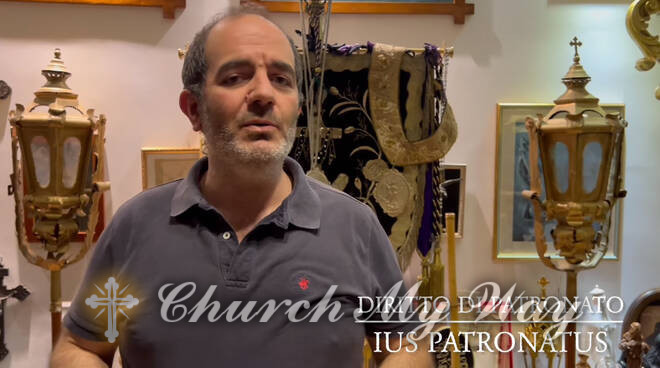
Piano di Sorrento, the Archconfraternity of Death and Prayer takes the field to claim the “Ius Patronatus”
Piano di Sorrento. After the news of the transfer of Don Pasquale Irolla, we go back to talking about the I.us Patronatus, or the right of the faithful of some parishes to elect their own parish priest. A right that has been denied for too long and that is now right and right to claim.
He intervenes on this point by Michele Gargiulo, Prior of the Archconfraternity of Death and Prayer who is organizing a meeting on the subject that will take place in the last week of June in the Basilica of San Michele Arcangelo: “The right of patronage, what we simply often dismiss as the right of the Carottese people to elect their own parish priest, has instead a great story behind it of devotion and faith and in particular of a people who have been close to their community for centuries, to their own church.
Why talk about the right of patronage? On the eve of my second term, the Government of the Archconfraternity set an appointment to claim this right, among many other things, which was also a right that had a strong presence in the history of our Archconfraternity, to which our Archconfraternity had contributed in an important way.
Is this right current? Is it right to reiterate this? Is it right to ask for respect for this tradition which has its foundation in the initial stages of our parish community?
On 4 February 2018 from the altar, between the programmatic lines, we talked about this, the fact of wanting to claim the right of patronage.
I, therefore, look forward to seeing you for the last week (we will define the date) in the Basilica of San Michele Arcangelo to talk about this right, to seek help from everyone, to make it clear why today in 2022 the right of patroness is still culturally and historically important. and especially as a participation in the faith of our Carottese people ».
Understanding the Ius Patronatus: History and Modern Implications
The claim to the Ius Patronatus in Piano di Sorrento is not an isolated local sentiment, but rather a resurgence of a deeply rooted canonical and social principle. Historically, the right of patronage, or ius patronatus, emerged in medieval Europe as a legal nexus between a benefactor (the patron) and a church. A family, guild, or entire community that funded the construction or endowment of a church and its maintenance often received, by papal or episcopal concession, the privilege to present a candidate for the pastoral care of that church. This was not a mere formality; it was a solemn recognition of the symbiotic relationship between the faithful and their spiritual home. In the context of Piano, this underscores that the Basilica of San Michele Arcangelo is not just an administrative unit of the diocese, but a living institution born from the tangible sacrifices and devotion of the “Carottese” people themselves over centuries.
Common Misconceptions and Mistakes in the Discourse
When communities revive such historical rights, several common mistakes can cloud the discussion. Firstly, there is a tendency to view the Ius Patronatus as a purely democratic, modern electoral process. While it involves community participation, it is fundamentally a right of presentation, not a popular vote in the secular sense. The patron (in this case, arguably the historic community represented by entities like the Archconfraternity) presents a suitable, canonically qualified candidate to the bishop, who then provides the canonical institution. Confusing this with autonomy from diocesan authority is a critical error. Secondly, there is the mistake of historical selectivity. Claiming a right requires understanding its accompanying duties—the ongoing material and spiritual support that originally justified the privilege. The Archconfraternity’s long history of care for the Basilica positions it strongly here. Finally, a common pitfall is framing the claim as an oppositional stance against the diocese. As Prior Gargiulo’s call for dialogue suggests, the more effective path is to demonstrate how exercising this right strengthens the local church and, by extension, the wider diocesan community through vibrant, invested leadership.
Expert Perspectives on Canonical Revival
Canon law scholars note that while the Code of Canon Law of 1983 still recognizes the right of patronage (Canons 1308-1316), it significantly restricts its creation and cautiously regulates its use. The prevailing modern ecclesiological emphasis is on the bishop’s role as the chief pastor of a diocese. Therefore, experts advise that communities seeking to assert dormant rights must build a case on three pillars: unbroken historical precedent, continuous fulfillment of associated obligations, and demonstrable benefit for the pastoral good. The meeting organized by the Archconfraternity serves as a crucial first step in marshaling this evidence publicly. Furthermore, consulting with a canon lawyer specializing in historical rights is often recommended to navigate the intricate legal processes of the diocesan curia and the Vatican’s Congregation for the Clergy. The goal is not to “win a dispute” but to formally petition for recognition through proper channels, a nuanced but vital distinction.
Practical Steps for Community Engagement
For the faithful of Piano di Sorrento who wish to support this initiative, moving beyond sentiment into structured action is key. The upcoming meeting is the primary forum, but the work extends far beyond it. Here are practical ways to contribute:
- Documentary Research: Volunteers can assist in scouring the parish, Archconfraternity, and local historical archives for any documents, ledgers, or letters that explicitly mention the endowment of the Basilica and the conditions attached. Nineteenth-century notarial acts could be particularly revealing.
- Oral History Project: Systematically recording the memories of the community’s elders can provide invaluable social evidence of how this tradition was understood and lived, even during periods when it was not formally exercised.
- Clear Communication: Supporters should strive to articulate the cause using precise, respectful language that aligns with church doctrine, emphasizing spiritual patrimony rather than historical grievance.
- Spiritual Foundation: Ultimately, this is a spiritual endeavor. Coupling the historical campaign with organized prayer for the guidance of the Holy Spirit and for the diocesan bishop reflects the true, faith-based nature of the claim.
The path to reclaiming a historical right like the Ius Patronatus is a marathon, not a sprint. It requires the patience of historians, the precision of lawyers, and, above all, the persevering faith of a community that sees its identity inextricably linked to its sacred space. The Archconfraternity of Death and Prayer, with its centuries-long witness, is uniquely positioned to steward this delicate process, ensuring that the voice of the Carottese people is heard not as a echo from the past, but as a living testament to their enduring role in the story of their church.
📅 Last updated: 22.12.2025
❓ Frequently Asked Questions
💬 What is the “Ius Patronatus” in the Catholic Church?
The “Ius Patronatus,” or right of patronage, is a historical right allowing the faithful of certain parishes to elect their own parish priest. It is a tradition rooted in local devotion and the community’s long-standing support of their church.
💬 Why is the Archconfraternity of Death and Prayer in Piano di Sorrento claiming the right of patronage?
The Archconfraternity is claiming the right because they believe it has been unjustly denied and is a significant part of their history and tradition. They argue the community has earned this right through centuries of support and that it is time to respect this foundational parish tradition.
💬 What is happening with the parish priest in Piano di Sorrento?
Following the transfer of Don Pasquale Irolla, there is renewed discussion about who appoints the parish priest. The Archconfraternity is organizing a meeting in late June 2024 to publicly claim the community’s right to elect their own priest under the “Ius Patronatus.”
