📅 Last updated: 30.10.2026
Early Christian art was never merely decoration; it was theology compressed into symbol, a visual catechism for a church that often could not afford to speak plainly. Long before Constantine legalized Christianity in 313 AD, believers scratched fish into plaster, painted Good Shepherds in burial chambers, and carved Jonah being swallowed by a sea monster onto sarcophagi—images that meant little to a Roman official but everything to an initiate. These images functioned as a kind of coded gospel, hiding the hope of resurrection, the promise of salvation, and the identity of Christ in plain sight.
Early Christian art used symbolic imagery—the fish (ichthys), the Good Shepherd, the anchor, the dove, Jonah, and the orans figure—to communicate core gospel truths to believers while remaining opaque or harmless to hostile outsiders. Because Christians faced sporadic persecution, ridicule, and social ostracism, these symbols served as a shared visual language that encoded the death, burial, and resurrection of Jesus in forms that could pass unnoticed in Roman culture.
- Why Did Early Christian Art Need to Hide the Gospel at All?
- What Were the Most Common Symbols in Early Christian Art?
- How Did Catacomb Frescoes and Sarcophagi Teach the Resurrection?
- Early Christian Art in the Age of Persecution: A Timeline of Survival
- Were Christians Really Hiding, or Just Speaking in a Shared Language?
- Why Did the Cross Stay Hidden in Early Christian Art?
- What Can Early Christian Art Teach Believers Today?
- The Gospel in Plain Sight: A Lasting Perspective
Why Did Early Christian Art Need to Hide the Gospel at All?
The popular image of Christians huddled in catacombs, painting by candlelight while Roman soldiers patrolled above, is partly romanticized. Persecution was sporadic rather than constant—long stretches of relative peace punctuated by violent local outbreaks, most notoriously under Nero in 64 AD, Decius in 250, and Diocletian in 303. Yet the threat was real enough that prudence shaped how believers expressed their faith in public.
Consider the social world of the second and third centuries. Christianity was widely misunderstood. The pagan writer Minucius Felix records the rumor that Christians worshipped a donkey’s head; others accused them of incestuous “love feasts” and cannibalism because of the language of eating Christ’s body and drinking His blood. To display an unmistakable crucifix or a bold doctrinal inscription on a family tomb could invite vandalism, mockery, or worse. The earliest surviving depiction of the crucifixion—the Alexamenos graffito in Rome, roughly 200 AD—is not Christian art at all but a pagan insult: a man worshipping a figure with a donkey’s head on a cross, scrawled with the taunt “Alexamenos worships his god.”
Against that backdrop, symbolic art was both a shield and a sermon. A fish drawn in a house church courtyard read as a harmless doodle to a neighbor but as “Jesus Christ, Son of God, Savior” to a brother or sister in the faith. The gospel was present, but only those with eyes to see—ears attuned by catechesis—could hear it.
What Were the Most Common Symbols in Early Christian Art?
From roughly the late second century through the Constantinian turn, a remarkably stable visual vocabulary emerged. These symbols were not random; each carried scriptural freight and drew on a shared catechetical memory.
The Fish (Ichthys)
The Greek word ichthys (ἰχθύς) served as an acrostic: Iesous Christos Theou Yios Soter—Jesus Christ, Son of God, Savior. The fish appears everywhere in early Christian art: scratched into the walls of Roman catacombs such as those of Callixtus and Priscilla, carved on tombs, and paired with loaves in eucharistic scenes echoing the feeding of the five thousand (Matthew 14:13–21). Tertullian, writing around 200 AD in On Baptism, connected believers to the fish: “we, little fishes, after the image of our Ichthys, are born in water” (chapter 1). The symbol also evoked Jesus’ call to the disciples to become “fishers of men” (Matthew 4:19).
The Good Shepherd
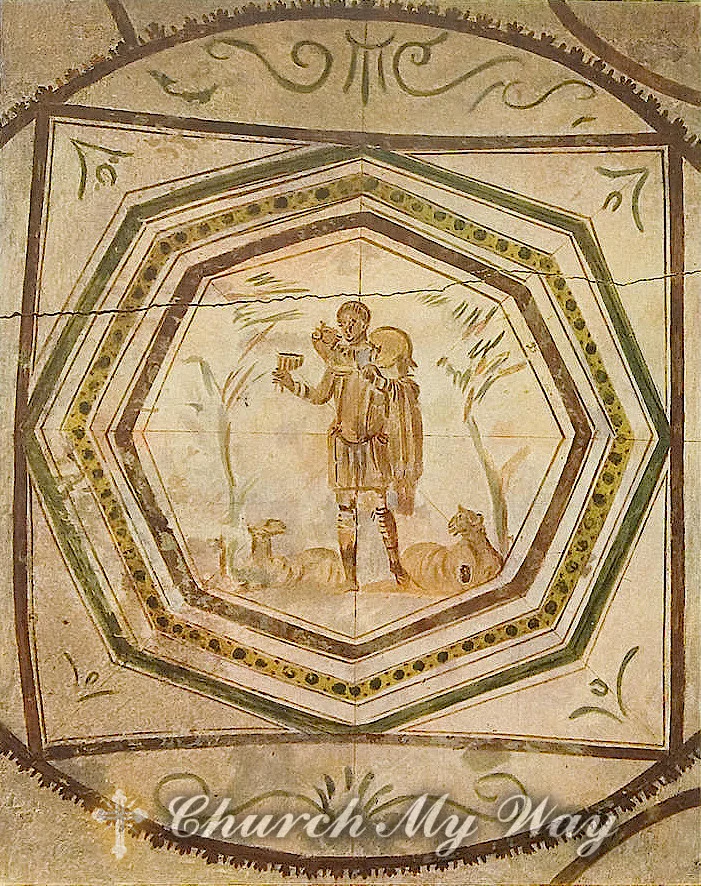
Perhaps the most beloved image in early Christian art is the beardless young shepherd carrying a lamb on his shoulders. It appears in the Catacomb of Priscilla and on countless sarcophagi. The image drew directly on Jesus’ parable in John 10:11–18—”I am the good shepherd. The good shepherd lays down his life for the sheep”—and on Psalm 23. Crucially, the shepherd image also resembled pagan depictions of Hermes the ram-bearer and Orpheus charming animals, letting it blend into the surrounding culture while pointing the trained eye to Christ.
The Anchor, the Dove, and the Orans
The anchor, drawn from Hebrews 6:19 (“a sure and steadfast anchor of the soul”), expressed hope in the face of death. The dove, recalling the Spirit descending on Jesus at His baptism (Matthew 3:16) and the peace of Noah’s ark (Genesis 8:11), signified the Holy Spirit and the soul at peace. The orans figure—a person standing with arms outstretched in prayer—appeared constantly in catacomb frescoes and on the lids of tombs, often representing the deceased or the church at prayer, echoing 1 Timothy 2:8.
- Ichthys (fish): acrostic for Jesus Christ, Son of God, Savior; tied to baptism and the feeding miracles.
- Good Shepherd: John 10 and Psalm 23; resurrection hope and divine care.
- Anchor: Hebrews 6:19; steadfast hope beyond the grave.
- Dove: the Holy Spirit (Matthew 3:16) and peace (Genesis 8:11).
- Orans: the praying church and the faithful departed.
How Did Catacomb Frescoes and Sarcophagi Teach the Resurrection?
The Roman catacombs—vast underground burial networks, some stretching for miles—preserve the richest surviving corpus of early Christian art. The Catacomb of Callixtus alone contains dozens of painted chambers from the third century. What strikes a modern viewer is how rarely these images show the crucifixion. Instead, they cluster around deliverance and resurrection.
Jonah is everywhere. He is depicted being thrown from a ship, swallowed by a great fish, and vomited onto dry land—a three-part narrative drawn from Jonah 1–2. Jesus Himself made the connection explicit: “For as Jonah was three days and three nights in the belly of the great fish, so will the Son of Man be three days and three nights in the heart of the earth” (Matthew 12:40). For a grieving family carving a sarcophagus, Jonah was not a children’s story but a promise: as God delivered Jonah from the deep, so He would raise the dead.
Other deliverance scenes repeat the pattern: Daniel in the lions’ den (Daniel 6), the three young men in the fiery furnace (Daniel 3), Noah in the ark, Susanna vindicated, Lazarus raised (John 11). Each image declared the same theological claim—God rescues His people from death—without writing a single word that an outsider could use against them.
Early Christian Art in the Age of Persecution: A Timeline of Survival
The development of this visual language tracks closely with the church’s changing circumstances. The table below traces key milestones.
| Period | Key Development | Example / Evidence |
|---|---|---|
| c. 64–250 AD | Sporadic persecution; symbols dominate | Ichthys, anchor, and shepherd motifs; Alexamenos graffito (c. 200) |
| c. 200–250 AD | Catacomb frescoes flourish | Catacombs of Callixtus and Priscilla; Jonah and orans scenes |
| c. 250–311 AD | Intensified persecution under Decius and Diocletian | Discreet house-church art; Dura-Europos church frescoes (c. 235) |
| 313 AD | Edict of Milan legalizes Christianity | Public art begins to expand; symbols persist alongside narrative scenes |
| c. 350–400 AD | Open monumental art emerges | Santa Maria Maggiore mosaics; clearer crucifixion imagery later develops |
Were Christians Really Hiding, or Just Speaking in a Shared Language?
Honesty requires nuance here. Not all early Christian art was produced under threat. The house church at Dura-Europos in Syria, painted around 235 AD, was decorated with biblical scenes—the healing of the paralytic, the women at the tomb—in a city where Christians were not, at that moment, under active assault. The images were still symbolic, but for reasons of catechesis as much as concealment.
The church father Clement of Alexandria, writing around 200 AD in The Instructor (Paedagogus), advised Christians on which images were appropriate for signet rings: a dove, a fish, a ship, a lyre, an anchor, or a fisherman—”and if he be a fisherman, he will remind us of the apostle and of the little children drawn up out of the water.” Notice what Clement does not list: a cross. The symbol set was a deliberate, taught vocabulary, a kind of visual grammar that insiders recognized instantly.
So the answer is both. In times of danger, the symbols genuinely protected believers. In times of peace, they taught, unified, and comforted. The same image could serve both purposes, which is precisely why it endured.
Why Did the Cross Stay Hidden in Early Christian Art?
The crucifix—the central emblem of modern Christianity—is strikingly absent from early Christian art until well after Constantine. This surprises many believers. The reason is not shame about the gospel but the cultural meaning of crucifixion itself.
In the Roman world, the cross was an instrument of state terror reserved for slaves, rebels, and the lowest criminals. Cicero called crucifixion the “most cruel and disgusting penalty.” To depict a man dying on a cross was, to pagan eyes, absurd and contemptible—exactly the mockery captured in the Alexamenos graffito. Early Christians therefore emphasized the results of the cross—resurrection, deliverance, victory over death—through symbols like the anchor, the fish, and Jonah, rather than its brutal mechanics.
Paul had already named this paradox: “we preach Christ crucified, a stumbling block to Jews and folly to Gentiles” (1 Corinthians 1:23). The church learned to proclaim the crucified and risen Lord in a visual dialect that could be heard by those ready to understand. When the cultural stigma faded, the cross emerged openly—but the church had already spent two centuries preaching it in code.
What Can Early Christian Art Teach Believers Today?
These symbols are not antiquarian curiosities. They offer a corrective and an encouragement for the contemporary church.
First, they remind us that the gospel has always been translatable. The earliest Christians did not merely copy Roman art; they baptized its forms, filling familiar images with new meaning. The Good Shepherd borrowed from pagan pastoral imagery and became a vehicle for John 10. The fish and anchor were ordinary objects transformed into declarations of faith. This is incarnational communication—meeting a culture in its own visual language and redirecting it toward Christ.
Second, they teach us the value of a shared vocabulary. A believer in Rome and a believer in Alexandria could look at the same anchor and know the same hope (Hebrews 6:19). In an age of endless individualized content, the early church’s disciplined symbolic language fostered unity and memory. Catechesis happened through images as much as words.
Third, they model courage without recklessness. Jesus told His disciples to be “wise as serpents and innocent as doves” (Matthew 10:16). The early Christians were neither naive about danger nor paralyzed by it. They proclaimed the resurrection boldly and prudently, trusting that the message would reach those whose hearts God had prepared.
- Communicate in the culture’s language—redeem familiar forms rather than rejecting them wholesale.
- Build a shared vocabulary—repeat the core truths until they become instinctive.
- Balance boldness and prudence—speak clearly, but with wisdom about timing and context.
The Gospel in Plain Sight: A Lasting Perspective
When you stand in the Catacomb of Priscilla and look at a shepherd carrying a lamb, you are looking at a sermon. When you see a fish scratched beside a name, you are reading a creed. When you find Jonah spat onto the shore, you are witnessing a funeral hope that refused to die. Early Christian art was not a lesser form of witness than preaching; it was preaching, pressed into plaster and stone for those with ears to hear.
The believers who made these images believed what they painted. They believed that death was not the end, that the Shepherd had laid down His life and taken it up again (John 10:18), and that the anchor held fast beyond the veil. They hid the gospel in plain sight because they trusted it was powerful enough to be found—by the seeker, the mourner, the catechumen, and, in God’s timing, even the persecutor.
That same gospel still speaks. It speaks in symbols and sacraments, in Scripture and song, in the quiet courage of ordinary believers who live as though the resurrection is true. The early church did not need a billboard to proclaim Christ. It needed a fish, a shepherd, an anchor—and a faith that made those small signs mean everything. May we, like them, learn to carry the gospel in plain sight, trusting that the One who hid His glory in human flesh will make Himself known through whatever faithful signs we offer.
