📅 Last updated: 26.10.2026
The cross in art is far more than a decorative motif; it is the visual heartbeat of two thousand years of Western imagination, worship, and culture. From crude graffiti scratched on Roman plaster to the soaring steel and glass of modern sanctuaries, artists have returned again and again to the instrument of execution that the first Christians dared to call their glory. To trace the cross through art history is to watch the central claim of the gospel—that God entered human suffering and transformed it—take shape in stone, pigment, wood, and light.
The cross in art refers to the visual representation of Christ’s crucifixion and the symbol of the cross across painting, sculpture, mosaic, and architecture. Emerging from near-invisibility in the catacombs (2nd–3rd centuries) to becoming the dominant icon of Western art by the Middle Ages, it shaped the imagery, patronage, and even the architecture of European civilization.
- Why Did the Cross Stay Hidden in Early Christian Art?
- From Catacombs to Cathedrals: The Cross in Art Enters the Light
- How Did Medieval Artists Transform the Cross in Art?
- What Did the Renaissance and Reformation Do to the Cross?
- How Did Baroque Art Make the Cross Visceral?
- Why Does the Cross Endure in Modern and Contemporary Art?
- What Can the Cross in Art Teach Believers Today?
- A Lasting Perspective
Why Did the Cross Stay Hidden in Early Christian Art?
For roughly the first three centuries, Christians lived as a minority within a Roman world that regarded crucifixion as the most shameful of deaths—a punishment reserved for slaves, rebels, and non-citizens. The Roman orator Cicero called the cross a word that should be far removed not only from the body of a Roman citizen but even from his thoughts, his eyes, and his ears (In Verrem 2.5.165). Given that cultural revulsion, it is striking that early Christian art rarely depicted the crucifixion directly.
Instead, believers favored symbols of deliverance: the Good Shepherd, the anchor, the fish (ichthys), and the staurogram—a monogram-like ligature of the Greek letters tau and rho that appears in early papyrus manuscripts of the New Testament. The earliest known depiction of a crucifixion in art is a piece of Roman graffiti from the Palatine Hill in Rome, dating to around the year 200. It shows a figure with a donkey’s head on a cross, scrawled with the mocking caption, “Alexamenos worships his god.” The very earliest image of the crucifixion in surviving art was, ironically, an insult.
This reticence should not be mistaken for embarrassment about the gospel. Paul had written to the Corinthians that “we preach Christ crucified: a stumbling block to Jews and foolishness to Gentiles” (1 Corinthians 1:23). The early church understood the scandal. But as the faith moved from the margins into the public square, the cross would step out of the shadows with it.
From Catacombs to Cathedrals: The Cross in Art Enters the Light
The turning point came in 313, when the Emperor Constantine issued the Edict of Milan, granting toleration to Christianity. According to the historian Eusebius, Constantine had seen a vision of a cross of light before the Battle of the Milvian Bridge in 312, with the words In hoc signo vinces—”In this sign, conquer.” Whether or not one accepts the vision as supernatural, its cultural effect was seismic. The cross moved from a symbol of criminal shame to an emblem of imperial victory.
Yet even in this new era, artists hesitated to show Christ’s body on the cross. One of the earliest surviving depictions appears on the wooden doors of the Basilica of Santa Sabina in Rome, carved around 430. It is a remarkably serene scene: Christ is shown with open eyes, arms outstretched, almost regal rather than agonized. This “Christus triumphans” or triumphant Christ convention dominated for centuries. The crucifixion was portrayed as a victory already won, not a moment of defeat.
The Triumphant Christ and the Shift in Emphasis
This early iconography reflected a theological instinct: the cross was the throne from which Christ reigned. But as the medieval period progressed, the visual language changed. Artists began to emphasize the physical suffering of Christ, partly in response to devotional movements that encouraged believers to meditate on the Passion. The crucifix became less a symbol of cosmic victory and more an invitation to grieve and to love.
How Did Medieval Artists Transform the Cross in Art?
The Middle Ages produced the most dramatic developments in the visual treatment of the crucifixion. In the Romanesque and Gothic periods, the cross became the centerpiece of church architecture and devotional life. The rood—a large crucifix mounted on a screen dividing the nave from the chancel—placed the suffering Christ literally at the center of every churchgoer’s sightline.
One of the most influential works of the era is the Gero Crucifix, a painted wooden crucifix created around 965–970 for Cologne Cathedral. It is among the earliest large-scale sculptures to depict Christ in visible agony, his head bowed, his body contorted. This was a departure from the calm, upright figures of earlier centuries. The Gero Crucifix signaled a new emotional intensity that would define Gothic art.
| Period | Approximate Dates | Dominant Crucifixion Style | Key Example |
|---|---|---|---|
| Early Christian | 2nd–5th century | Symbolic, rare depiction; Christus Triumphans | Santa Sabina doors (c. 430) |
| Byzantine | 5th–12th century | Formal, iconic; Christ serene on the cross | Daphni Monastery mosaic (11th century) |
| Romanesque | 10th–12th century | Increasing emphasis on suffering; sculpted crucifixes | Gero Crucifix (c. 965–970) |
| Gothic | 12th–15th century | Emotional realism; narrative scenes with mourners | Cimabue’s Crucifix (c. 1280s) |
| Renaissance | 14th–16th century | Anatomical precision; humanist perspective | Grünewald’s Isenheim Altarpiece (1512–1516) |
By the late Gothic period, artists such as Cimabue and Giotto were painting crucifixes with unprecedented psychological depth. Giotto’s Lamentation in the Scrovegni Chapel in Padua (c. 1305) places the dead Christ in a landscape of grief, with Mary’s face pressed close to her son’s. The cross in art had become a stage for human emotion, not merely a theological emblem.
What Did the Renaissance and Reformation Do to the Cross?
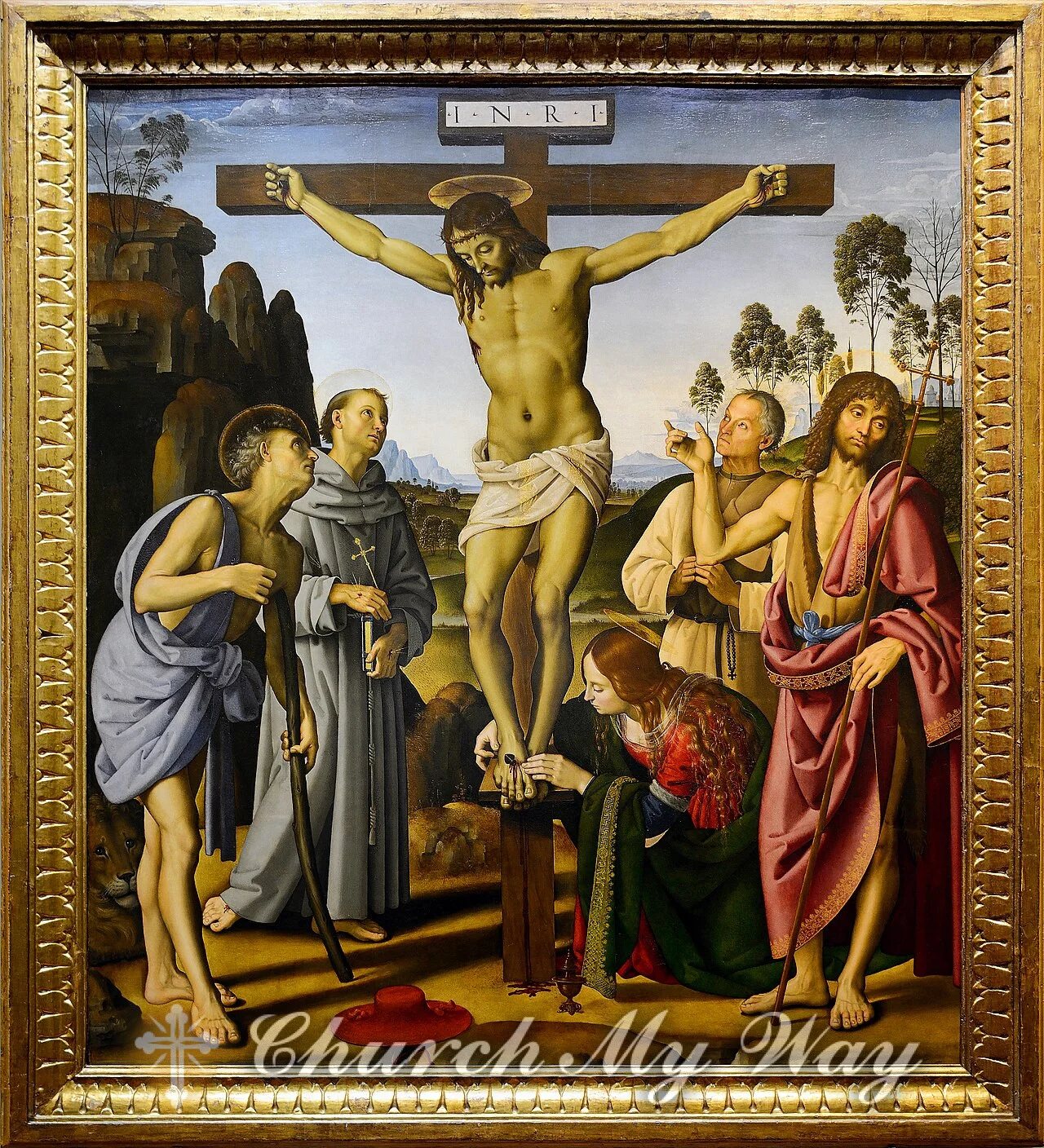
The Renaissance brought new tools to the depiction of the crucifixion: anatomical study, linear perspective, and a revived interest in classical form. Artists now approached the body of Christ with the same precision they applied to mythological figures. But this technical mastery often served a deepening spiritual realism. Matthias Grünewald’s Isenheim Altarpiece (1512–1516), painted for a hospital chapel serving patients with skin diseases, presents a Christ whose flesh is livid and torn, his fingers contorted—an image designed to speak directly to physical suffering.
The Reformation of the 16th century complicated the role of the cross in art. Protestant reformers such as Andreas Karlstadt and, more forcefully, Huldrych Zwingli, argued that images in worship risked idolatry. Zwingli’s followers removed images from churches in Zurich in 1524. Martin Luther, by contrast, took a moderate position, permitting images as aids to faith while insisting they were not objects of veneration. The result was a divided visual culture: Catholic regions continued to produce elaborate crucifixion scenes, while Protestant territories often favored the plain cross or the cross as a symbol without the corpus.
The Cross and the Printed Image
Albrecht Dürer’s woodcuts and engravings, including his Small Passion series (c. 1509–1511), spread crucifixion imagery across Europe in printed form for the first time. The printing press made the cross in art reproducible and affordable, allowing ordinary believers to hold devotional images in their hands. This democratization of religious art was one of the quiet revolutions of the Reformation era.
How Did Baroque Art Make the Cross Visceral?
The Baroque period of the 17th century pushed the crucifixion toward theatrical intensity. Caravaggio’s Crucifixion of Saint Peter (1600–1601) and his Entombment of Christ (1602–1604) used dramatic chiaroscuro—stark contrasts of light and shadow—to draw viewers into the scene. Peter Paul Rubens painted crucifixions with swirling energy and fleshy realism, while Diego Velázquez’s Christ Crucified (c. 1632) presents a figure of quiet dignity against a dark background.
Baroque art served the Catholic Counter-Reformation’s aim of moving the heart through the senses. The crucifixion became a vehicle for affective devotion—an invitation to feel the cost of redemption. This period also saw the crucifix become a standard fixture in homes and on personal altars, extending the cross in art beyond the church walls.
Why Does the Cross Endure in Modern and Contemporary Art?
Secularization did not retire the cross from Western art. In the 20th century, artists as varied as Salvador Dalí, Marc Chagall, and Graham Sutherland engaged the crucifixion. Dalí’s Christ of Saint John of the Cross (1951) reimagines the scene from above, with Christ’s body suspended over a dark harbor—a striking departure from traditional perspective. Chagall painted crucifixions repeatedly, often with Jewish and Christian symbols intertwined, as in White Crucifixion (1938), a response to the persecution of Jews in Europe.
Even in explicitly secular contexts, the cross retains its cultural power. It appears in memorials, in the visual language of cinema, and in architecture—from the concrete crosses of Le Corbusier’s Ronchamp chapel (1955) to the illuminated crosses of contemporary worship spaces. The cross in art remains a living symbol, capable of bearing new meanings while never quite losing its original one.
What Can the Cross in Art Teach Believers Today?
For Christians, the history of the cross in art is not merely an aesthetic chronicle. It is a record of how the church has wrestled with the meaning of Christ’s death—now emphasizing triumph, now suffering, now grief, now hope. Each era’s depiction reveals something about what believers needed to see.
- Art as theology: Images of the crucifixion have functioned as visual sermons, teaching doctrine and shaping devotion across centuries.
- Context shapes meaning: The same symbol has been used to comfort the sick, confront the complacent, and protest injustice—its power lies in its adaptability.
- Beauty serves faith: From catacomb frescoes to cathedral windows, the church has consistently invested in beauty as a vehicle for the gospel.
The apostle Paul wrote to the Galatians, “Before your very eyes Jesus Christ was clearly portrayed as crucified” (Galatians 3:1). He was speaking of the vividness of his preaching, but the words apply equally to the visual tradition that followed. Artists have portrayed Christ crucified so that believers might see, and seeing, believe.
A Lasting Perspective
The cross in art has shaped Western culture in ways that extend far beyond the walls of churches. It has influenced architecture, inspired masterpieces, informed the language of suffering and hope, and given ordinary believers a tangible focus for prayer and reflection. The symbol that once scandalized the Roman world—foolishness to some, a stumbling block to others—became the most recognizable image in human history.
When we look at a crucifix, a mosaic, or a simple wooden cross, we are joining a conversation that stretches back to the catacombs and forward into the present. The cross in art is not a relic of the past. It is an ongoing testimony to the claim at the heart of the Christian faith: that in the suffering and death of Jesus, God did something that changed everything. The artists who have returned to that scene across twenty centuries were not merely decorating churches. They were preaching, in pigment and stone, the oldest and most astonishing message the world has ever heard.
