📅 Last updated: 14.10.2026
The kenosis of Christ names the mystery at the heart of the gospel: that the eternal Son of God “emptied himself” (Greek ekenōsen) and took the form of a servant. The word comes from Philippians 2:7, where Paul writes that Jesus “made himself nothing”—literally “poured himself out”—without ceasing to be who he eternally was. Few passages in Scripture have generated more theological reflection, and few are more practically urgent for how believers understand humility, obedience, and the character of God.
The kenosis of Christ refers to the self-emptying described in Philippians 2:5–8, where the preexistent Son of God voluntarily set aside the independent exercise of His divine prerogatives to become a human servant. It does not mean He ceased to be God or surrendered His divine nature; it means He chose not to exploit His equality with the Father for His own advantage, humbling Himself even to death on a cross.
- What Does "Kenosis" Actually Mean in Philippians 2?
- The Historical Debate: How Have Theologians Understood the Kenosis of Christ?
- What Did Jesus Actually Empty Himself Of?
- Why the Kenosis of Christ Matters for the Trinity
- How the Kenosis Answers Real Objections
- What the Kenosis Means for Everyday Discipleship
- The Kenosis and the Cross: Where Self-Emptying Leads
- The Exaltation: The Kenosis Is Not the End of the Story
- What the Kenosis Reveals About the Heart of God
What Does “Kenosis” Actually Mean in Philippians 2?
The term derives from the Greek verb kenoō, meaning “to empty,” “to make void,” or “to pour out.” Paul uses it once in the New Testament in this specific theological sense, at Philippians 2:7: heauton ekenōsen—”he emptied himself.” The context is a first-century hymn or poetic creed that Paul quotes, likely an early Christian confession predating his letter (written around A.D. 60–62 from Roman imprisonment). Scholars from Lightfoot to Hawthorne have noted its rhythmic, strophic structure, suggesting the earliest Christians already sang about the self-humbling of Jesus.
What makes the passage remarkable is its grammar. Paul does not say Christ “was emptied” by an external force. He says Christ “emptied himself”—an active, voluntary act of the will. The self-emptying is not something done to the Son; it is something the Son does. He is simultaneously the subject and the object of the verb. This grammatical detail carries enormous theological weight: the incarnation was not a divine concession forced by circumstance but a deliberate, loving choice made within the eternal fellowship of the Trinity.
The hymn unfolds in three movements:
- Pre-existence: Christ existed “in the form of God” (en morphē theou) and possessed equality with God as His rightful status.
- Self-emptying: He “did not consider equality with God something to be grasped” but “emptied himself, taking the form of a servant” (morphē doulou) and being “born in the likeness of men.”
- Exaltation: Because of His obedience to the point of death, God “highly exalted him” and gave Him “the name that is above every name” (Philippians 2:9).
The parallel between morphē theou (form of God) and morphē doulou (form of a servant) is deliberate. Paul is not describing a change in essence but a change in condition. The one who possessed the outward expression of deity took on the outward expression of slavery. He did not stop being God; He became what He was not—human—without ceasing to be what He was.
The Historical Debate: How Have Theologians Understood the Kenosis of Christ?
The church has wrestled with the implications of Philippians 2 since at least the fourth century. The Council of Nicaea (A.D. 325) and the Council of Chalcedon (A.D. 451) established the orthodox boundaries: Jesus Christ is one person in two natures, fully divine and fully human, “without confusion, without change, without division, without separation.” Yet within those boundaries, significant questions remained about what the Son actually relinquished in the incarnation.
The Classical View: Veiling, Not Divesting
Most patristic and Reformation-era theologians held that the kenosis involved a voluntary veiling or non-use of divine prerogatives rather than an actual divestment of divine attributes. Athanasius, in On the Incarnation (c. A.D. 318), argued that the Word remained fully God even while taking on flesh: “He was not diminished by becoming man; rather, He made man partaker of His own divinity.” Augustine similarly insisted that the Son’s humility did not entail the loss of His divine nature. The emptying was functional and relational, not ontological.
This view preserves the immutability of God (Malachi 3:6; James 1:17) and the full deity of Christ affirmed at Nicaea. What changed was not God’s essence but the mode of His self-expression. The Son who “upholds the universe by the word of his power” (Hebrews 1:3) chose to live within the limitations of a human nervous system, a first-century Galilean village, and a mortal body—without ceasing to sustain all things.
The Kenoticist Controversy of the Nineteenth Century
A different approach emerged in nineteenth-century German Lutheran theology. Gottfried Thomasius (1802–1875) and later British theologians like Charles Gore (1853–1932) proposed that the Son actually surrendered certain divine attributes—omniscience, omnipotence, omnipresence—during His earthly life. This “kenotic theology” sought to take the humanity of Jesus with radical seriousness: if He was truly human, He must have had a genuinely human consciousness with human limitations.
The kenoticists were not heretics; they were attempting to address a real tension. But their solution raised serious problems. If the Son ceased to be omniscient or omnipotent, in what sense was He still God? Could a being who lacks divine attributes be worshiped as divine? The classical response, articulated by theologians like B.B. Warfield and later defended by contemporary scholars such as Gerald Hawthorne and Daniel Wallace, is that the Son possessed all divine attributes but voluntarily chose not to exercise some of them during His incarnate state. The distinction is between possession and use, between being and manifestation.
A Comparative Timeline of Kenotic Interpretation
| Period | Key Figure(s) | Core Position |
|---|---|---|
| 4th–5th centuries | Athanasius, Augustine, Leo the Great | Kenosis = veiling of glory; Christ remained fully divine in essence |
| 16th–17th centuries | Lutheran and Reformed scholastics | Distinction between divine nature and its voluntary non-use |
| 19th century | Thomasius, Gess, Gore | Kenosis = actual surrender of certain divine attributes during incarnation |
| 20th–21st centuries | Warfield, Hawthorne, Wallace, Bauckham | Kenosis = functional self-limitation; full deity retained and exercised selectively |
The majority report of historic Christianity lands on the side of functional self-limitation. Jesus could say “I and the Father are one” (John 10:30) and also “the Son can do nothing of his own accord” (John 5:19). He could know all things (John 16:30; 21:17) and yet grow “in wisdom and in stature” (Luke 2:52). He could calm storms with a word and yet be “wearied” by a journey (John 4:6). These are not contradictions; they are the paradox of the incarnation, and they are exactly what the kenosis of Christ explains.
What Did Jesus Actually Empty Himself Of?
The text does not specify what was emptied. Paul leaves the content of the kenosis theologically suggestive rather than exhaustively defined. But by comparing Scripture with Scripture, several things become clear about what the Son relinquished—and what He did not.
What He Set Aside
- The independent exercise of divine authority: Jesus repeatedly stated that He acted only as the Father directed (John 5:19, 30; 8:28; 12:49). He did not wield divine power autonomously but in perfect submission to the Father’s will.
- The visible manifestation of divine glory: The Son who shared the Father’s glory “before the world existed” (John 17:5) veiled that glory in human flesh. The transfiguration (Matthew 17:1–8) was a momentary unveiling, not the norm.
- The prerogatives of divine majesty: He who was worshiped by angels (Hebrews 1:6) allowed Himself to be mocked, spat upon, and crucified. He who could have called “twelve legions of angels” (Matthew 26:53) chose instead to be arrested.
- The riches of divine self-sufficiency: “Though he was rich, yet for your sake he became poor, so that you by his poverty might become rich” (2 Corinthians 8:9). This is the kenosis applied to material and relational existence.
What He Did Not Set Aside
- His divine nature: The Son did not cease to be God. Colossians 2:9 declares that “in him the whole fullness of deity dwells bodily”—present tense, during His incarnate life.
- His divine attributes: He possessed omniscience (John 2:24–25; 16:30), omnipotence (Matthew 28:18), and omnipresence (Matthew 18:20; 28:20) even during His earthly ministry, though He exercised them in accordance with the Father’s will.
- His identity as the second person of the Trinity: The Son remained the Son. The incarnation added a human nature to His divine person; it did not subtract deity or create a new being.
The best analogy may be that of a king who chooses to live as a peasant. He does not stop being king; he stops living as king. His royal authority remains intact, but he voluntarily refrains from using it. He experiences hunger, cold, and contempt—not because he has lost his throne, but because he has chosen to enter fully into the condition of his subjects. This is precisely what Paul describes in Philippians 2.
Why the Kenosis of Christ Matters for the Trinity
The kenosis is not merely a christological curiosity; it reveals the inner life of the Triune God. The self-emptying of the Son is the supreme display of the love that has always existed between the Father, Son, and Spirit. Before Bethlehem, before creation, the Son eternally delighted in the Father (Proverbs 8:30; John 17:24). The incarnation did not create that love; it manifested it in history.
Notice the Trinitarian structure of Philippians 2. The Son empties Himself. The Father exalts Him (v. 9). The Spirit is not mentioned explicitly, but the entire drama unfolds within the divine fellowship. The humility of the Son is not a departure from deity; it is the expression of deity’s deepest character. God is not proud. God is love (1 John 4:8), and love “does not insist on its own way” (1 Corinthians 13:5). The kenosis is what love looks like when it enters a fallen world.
This has profound implications. If the eternal Son could humble Himself without diminishing His deity, then humility is not weakness. It is strength under perfect control. It is the freedom to lay down power without losing identity. The cross is not the failure of divine power; it is its supreme expression.
How the Kenosis Answers Real Objections
“If Jesus was God, how could He not know the day or hour?”
In Mark 13:32, Jesus says that “concerning that day or that hour, no one knows, not even the angels in heaven, nor the Son, but only the Father.” Critics of the kenosis argue this proves Jesus was not omniscient. But the classical view holds that Jesus possessed all divine knowledge but voluntarily did not access or disclose certain knowledge during His incarnate state. His human consciousness operated within the limits of a first-century Jewish man, even as His divine nature remained fully omniscient. The Son chose to live within human limitations—not because He had lost His omniscience, but because He had chosen not to use it independently of the Father’s will.
“If Jesus was fully God, how could He die?”
The person of Christ died. Because He is one person with two natures, His human nature experienced death while His divine nature did not. The Son did not cease to exist; He experienced the separation of body and soul that we call death, and in that state He “went and proclaimed to the spirits in prison” (1 Peter 3:19)—a mysterious but powerful indication that His divine activity continued even between the cross and the empty tomb.
“Doesn’t the kenosis make Jesus less than God?”
No. The kenosis is a voluntary self-limitation, not a necessary deficiency. A billionaire who chooses to live on a modest salary has not ceased to be a billionaire. He has chosen not to use his wealth. Jesus chose not to use His divine prerogatives for His own comfort or advantage—but He never ceased to possess them. The miracles, the authority to forgive sins, the power over demons and death—all demonstrate that His divine nature was fully present and fully active throughout His ministry.
What the Kenosis Means for Everyday Discipleship
Paul does not present the kenosis as abstract theology. He presents it as a pattern for Christian living. The entire passage begins with an ethical imperative: “Have this mind among yourselves, which is yours in Christ Jesus” (Philippians 2:5). The self-emptying of Christ is not just something to believe about Jesus; it is something to imitate in our own lives.
This is where the kenosis becomes practical. If the eternal Son of God could lay aside His rights, His comfort, and His prerogatives for the sake of others, then no Christian has grounds for self-assertion, entitlement, or pride. The kenosis calls us to a lifestyle of voluntary self-giving:
- In relationships: “Do nothing from selfish ambition or conceit, but in humility count others more significant than yourselves” (Philippians 2:3). The kenosis means preferring others, not because they deserve it, but because Christ preferred us.
- In service: “Let each of you look not only to his own interests, but also to the interests of others” (Philippians 2:4). The kenosis means actively pursuing the good of others, even at personal cost.
- In suffering: “Christ also suffered for you, leaving you an example, so that you might follow in his steps” (1 Peter 2:21). The kenosis means that suffering for the sake of others is not meaningless; it is Christlike.
The kenosis does not call us to deny our identity or to pretend we have no needs. It calls us to hold our rights loosely, to use our power for others rather than ourselves, and to trust that God will exalt those who humble themselves (Luke 14:11; 1 Peter 5:6). The Son did not become a servant because He had no other choice. He became a servant because love always chooses the lowest place.
The Kenosis and the Cross: Where Self-Emptying Leads
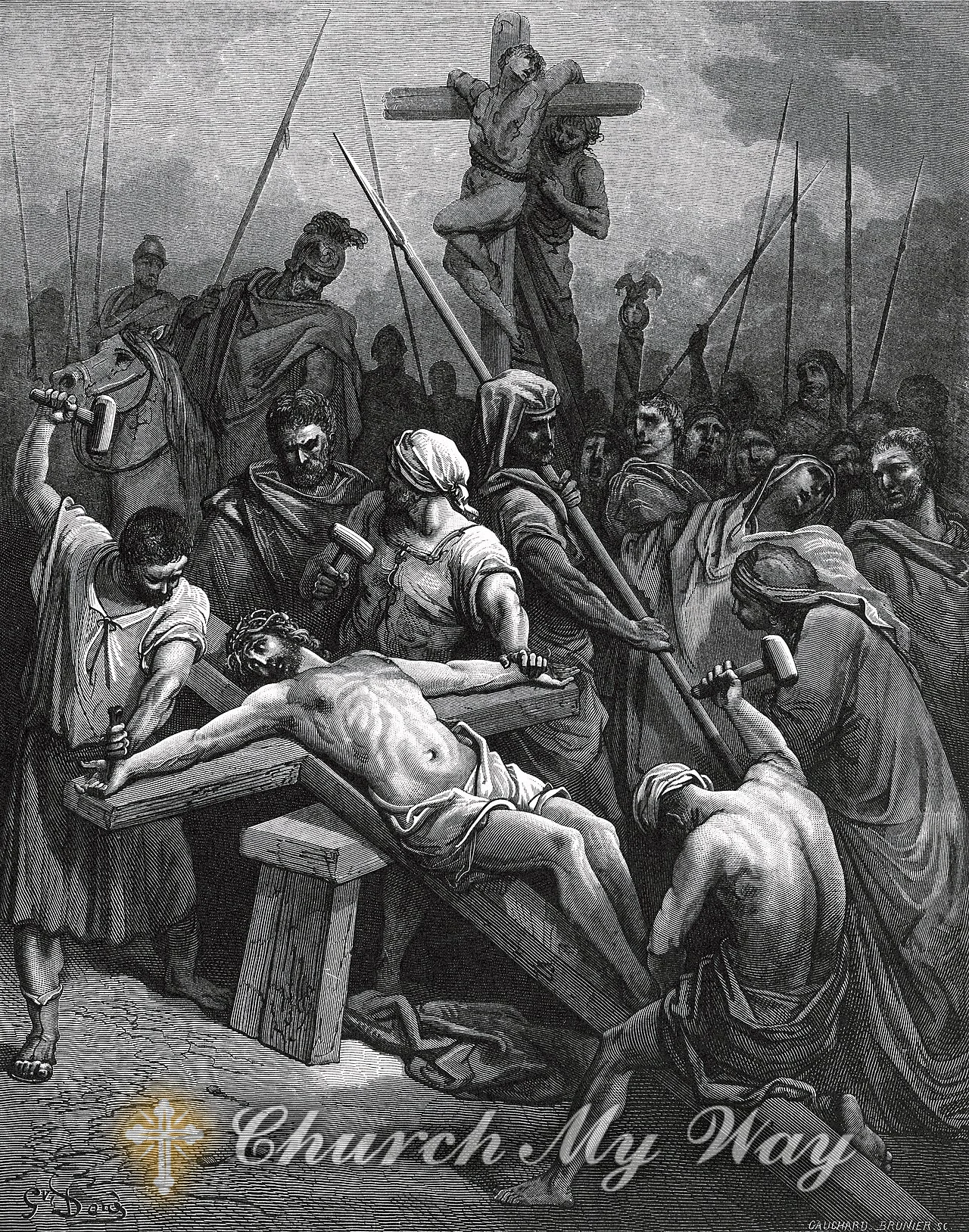
Paul does not stop at the incarnation. He follows the downward path of the Son all the way to its lowest point: “he humbled himself by becoming obedient to the point of death, even death on a cross” (Philippians 2:8). The kenosis is not merely the Son taking on flesh; it is the Son taking on death. The one who “was in the form of God” became obedient to the most shameful form of execution the ancient world could devise.
Crucifixion was designed to humiliate. It stripped the victim of clothing, dignity, and control. It was reserved for slaves, rebels, and the lowest classes. For the Son of God to submit to it was not merely death; it was the ultimate self-emptying. Every step of the incarnation was a further descent: from heaven to earth, from earth to servant, from servant to condemned criminal, from condemned criminal to a borrowed tomb. And every step was voluntary.
This is why the cross is the definitive revelation of who God is. God is not a distant sovereign who demands sacrifice; He is the God who makes the sacrifice. He does not stand outside human suffering and observe it; He enters it, absorbs it, and overcomes it from within. The kenosis means that when we look at the cross, we are not looking at a tragic miscarriage of justice. We are looking at the eternal character of God displayed in time.
The Exaltation: The Kenosis Is Not the End of the Story
Philippians 2 does not end at the cross. It ends at the throne: “Therefore God has highly exalted him and bestowed on him the name that is above every name, so that at the name of Jesus every knee should bow, in heaven and on earth and under the earth, and every tongue confess that Jesus Christ is Lord, to the glory of God the Father” (Philippians 2:9–11).
The self-emptying of Christ is followed by the self-exaltation of God the Father on behalf of the Son. The one who humbled Himself is the one who is now exalted. The one who became obedient is the one before whom every knee will bow. The kenosis is not a permanent state of diminishment; it is the path to glory. The Son did not remain in the form of a servant forever. He ascended, He reigns, and He will return in glory.
This pattern—humility before exaltation, suffering before glory, death before resurrection—is the shape of the Christian life as well. Jesus said, “Whoever exalts himself will be humbled, and whoever humbles himself will be exalted” (Matthew 23:12). The kenosis is not just a doctrine to be believed; it is a pattern to be lived. And it comes with a promise: those who share in Christ’s humility will share in His exaltation (Romans 8:17; 2 Timothy 2:11–12).
What the Kenosis Reveals About the Heart of God
The kenosis of Christ answers a question that every human being eventually asks: What is God really like? The answer is not a philosophical abstraction or a theological formula. The answer is a person—a person who emptied Himself, took the form of a servant, and died on a cross. In the self-emptying of the Son, we see the heart of God laid bare.
God is not a tyrant who clings to power. He is a Father who gives His Son (John 3:16). The Son is not a reluctant sacrifice; He is the willing servant who “loved me and gave himself for me” (Galatians 2:20). The Spirit is not an impersonal force; He is the one who applies the work of Christ to our hearts and conforms us to His image (Romans 8:29). The kenosis is the triune God in action, and it reveals that at the very center of the universe is not power, not wrath, not indifference—but love.
This is why the kenosis matters. It is not a theological puzzle to be solved but a mystery to be adored. It tells us that the God who made the galaxies chose to become a baby in a feeding trough. It tells us that the God who spoke the universe into existence chose to learn a trade in a Galilean workshop. It tells us that the God who is worshiped by angels chose to be mocked by soldiers. And it tells us that the God who could have destroyed His enemies chose instead to die for them.
The kenosis of Christ is the deepest revelation of the character of God, and it is the surest ground of our hope. The one who emptied Himself for us will never abandon us. The one who humbled Himself to the point of death will never despise our weakness. The one who is now exalted will one day make all things new. And in that day, every knee will bow and every tongue will confess that Jesus Christ is Lord—the servant who became King, the humble one who is now exalted, the emptied one who fills all in all.
