📅 Last updated: 20.11.2026
The Martyrdom of Polycarp is the earliest surviving account of a Christian martyrdom written as a distinct literary work, composed by the church at Smyrna around AD 155–160 to circulate the story of their aged bishop’s arrest and execution. It records how Polycarp, a disciple of the apostle John and bishop of Smyrna for over half a century, refused to curse Christ before a Roman proconsul and was burned alive in the stadium, and it became the template that shaped how Christians for centuries would tell the stories of their martyrs.
The Martyrdom of Polycarp is a circular letter written by the church of Smyrna shortly after AD 155, narrating the arrest, trial, and execution of their elderly bishop Polycarp. It is the earliest extant Christian martyrdom account composed as a standalone document, and it established the literary and theological pattern—voluntary witness, refusal to recant, dignified death, and reverent collection of relics—that later martyr acts would follow.
- What Is the Martyrdom of Polycarp and Why Does It Matter?
- The Historical Polycarp: Bishop, Apostolic Link, and the World of Second-Century Smyrna
- Inside the Narrative: The Arrest, Trial, and Death of Polycarp
- Martyrdom of Polycarp: Key Facts at a Glance
- How the Martyrdom of Polycarp Shaped the Christian Martyr Tradition
- What the Martyrdom of Polycarp Teaches About Faithful Witness
- Controversies and Questions About the Text
- Conclusion: Why the Martyrdom of Polycarp Still Matters
Few documents from the second century carry as much weight per page as this short letter. It is our earliest surviving martyrdom narrative written as its own composition, predating the accounts of the Scillitan martyrs and the letters of Ignatius’s later editors. It preserves a rare eyewitness-adjacent window into how a Christian congregation in Roman Asia processed the violent death of their pastor—grief, awe, theological reflection, and careful pastoral instruction all pressed into one text. And it left fingerprints on nearly everything that came after it in the martyrdom tradition.
What Is the Martyrdom of Polycarp and Why Does It Matter?
The document is framed as a letter from the church at Smyrna to the church at Philomelium in Phrygia, and through them to “all the brotherhoods of the holy and catholic church in every place.” Its stated purpose is catechetical and pastoral: the Smyrnaeans want other congregations to know what actually happened, to glorify God, and to hold up Polycarp as a model of faithful witness. The author is anonymous, though the letter names a certain Marcion (or Marcianus) as a scribe and Evarestus as the recorder of the events.
Its significance rests on several historical pillars:
- Chronological priority: Composed within roughly a year of Polycarp’s death (traditionally dated to February 23, AD 155, though some scholars argue for 156 or 167), it is the earliest martyrdom account written as a self-contained work rather than a passing notice in a church history.
- Apostolic linkage: Polycarp is presented as a disciple of John and an associate of the apostles, giving the Smyrna church a direct line to the apostolic generation. Irenaeus, who heard Polycarp teach as a young man, confirms this connection in Against Heresies 3.3.4.
- Theological influence: The letter’s distinction between genuine martyrdom and self-sought death, its treatment of the martyr’s body, and its use of “martyr” in a technical sense all shaped later Christian thought.
- Liturgical memory: The churches of Smyrna began commemorating Polycarp’s death annually, making this one of the earliest documented martyr commemorations.
The letter also carries a striking line that has echoed through two millennia of Christian devotion. When the proconsul urged the eighty-six-year-old bishop to recant with the words “Swear, and I will release you; revile Christ,” Polycarp answered: “Eighty and six years have I served Him, and He never did me any wrong. How can I blaspheme my King who saved me?” (Martyrdom of Polycarp 9).
The Historical Polycarp: Bishop, Apostolic Link, and the World of Second-Century Smyrna
Who Was Polycarp?
Polycarp (Greek: Polykarpos, “much fruit”) served as bishop of Smyrna, a prosperous port city on the Aegean coast of Asia Minor—modern İzmir, Turkey. The city was a major center of imperial cult worship, with temples to Rome and to the emperor, and a substantial Jewish community. For a Christian bishop to lead a church there for decades was to live permanently in the shadow of the empire’s religious expectations.
Irenaeus of Lyons, writing around AD 180, records that he had listened to Polycarp as a boy and that Polycarp had been “instructed by apostles” and “conversed with many who had seen Christ” (Against Heresies 3.3.4). Tertullian and later tradition specifically name John as his teacher. The Martyrdom itself refers to Polycarp’s long episcopal tenure and his reputation for blameless conduct. His surviving Letter to the Philippians—a short, practical epistle dense with quotations from the New Testament—confirms a pastor’s heart more than a speculative theologian’s mind.
The Political and Religious Setting
The persecution that claimed Polycarp was not a general empire-wide pogrom. It was local, sporadic, and often driven by mob pressure, economic resentment, and the refusal of Christians to participate in civic religious life—especially emperor worship and sacrifices to the gods. Pliny the Younger’s famous letter to Trajan around AD 112 (Epistulae 10.96–97) had established a rough legal framework: Christians were not to be hunted down, but if accused and convicted, they were to be punished; those who denied the faith and demonstrated loyalty to the gods could be released. That framework left enormous discretion to provincial governors and to the mood of local crowds.
The Martyrdom reflects exactly this environment. The proconsul Statius Quadratus (the letter names him, though some manuscripts read “Quadratus” alone) conducts the hearing, applies pressure, and offers release in exchange for a simple act of civic conformity. The crowd in the stadium—”the whole mob, both of the heathen and of the Jews who were in Smyrna”—demands the bishop’s death. This is the messy, localized reality of second-century persecution, not a coordinated imperial assault.
Inside the Narrative: The Arrest, Trial, and Death of Polycarp
The Arrest
The letter opens with a theology of martyrdom before it tells the story. The Smyrnaeans praise the martyrs who had already died in their city, but they are careful to insist that those deaths happened according to God’s will, not through the martyrs’ own self-will. This is a deliberate correction of a tendency, already visible in the second century, toward volunteering for martyrdom—what the letter calls “handing themselves over” without divine calling.
Polycarp, by contrast, waits. When the persecution reaches Smyrna, his congregation urges him to leave the city, and he withdraws to a farm outside town, spending his time in prayer for the whole church. He is eventually betrayed by a household servant—the letter notes with sorrow that the betrayer was “of his own household”—and arrested by a detachment of police and soldiers on a Saturday evening. The captain, named Herod, and his father Nicetes, meet him and try persuasion: “What harm is it to say ‘Caesar is Lord’ and to offer sacrifice and be saved?” Polycarp does not answer at first; he asks for time to pray, and then prays aloud for two hours, so movingly that some of the soldiers begin to regret what they are doing.
The Trial and the Proconsul’s Pressure
Brought into the stadium, Polycarp is met by the proconsul, who presses him to have respect for his age: “Swear by the fortune of Caesar; repent; say, ‘Away with the atheists.'” The proconsul means the Christians—accused of “atheism” because they rejected the gods. Polycarp, according to the letter, gestures toward the pagan crowd and says, “Away with the atheists”—turning the formula back on the idolaters.
The proconsul then tries again, urging him to “revile Christ.” This is where the famous reply comes. The dialogue continues with the proconsul threatening wild beasts and then fire. Polycarp answers that the fire of judgment to come is worse, and that he will not change his mind. The crowd, whipped into fury, calls for a lion or for Polycarp to be burned alive. The proconsul orders the herald to proclaim three times: “Polycarp has confessed himself to be a Christian.”
The Execution
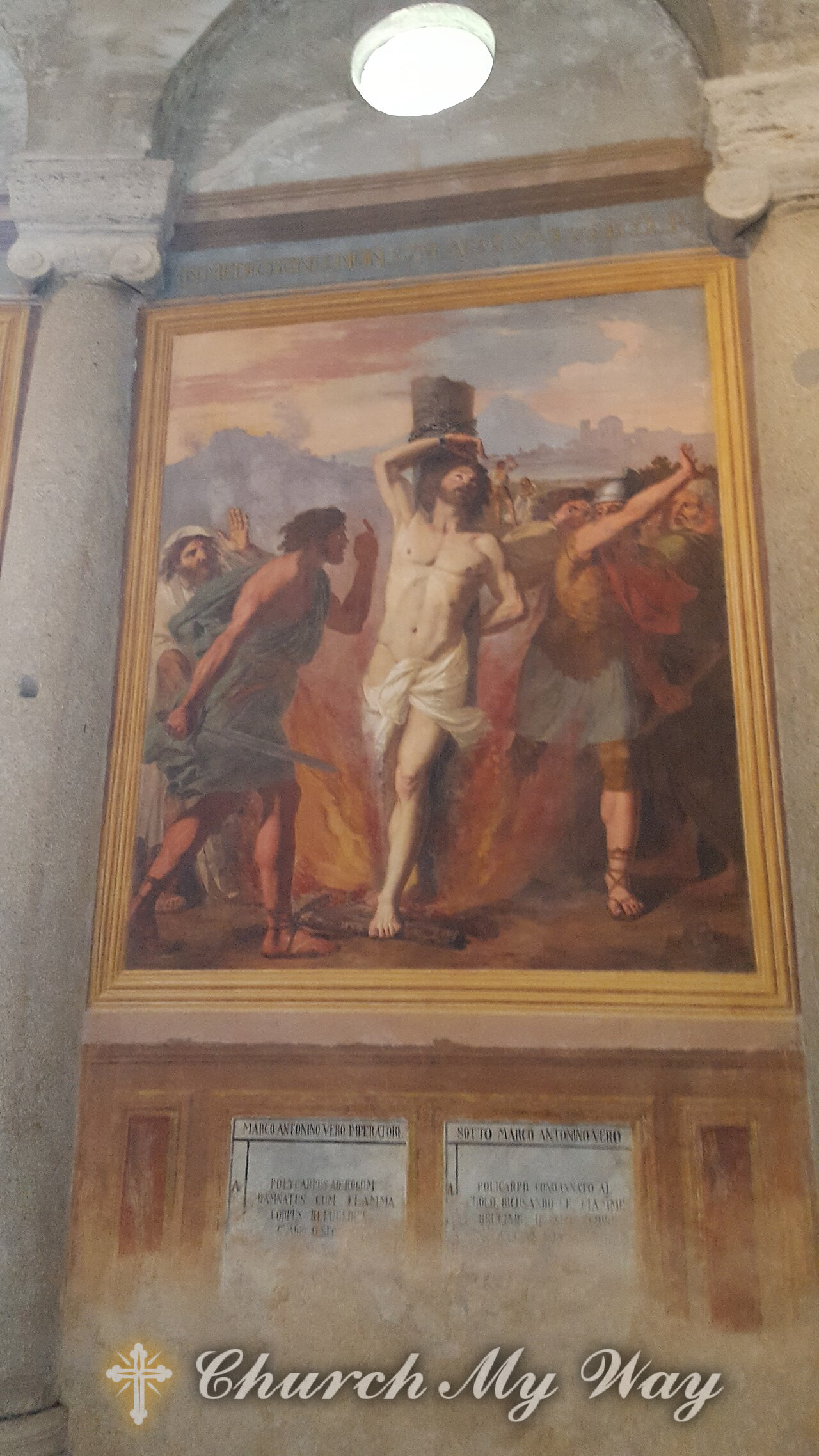
The letter’s account of the death is vivid and theologically charged. Polycarp is bound—not nailed, the author notes, because the fire would consume him anyway—and placed on a pyre. He prays a long eucharistic-style prayer, thanking God for counting him worthy of the cup of Christ and for the resurrection to eternal life. When the fire is lit, the letter reports a miracle: the flames do not consume him but form a kind of arch around him, and the executioner is finally ordered to stab him with a dagger. A great quantity of blood pours out and extinguishes the fire, and the centurion orders the body burned to prevent the Christians from venerating it.
The Smyrnaeans, however, gather the bones—”more precious than precious stones and finer than gold”—and bury them, establishing a place where they intend to commemorate his martyrdom annually. This detail is one of the earliest witnesses to the Christian practice of honoring martyrs’ relics and celebrating their feast days.
Martyrdom of Polycarp: Key Facts at a Glance
| Detail | Information |
|---|---|
| Date of composition | c. AD 155–160, shortly after Polycarp’s death |
| Traditional date of martyrdom | February 23, AD 155 (some scholars propose 156 or 167) |
| Author | Church of Smyrna (anonymous; scribe named Marcion/Marcianus, recorder Evarestus) |
| Recipient | Church at Philomelium in Phrygia, and all churches |
| Roman official | Proconsul Statius Quadratus; police captain Herod; father Nicetes |
| Polycarp’s age at death | 86 years (by his own statement in the trial) |
| Cause of death | Burned at the stake, then stabbed; body burned and bones collected by the church |
How the Martyrdom of Polycarp Shaped the Christian Martyr Tradition
The First Standalone Martyrdom Account
Before this letter, Christians had written about martyrdom within other genres—Luke’s account of Stephen in Acts 7, the letters of Ignatius anticipating his own death, the visions of the book of Revelation. The Martyrdom of Polycarp is the first surviving text that takes the martyrdom itself as its subject and treats it as a story to be told, circulated, and read aloud in worship. That literary move mattered enormously. It gave later churches a form to imitate: the arrest narrative, the trial dialogue, the refusal to recant, the death scene, the burial, and the theological interpretation of the whole.
The Definition of “Martyr”
The letter is also a key witness to the shift in the meaning of the Greek word martys. In the New Testament, martys normally means “witness” in a general sense—someone who testifies to what they have seen or heard (Acts 1:8; 1 Peter 5:1). By the time of this letter, the word is being used in its technical sense: a martyr is someone who seals their testimony to Christ with their death. The Martyrdom uses the term this way repeatedly, and it distinguishes genuine martyrs from those who sought death rashly.
The Pastoral Correction of Voluntary Martyrdom
One of the letter’s most striking features is its insistence that Polycarp did not court death. He hid when his congregation urged him to, he prayed for the church, and he went to his trial only when he was arrested. The Smyrnaeans explicitly contrast him with others who “handed themselves over” and were later criticized. This pastoral correction became a standard in early Christian teaching: martyrdom is a gift to be received, not a feat to be performed. The Didache and later church fathers echo the same caution.
Relics and Commemoration
The gathering of Polycarp’s bones “more precious than precious stones” and the annual commemoration of his death are among the earliest documented examples of what would become standard Christian practice. The letter does not develop a full theology of relics, but it shows the instinct: the body of a martyr is honored, and the memory of the martyr is celebrated in worship. This pattern would grow into the elaborate martyr cult of the later church.
What the Martyrdom of Polycarp Teaches About Faithful Witness
The letter is not merely a historical artifact. It is a piece of pastoral theology, and it offers several lessons that remain relevant to believers today.
- Faithfulness over spectacle: Polycarp’s witness is quiet, steady, and rooted in decades of service. The drama of his death is the fruit of a long life of obedience, not a sudden act of heroism.
- Theology of suffering: The letter insists that martyrdom is a participation in the sufferings of Christ. Polycarp’s prayer at the pyre is explicitly eucharistic, offering his death as a sacrifice of praise.
- Courage is communal: Polycarp is sustained by the prayers of the church, and the church is sustained by his witness. The letter is addressed to other congregations precisely because martyrdom is a shared experience, not a private one.
- Hope in resurrection: The letter’s hope is not in the preservation of the body but in the resurrection. The burning of Polycarp’s body is not a defeat but a planting.
The letter also models how a church can grieve well. The Smyrnaeans do not pretend the death was easy or the loss was small. They weep, they pray, they gather the bones, and they tell the story. That pattern—honest grief, theological interpretation, and communal memory—is a template for how Christians have faced loss ever since.
Controversies and Questions About the Text
Date and Historicity
The traditional date of AD 155 is supported by the proconsul’s name (Statius Quadratus, whose tenure is roughly datable) and by the letter’s internal references. Some scholars argue for a later date, around 167, based on chronological difficulties in the sources. The core of the narrative—Polycarp’s arrest, trial, and execution in the stadium at Smyrna—is widely accepted as historical, even by scholars who question the miraculous details.
The Miracles
The letter reports several miraculous elements: the voice from heaven saying “Be strong, Polycarp,” the fire that does not consume him, and the blood that extinguishes the flames. Some modern readers treat these as literary embellishments; others accept them as genuine. The letter itself presents them as part of the story, and the Smyrnaeans are careful to attribute the events to God’s providence rather than to Polycarp’s own power.
The Anti-Jewish Polemic
One of the more troubling features of the letter for modern readers is its hostile reference to “the Jews” who joined the crowd in demanding Polycarp’s death. This reflects the tense religious environment of second-century Smyrna, where the church and the synagogue were in painful conflict. It is important to read the passage in its historical context and not to use it to justify antisemitism. The letter’s primary target is the pagan mob and the Roman authorities, and its theological concern is the faithfulness of the church, not the condemnation of Judaism.
Conclusion: Why the Martyrdom of Polycarp Still Matters
The Martyrdom of Polycarp endures because it does what the best Christian writing has always done: it takes a specific, concrete event and opens it up to reveal something universal. An old man in a provincial city refuses to deny his Lord, and in that refusal the church sees the shape of its own calling. The letter is a window into the second century, but it is also a mirror for every century since.
Its legacy is not only literary. The church at Smyrna gave later generations a way to remember, a way to grieve, and a way to hope. They gave us the image of an eighty-six-year-old bishop standing before a Roman proconsul and saying, with quiet finality, that he could not blaspheme the King who had saved him. That image has strengthened believers in prisons, in stadiums, and in ordinary lives of quiet faithfulness for nearly two thousand years.
For the modern reader, the letter’s invitation is not to seek martyrdom but to live faithfully. Polycarp’s witness was the culmination of a long life of service, not a sudden burst of courage. The same Spirit that sustained him sustains the church today. And the same hope that carried him through the fire—the hope of resurrection, of the cup of Christ, of a King who saves—remains the church’s hope still.
