📅 Last updated: 15.11.2026
The sign of the cross is one of the oldest and most widespread gestures in Christian worship—a small motion of the hand that carries two thousand years of theology, memory, and devotion. Long before it appeared in written liturgies, believers were already marking themselves with the cross as a seal of belonging to Christ. Tracing the cross is at once a prayer, a declaration of faith, and a physical reminder of the gospel’s central claim: that God entered human suffering and transformed it into salvation.
The sign of the cross is a Christian gesture in which a believer traces the shape of the cross on the forehead or body, usually while invoking the Trinity—”In the name of the Father, and of the Son, and of the Holy Spirit.” It functions as a compact confession of faith, a request for divine protection, and a bodily participation in the death and resurrection of Jesus Christ.
- What Is the Sign of the Cross, and Where Did It Come From?
- What Does the New Testament Say About the Sign of the Cross?
- How Did the Sign of the Cross Develop Across Church History?
- Why Do Christians Trace the Cross? Five Theological Reasons
- How Is the Sign of the Cross Practiced Today?
- Is the Sign of the Cross Biblical or Merely Traditional?
- What Does the Sign of the Cross Mean for Daily Christian Life?
- Frequently Asked Questions About the Sign of the Cross
- A Lasting Perspective: Signing the Cross in an Age of Distraction
What Is the Sign of the Cross, and Where Did It Come From?
The gesture’s earliest documented form is remarkably modest. Around the year 200, the North African theologian Tertullian, in De Corona Militis (chapter 3), described how Christians “wear out the forehead” with the sign of the cross at every step and turn—when entering or leaving a house, when dressing, when sitting at table. He treated the practice as an unwritten tradition handed down from the apostles themselves. Whether or not readers accept Tertullian’s claim of apostolic origin, his testimony proves the custom was well established in the church within a century or so of the New Testament’s completion.
Writing a few decades later, Hippolytus of Rome in the Apostolic Tradition instructed catechumens to “sign” their foreheads as a defense against evil, and the third-century Didascalia Apostolorum advised believers to make the sign of the cross on the forehead “in all your actions.” By the fourth century, Cyril of Jerusalem’s Catechetical Lectures (13.36) told candidates for baptism to make the sign of the cross boldly on the forehead, calling it a “shield” against the enemy. The early church, living under intermittent persecution, understood the cross not merely as an emblem of suffering but as a weapon of spiritual victory.
From the Forehead to the Whole Body
The earliest form of the gesture involved tracing a small cross on the forehead with the thumb—a practice still visible today at Ash Wednesday and in the baptismal anointing. Over the centuries, especially in the Eastern churches, the sign expanded into a full-body gesture: forehead, chest, and shoulders. The Western church settled on touching the forehead, the breast, and then the left and right shoulders, while many Eastern Christians (and, since the sixteenth century, the Russian Old Believers) use the opposite shoulder order and a different finger configuration.
What Does the New Testament Say About the Sign of the Cross?
No verse in Scripture describes the sign of the cross as a formal ritual. The New Testament never commands it, and honest readers should acknowledge that. Yet the gesture is not foreign to the biblical imagination; it grows from several scriptural roots.
Marking and Sealing
Ezekiel 9:4 records a vision in which God commands an angel to “put a mark on the foreheads” of those who grieve over Jerusalem’s abominations—a protective seal on the faithful. Revelation echoes this imagery repeatedly: the servants of God are “sealed on their foreheads” (Revelation 7:3; 9:4), and the redeemed bear the name of the Lamb and the Father on their foreheads (Revelation 14:1; 22:4). The church’s practice of marking the forehead with the cross is best understood as a lived-out response to this biblical theme of the protective, identifying seal.
Baptism “Into” the Cross
Romans 6:3–4 declares that all who were baptized into Christ Jesus were baptized into his death and raised to new life. The sign of the cross accompanies baptismal water as a visible enactment of that union—the believer is literally “signed” with the death and resurrection of Christ. Galatians 3:27 makes the same point: “as many of you as were baptized into Christ have put on Christ.” The gesture is a rehearsal of baptismal identity.
Glorying in the Cross
Paul’s declaration in Galatians 6:14—”May I never boast except in the cross of our Lord Jesus Christ”—captures the theological heart of the gesture. To trace the cross on one’s body is to make Paul’s boast with one’s hand. Similarly, 1 Corinthians 1:18 calls the message of the cross “the power of God” to those being saved. The sign is a physical act of confidence in that power.
How Did the Sign of the Cross Develop Across Church History?
The gesture’s history tracks the church’s broader journey through persecution, establishment, schism, and renewal. The table below summarizes key milestones.
| Period | Development | Key Witness |
|---|---|---|
| c. 200 | Forehead signing at every daily action; treated as apostolic tradition | Tertullian, De Corona 3 |
| c. 215 | Signing the forehead as spiritual armor for catechumens | Hippolytus, Apostolic Tradition |
| c. 350 | Sign of the cross on the forehead at baptism and against temptation | Cyril of Jerusalem, Catechetical Lectures 13.36 |
| c. 400 | Full-body gesture with hand; Trinitarian formula firmly attached | Augustine, De Trinitate; sermons |
| c. 800–1100 | Two-finger and three-finger forms develop; East/West shoulder order diverges | Byzantine and Latin liturgical books |
| 16th century | Reformation debates; gesture retained in Lutheran and Anglican practice, largely dropped by many Reformed and Anabaptist bodies | Luther’s Small Catechism; Book of Common Prayer |
Augustine of Hippo, writing around 400, assumed the sign was universal: in De Trinitate and in his sermons he refers to the cross on the forehead as the mark of the Christian, and in Confessions he recalls his mother Monica signing her children with the cross. The gesture was not a medieval accretion; it was embedded in the church’s life from the patristic age.
Why Do Christians Trace the Cross? Five Theological Reasons
Behind the simple motion lies a dense theology. Consider what the gesture actually says.
- It confesses the Trinity. The words “Father, Son, and Holy Spirit” are not decoration; they are the church’s baptismal formula from Matthew 28:19. The sign is a creed in miniature.
- It proclaims the atonement. The cross is where sin was judged and reconciliation accomplished (2 Corinthians 5:19–21). Tracing it is a personal claim on that work.
- It marks identity. Like the seal in Revelation, the gesture declares “I belong to Christ”—a daily re-enlistment under his banner.
- It invokes protection. The early church used it against evil; the gesture is a prayer for the shielding presence of God in ordinary moments.
- It engages the body. Christianity is not a faith of minds only. Kneeling, lifting hands, and signing the cross let the body pray what the mind believes.
How Is the Sign of the Cross Practiced Today?
Practice varies widely, and the variation itself is instructive. The gesture is not a mark of one denomination but a shared inheritance, expressed differently across traditions.
Western Forms
In the Roman Catholic, Lutheran, Anglican, and Methodist traditions, the sign is typically made with the right hand touching the forehead, then the breast, then the left shoulder, then the right, while saying the Trinitarian formula. Catholics often accompany it with a small cross on the lips or heart at the Gospel reading, and with holy water on entering a church. Luther’s Small Catechism (1529) famously instructs believers to begin the day by making the sign of the holy cross—evidence that the Reformers did not reject the gesture wholesale.
Eastern Forms
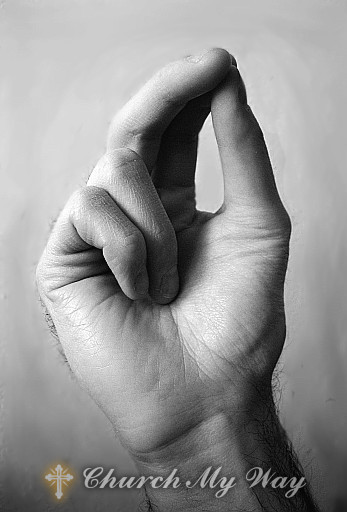
Eastern Orthodox and many Eastern Catholic Christians join the thumb, index, and middle fingers (confessing the Trinity) with the ring and little fingers folded to the palm (confessing the two natures of Christ), then touch forehead, chest, right shoulder, then left. The order and finger symbolism carry explicit doctrinal meaning and became flashpoints in the Old Believer schism of the seventeenth century.
Where It Is Absent
Many Baptist, Presbyterian, and non-denominational congregations do not practice the sign, often out of a concern for scriptural warrant or a desire to avoid ritualism. This is a genuine theological conviction, not a spiritual deficiency. Scripture nowhere commands the gesture, and Romans 14:5–6 urges mutual respect between those who observe days and customs and those who do not.
Is the Sign of the Cross Biblical or Merely Traditional?
The honest answer is that the sign of the cross is a post-biblical tradition that is deeply biblical in substance. It is not commanded, but neither is it contrary to Scripture; it is a practice that embodies scriptural truths—the Trinity, the atonement, baptismal union with Christ, and the sealing of the faithful. The Reformers’ principle of adiaphora (things indifferent) applies: a practice neither commanded nor forbidden may be used if it serves faith and love, and omitted if it hinders them.
Critics sometimes worry the gesture is superstitious—that the motion itself accomplishes something. The historic teaching of the churches that practice it is clear: the sign has no power in the wood of the hand or the geometry of the motion. It is a prayer made visible, effective only as an expression of faith in the One to whom it points. The same logic applies to any religious action; the gesture is a means, never the end.
What Does the Sign of the Cross Mean for Daily Christian Life?
For those who practice it, the gesture functions as a spiritual rhythm woven into ordinary time. It is made at the beginning and end of prayer, before meals, upon waking and before sleep, when entering a church, and in moments of fear or temptation. Each use re-anchors the believer in the gospel narrative: I am a sinner, Christ died for me, I am sealed by the Spirit.
- Before prayer: it gathers the scattered mind and signals that the conversation about to begin is with the Triune God.
- In anxiety or temptation: it is a tactile prayer for protection, echoing the early church’s use of the sign as a shield.
- At the Gospel reading: it asks that the words just heard be written on the heart.
- At the end of the day: it is a final act of surrender and trust before sleep.
Even believers who do not practice the gesture can honor its logic: the Christian life is meant to be signed—marked, shaped, and oriented—by the cross in every ordinary moment. The sign of the cross simply makes that orientation visible, giving the body a way to say what the heart believes.
Frequently Asked Questions About the Sign of the Cross
Is the sign of the cross only for Catholics?
No. Lutherans, Anglicans, Methodists, and many Eastern Orthodox and Oriental Orthodox Christians also practice it. Its use is a matter of tradition and conscience, not a boundary of genuine faith.
Does the sign of the cross have power in itself?
Historic Christian teaching is that the gesture has no inherent power; it is a prayer and confession, effective through faith in Christ, not through the motion.
Can a Protestant make the sign of the cross?
Many Protestants do—especially in liturgical traditions. Where it is not practiced, its absence reflects a different theological emphasis, not a lesser faith.
Why do Eastern and Western Christians use different shoulder orders?
The divergence developed gradually in the medieval period. The East touches the right shoulder first, the West the left; both regard the gesture as a confession of the Trinity and the cross.
A Lasting Perspective: Signing the Cross in an Age of Distraction
In a culture of constant motion and fragmented attention, the sign of the cross offers something rare: a bodily act that gathers the whole person—mind, heart, and hand—around the central facts of the faith. It is ancient enough to connect believers to the persecuted church of the second century, simple enough for a child to learn, and deep enough to sustain a lifetime of reflection. Whether or not a Christian makes the gesture, the truth it points to remains the hinge of the gospel: that the cross, once an instrument of shame, has become the sign of salvation, and those who belong to Christ are marked by it forever.
