📅 Last updated: 17.11.2026
The Martyrs of Lyon remain one of the most vivid and best-documented episodes of early Christian suffering, a persecution that unfolded in Roman Gaul in AD 177 and preserved for us through a letter from the churches of Lyon and Vienne to their brethren in Asia Minor. This article examines the historical setting, the individual believers who died, the theological convictions that sustained them, and the lessons their witness still teaches the church today.
The Martyrs of Lyon (also called the Martyrs of Lyon and Vienne) were a group of Christians in Roman Gaul executed around AD 177 under Emperor Marcus Aurelius, during a violent popular uprising in the cities of Lugdunum (Lyon) and Vienna (Vienne). Roughly forty to fifty believers, including the elderly bishop Pothinus, the slave woman Blandina, and the deacon Sanctus, were tortured and killed. Their story survives in a detailed letter preserved by the church historian Eusebius in his Ecclesiastical History.
- What Happened at Lyon and Vienne in AD 177?
- Who Were the Martyrs of Lyon and Vienne?
- Why Were Christians Persecuted in the Roman Empire?
- What Does the Letter of the Churches of Lyon and Vienne Actually Say?
- How Did the Martyrs of Lyon Face Death?
- What Can We Learn from the Martyrs of Lyon Today?
- How Do the Martyrs of Lyon Fit into the Wider Story of Early Christianity?
- What Is the Legacy of the Martyrs of Lyon?
- What Should Christians Today Take from the Martyrs of Lyon?
What Happened at Lyon and Vienne in AD 177?
The persecution did not begin with an imperial decree aimed at Christians. It began with the street. The church historian Eusebius of Caesarea, writing in the early fourth century, preserves a letter sent by the congregations of Lyon and Vienne to the churches of Asia and Phrygia. The letter describes a sudden escalation of mob hostility. Christians were barred from houses and baths and markets; anyone who showed them kindness risked being treated as an enemy of the gods. Then the violence turned legal. Believers were dragged before the local tribunal, and the charge was not theft or sedition but the name itself—the mere confession of being Christian.
Lyon, known to the Romans as Lugdunum, was no backwater. It was the administrative capital of the province of Gallia Lugdunensis, a thriving commercial city at the confluence of the Rhône and Saône rivers, home to a substantial Greek-speaking immigrant community from Asia Minor. That detail matters. The churches of Lyon and Vienne were not isolated rural congregations; they were urban, connected to the wider Christian world, and their letter reads like a report from the front lines to the churches that had sent them.
The timing is significant. The persecution occurred during the reign of Marcus Aurelius (ruled AD 161–180), the philosopher-emperor whose Meditations are still read for their stoic wisdom. Christians have long wrestled with the irony that one of Rome’s most thoughtful rulers presided over one of the church’s bloodiest provincial persecutions. There was no sweeping edict against Christianity under Marcus Aurelius; persecution in this period was typically local, sporadic, and driven by accusers and mob pressure. The Lyon letter confirms this pattern precisely.
Who Were the Martyrs of Lyon and Vienne?
The letter names several believers with care, and those names have echoed through church history. The elderly bishop Pothinus, said to be over ninety years old, was beaten and dragged before the tribunal; when asked who the Christians’ God was, he answered that he would tell them if they were worthy. He died from the injuries of the beating. The deacon Sanctus of Vienne endured repeated torture and, according to the letter, refused to give even his name, answering only “I am a Christian.” The letter’s author marvels that after each round of torment his body was restored, so that the torturers themselves were exhausted.
Then there is Blandina, a slave woman whose mistress, also a martyr, feared she would deny Christ under pressure because of her physical frailty. The opposite happened. Blandina was suspended on a stake and exposed to wild beasts in the amphitheater; when the beasts did not touch her, she was taken down and returned to prison, where she encouraged the others. On the final day she was scourged, placed on a heated iron chair, enclosed in a net, and thrown to a bull. The letter records that even the pagans confessed that no woman among them had ever suffered so much.
Other names preserved include Attalus, a man of Pergamene origin and a Roman citizen, whose citizenship initially spared him but whose public confession sealed his fate; Alexander, a physician from Phrygia; Maturus, a recent convert; and Ponticus, a boy of about fifteen. The slave woman Biblis, who had earlier denied the faith under torture, was brought forward, confessed Christ, and was executed—the letter treats her recovery as a warning against denial and a sign of mercy.
The letter also records a haunting detail about the treatment of the bodies. The corpses of the martyrs were exposed for days, then burned, and their ashes swept into the Rhône River, with the mocking taunt that the Christians would have no share in the resurrection. The letter’s author answers that taunt with quiet confidence in the God who raises the dead.
Why Were Christians Persecuted in the Roman Empire?
Understanding Lyon requires understanding the legal and social machinery of Roman persecution. Christians were not usually sought out by the state in this period; they were prosecuted when accused. The correspondence between Pliny the Younger and Emperor Trajan around AD 112 established a rough precedent: Christians should not be hunted down, anonymous accusations should be ignored, but those who were formally accused and refused to sacrifice to the gods could be punished. That legal ambiguity left the church exposed to local hostility, economic jealousy, and the anger of neighbors who blamed Christians for offending the gods.
Several factors converged at Lyon:
- The name itself was a crime. Confessing “I am a Christian” was sufficient for conviction; the tribunals did not require evidence of any other offense.
- Social and economic resentment. Christians withdrew from the civic religious life of the empire—the sacrifices, festivals, and guild observances that bound communities together—and were seen as misanthropic and disloyal.
- Mob pressure and scapegoating. The letter describes crowds calling for the Christians’ arrest and demanding their deaths, a dynamic familiar from the riot at Ephesus in Acts 19:23–41.
- The refusal to sacrifice. The single act that could save a Christian was offering incense or sacrifice to the gods or the emperor’s genius. Refusal was read as treason against the social order.
The Lyon persecution also produced an uncomfortable complication: some believers, including the slave woman Biblis, had denied the faith under earlier pressure. The letter does not hide this. It records the denial, the torture that followed, and Biblis’s eventual confession and death, treating the whole sequence as a lesson about the danger of presumption and the reality of repentance. This honesty is one of the reasons historians trust the document.
What Does the Letter of the Churches of Lyon and Vienne Actually Say?
The primary source for the Martyrs of Lyon is the letter preserved by Eusebius in Ecclesiastical History 5.1–4. It is one of the most detailed martyrdom accounts to survive from the second century, and its literary quality suggests a careful author, possibly the presbyter Irenaeus, who later became bishop of Lyon and a major theologian. Irenaeus was a disciple of Polycarp, who had known the apostle John—a chain of memory that connects the Lyon church directly to the apostolic age.
The letter is structured as a narrative of escalating suffering and divine endurance. Its central theological claim is that the martyrs did not conquer through their own strength but through the grace of God, and that Christ suffered in them. The author writes that the martyrs were “strangled” by the devil in the case of the deniers but that Christ showed his mercy to the fallen, strengthening them to confess. The letter repeatedly insists that the martyrs’ endurance was not human courage but the power of Christ.
One of the most striking passages concerns the deacon Sanctus. After repeated torture, his body was so broken that he could not speak his own name, yet when asked who he was, he answered, “I am a Christian.” The letter treats this as evidence that the confession of Christ had become the martyr’s identity, replacing even the self. This is the same logic Paul articulates in Galatians 2:20—”I have been crucified with Christ; it is no longer I who live, but Christ who lives in me.”
The letter also preserves a detail about Blandina’s mistress, who feared her slave would deny Christ. The reversal—the weak confounding the strong—echoes 1 Corinthians 1:27: “God chose what is weak in the world to shame the strong.” The Lyon letter is, in effect, a lived commentary on that verse.
How Did the Martyrs of Lyon Face Death?
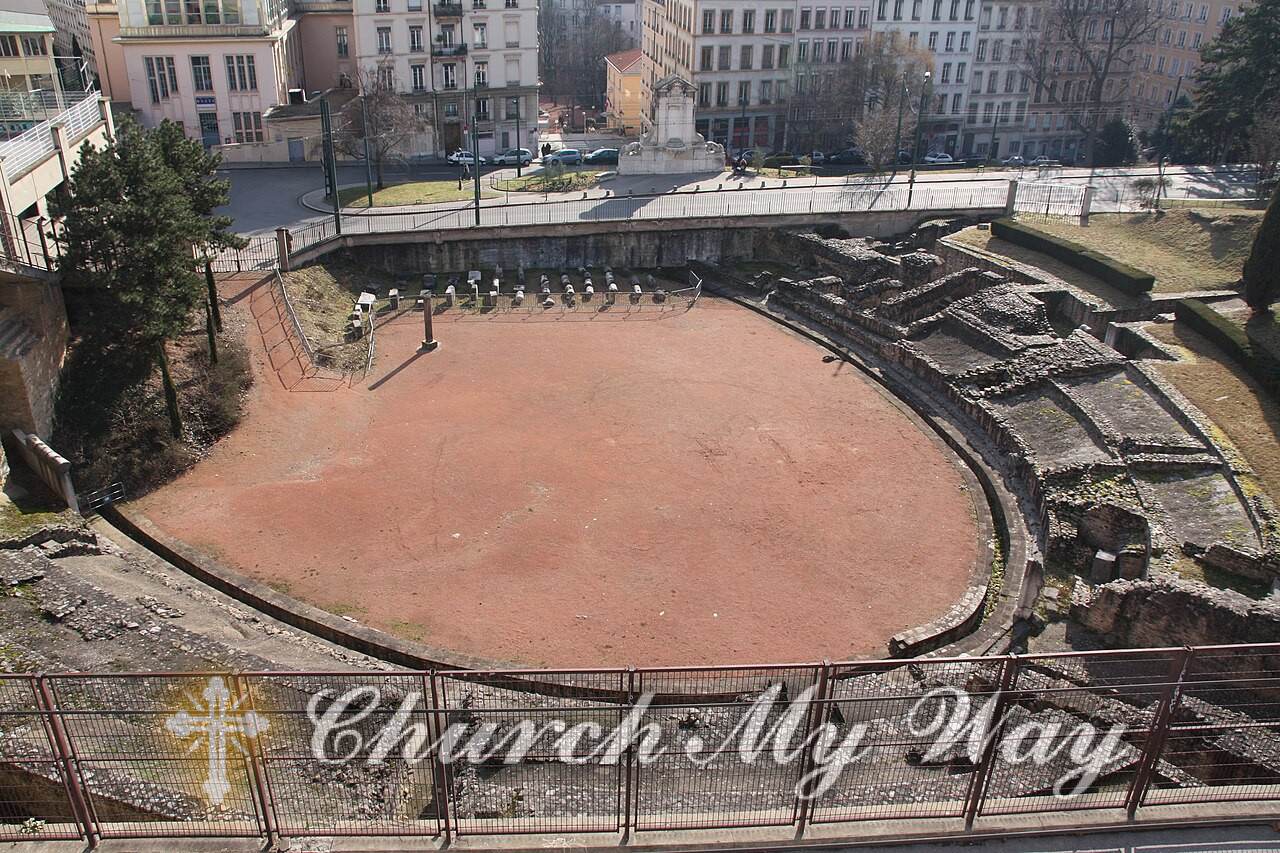
The executions unfolded over several days in the amphitheater of Lyon, a spectacle staged for the city’s entertainment. The letter describes a sequence of torments designed to break the believers’ resolve: scourging, exposure to beasts, the iron chair, and finally the sword or the beast for those who survived. The crowd’s appetite for the spectacle grew, and the authorities, according to the letter, were embarrassed that the Christians kept surviving.
The young boy Ponticus, about fifteen, was brought forward with Blandina. The letter says he endured every torment without wavering, encouraged by Blandina, and died under the sword. Blandina herself, after watching the others die, was at last enclosed in a net and thrown to a bull, and the letter records that even the pagans admitted no woman had ever suffered so much. Her body was then taken up and buried by the Christians, and the letter notes that the martyrs’ remains were eventually recovered despite the attempt to deny them burial.
Attalus, the Roman citizen, was brought into the amphitheater on a heated chair, and the smell of burning flesh reportedly turned the crowd against the spectacle. The governor, according to the letter, asked him whether he would recant if the people were appeased; Attalus answered that he would not, and he was executed. The letter also records the death of Alexander the physician, who stood by the tribunal and encouraged the confessors; when the crowd demanded his death, he was thrown to the beasts.
The letter’s account of the aftermath is as important as its account of the deaths. The authorities attempted to deny the martyrs burial, exposing the bodies and then burning them, scattering the ashes in the Rhône. The letter’s author interprets this as a satanic attempt to erase the hope of resurrection, and answers it with the conviction that the martyrs now live with Christ. This is the same hope Paul proclaims in 1 Corinthians 15:54–57, where death is swallowed up in victory.
What Can We Learn from the Martyrs of Lyon Today?
The Martyrs of Lyon are not merely a historical curiosity. They are a case study in how the church behaves under pressure, and their letter offers several enduring lessons.
- Grace, not grit, sustains the faithful. The letter insists that the martyrs endured by the power of Christ, not by their own strength. That is a corrective to any theology that treats martyrdom as a heroic human achievement.
- The weak confound the strong. Blandina, a slave woman, and Ponticus, a boy, became the church’s most powerful witnesses. God’s strength is made perfect in weakness (2 Corinthians 12:9).
- Denial is not the end of the story. Biblis denied Christ, was restored, and died confessing him. The letter treats her recovery as a warning and a mercy, a pattern of repentance the church still needs.
- The resurrection is the heart of the conflict. The authorities tried to deny the martyrs burial to mock the hope of resurrection. The church answered with confidence in the God who raises the dead.
There is also a practical lesson about the church’s public witness. The Lyon church did not seek martyrdom; it was dragged into it by a hostile city. But when the moment came, the believers did not recant. Their letter to the churches of Asia was written so that other congregations would know what had happened and would be strengthened. The martyrs of Lyon understood themselves as part of a wider body, and their suffering was reported as news for the whole church.
How Do the Martyrs of Lyon Fit into the Wider Story of Early Christianity?
The Lyon persecution belongs to a period of sporadic, local outbreaks rather than a systematic empire-wide campaign. The first great imperial persecution would come under Decius in AD 250, when every inhabitant of the empire was required to sacrifice to the gods and obtain a certificate. The Lyon martyrs died roughly seventy years before that, in a world where the legal status of Christians was ambiguous and their safety depended on local conditions. That makes their story especially instructive: persecution often arose from the ground up, from neighborly hostility and economic resentment, rather than from the throne.
The Lyon church also left a theological legacy through Irenaeus, who became bishop of Lyon and wrote Against Heresies, one of the most important works of early Christian theology. Irenaeus’s emphasis on the unity of the church, the apostolic tradition, and the goodness of creation was shaped by a community that had seen its members tortured and killed for the faith. The martyrs and the theologians were the same church.
The letter’s portrayal of the martyrs also shaped later Christian literature. The Acts of the Martyrs, the prison letters of the third century, and the martyrologies of the medieval church all owe something to the Lyon letter’s pattern: the confession of the name, the endurance of torture, the encouragement of the weak by the strong, and the final victory of the resurrection hope.
What Is the Legacy of the Martyrs of Lyon?
The legacy of the Martyrs of Lyon is preserved in the church’s memory, in the calendar, and in the city of Lyon itself. The letter they left behind is one of the earliest and most reliable martyrdom accounts we possess, and it has been read in churches since the second century. The names Pothinus, Blandina, Sanctus, Attalus, and the others are still commemorated, and the amphitheater of Lyon, where they died, remains a site of pilgrimage and reflection.
But the deeper legacy is theological. The Lyon martyrs demonstrate that the church’s survival did not depend on political favor or social respectability. It depended on the conviction that Christ had conquered death and that his people would share in that victory. That conviction is the same one Paul preached in Philippians 1:21—”For to me to live is Christ, and to die is gain”—and it is the conviction that has sustained Christians in every generation of persecution since.
The Martyrs of Lyon also remind us that the church’s enemies are not always emperors. Sometimes they are neighbors, business rivals, and crowds. The letter’s account of the mob’s hostility is a sober reminder that social pressure can be as lethal as legal decree, and that the church’s witness must be sustained by grace rather than by the approval of the surrounding culture.
What Should Christians Today Take from the Martyrs of Lyon?
The Martyrs of Lyon deserve to be better known than they are. Their story is not a legend or a pious embellishment; it is a first-hand report from a church that suffered and survived, and it is preserved in one of the earliest and most reliable documents of Christian history. It shows us a church that was urban, connected, and theologically serious, and it shows us individual believers—an old bishop, a slave woman, a boy, a physician—who faced death with a courage that was not their own.
The letter’s central claim is that the martyrs conquered through the grace of Christ, and that Christ suffered in them. That claim is the heart of the Christian gospel, and it is the reason the martyrs’ deaths were not a defeat. The authorities tried to erase their memory by burning their bodies and scattering the ashes in the Rhône, but the church remembered, and the letter they wrote has outlasted the empire that killed them.
For believers today, the Martyrs of Lyon are a call to faithfulness under pressure, a warning against presumption, and a comfort in suffering. They remind us that the church’s strength is not in its numbers or its cultural influence but in the risen Christ, who stands with his people in the fire. The letter’s final confidence—that the martyrs live with Christ and will share in the resurrection—is the same confidence the church has carried from the amphitheater of Lyon to the present day. The Martyrs of Lyon are not a forgotten footnote; they are a witness that the gates of hell have not prevailed, and will not prevail, against the church Christ built.
