📅 Last updated: 11.11.2026
Early Christian art did not emerge in a vacuum, nor did it begin as a fully formed aesthetic tradition. The earliest surviving Christian images—painted on the walls of Roman catacombs, scratched onto plaster, carved into sarcophagi—reveal a movement that borrowed heavily from the visual language of the pagan world around it. Yet what emerged from that borrowing was not imitation for its own sake but transformation: a deliberate reworking of Greco-Roman forms to carry distinctly Christian meaning.
Early Christian art refers to the visual culture produced by Christians roughly between the late second century and the sixth century AD. It adapted existing Greco-Roman motifs—shepherds, banquets, orants, and mythological figures—and reinterpreted them through biblical theology, often using symbol and allegory to communicate the gospel in a hostile or indifferent pagan society.
- Why Did Early Christian Art Borrow From Pagan Sources?
- What Were the Earliest Forms of Early Christian Art?
- How Did Early Christian Art Reinterpret Specific Pagan Motifs?
- What Role Did the Fish, the Cross, and the Chi-Rho Play in Early Christian Art?
- How Did Early Christian Art Change After Constantine?
- What Can Early Christian Art Teach Us About Faith and Culture?
- Frequently Asked Questions About Early Christian Art
- What Is the Lasting Legacy of Early Christian Art?
Why Did Early Christian Art Borrow From Pagan Sources?
The question of borrowing is not incidental; it sits at the heart of how the early church engaged culture. Christians of the first two centuries lived within the Roman Empire, surrounded by temples, statues, frescoes, and mosaics saturated with pagan religious imagery. They had no independent artistic tradition of their own. When they began to create visual expressions of faith, they drew on the only visual vocabulary available to them—the Hellenistic artistic conventions that dominated the Mediterranean world.
This was not a compromise of conviction but a strategic act of communication. The church father Tertullian, writing around AD 200 in De Idololatria, wrestled openly with the tension between artistic craft and idolatry, arguing that the same hands which crafted idols should not craft Christian images without careful intent. Yet Christians did create images, and they did so by redirecting pagan forms toward new ends. A Roman fresco of a shepherd carrying a lamb on his shoulders became, in Christian hands, an image of Christ the Good Shepherd—drawing directly on Jesus’ own words in John 10:11: “I am the good shepherd. The good shepherd lays down his life for the sheep.”
This method of reinterpretation mirrors what the apostle Paul did in Acts 17:23, when he stood in Athens and pointed to an altar “to an unknown god,” declaring that what they worshiped in ignorance, he now proclaimed to them. Early Christian art performed the same move visually: taking forms the culture already understood and filling them with the knowledge of Christ.
What Were the Earliest Forms of Early Christian Art?
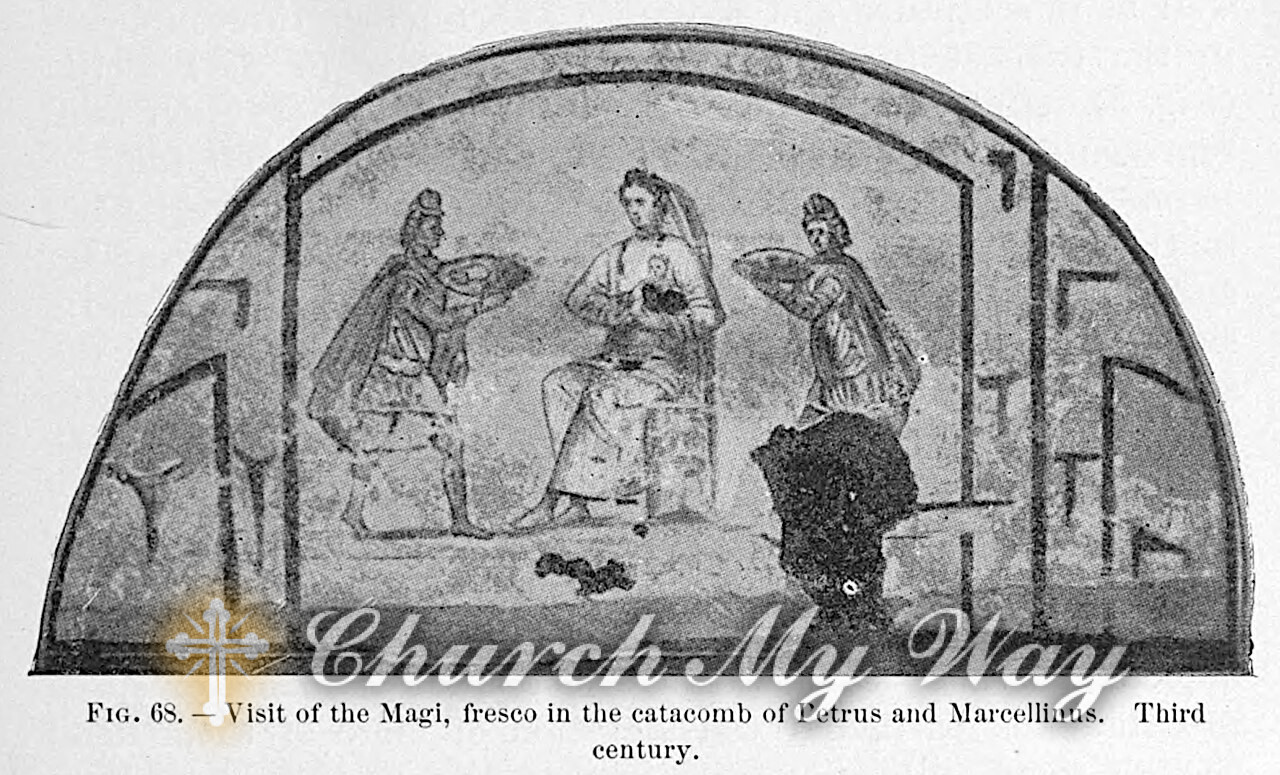
The earliest identifiable Christian images date from roughly the late second to early third century, appearing primarily in three contexts: catacomb frescoes, carved sarcophagi, and small domestic objects such as rings, lamps, and amulets. The catacombs of Rome—underground burial networks used by Christian communities—preserve some of the most significant examples, including the Catacomb of Priscilla and the Catacomb of Callixtus.
Catacomb Painting and the Language of Symbol
In these subterranean chambers, Christians painted scenes that combined Old Testament deliverance narratives with New Testament hope. Noah’s ark, Daniel in the lions’ den, Jonah swallowed by the fish, and the three Hebrews in the fiery furnace appear repeatedly. These were not random selections. Each image spoke of rescue from death—a theme of profound comfort in a burial context and a direct visual echo of passages like Psalm 23:4: “Even though I walk through the valley of the shadow of death, I will fear no evil.”
Jonah, in particular, carried layered meaning. Jesus himself had invoked the prophet as a sign of his own death and resurrection in Matthew 12:40: “For just as Jonah was three days and three nights in the belly of the great fish, so will the Son of Man be three days and three nights in the heart of the earth.” Early Christians read Jonah’s deliverance as a foreshadowing of Christ’s resurrection and, by extension, of the believer’s own hope beyond the grave.
The Good Shepherd and the Orant
Two images dominate the earliest Christian iconography. The first is the Good Shepherd, a youthful figure carrying a sheep—nearly indistinguishable in form from pagan depictions of Hermes Kriophoros (the ram-bearer) or Orpheus charming animals with music. The second is the orant, a figure standing with arms outstretched in prayer, a pose also used in pagan art for piety and petition. In Christian use, the orant came to represent the praying soul, often depicted as a woman, and was associated with intercession and hope.
These images demonstrate a key principle of early Christian visual theology: form was flexible, but meaning was fixed. A pagan viewer might see Orpheus; a Christian viewer saw Christ drawing all people to himself, an echo of John 12:32: “And I, when I am lifted up from the earth, will draw all people to myself.”
How Did Early Christian Art Reinterpret Specific Pagan Motifs?
The adaptation was neither wholesale nor uncritical. Early Christians exercised discernment, accepting some motifs, transforming others, and rejecting those too tightly bound to idolatrous worship. The table below summarizes how several key pagan motifs were received and repurposed.
| Pagan Motif | Original Pagan Meaning | Christian Reinterpretation | Scriptural Anchor |
|---|---|---|---|
| Good Shepherd (Hermes Kriophoros) | Divine messenger carrying a sacrificial ram | Christ the Shepherd who lays down his life | John 10:11–16 |
| Orant figure | Pietas—duty, devotion, prayer to the gods | The praying soul; intercession and hope | 1 Timothy 2:8 |
| Orpheus taming animals | Mythic musician whose song calms creation | Christ whose voice calls and gathers his flock | John 10:3–5 |
| Banquet scene (philosophical or funerary) | Fellowship, afterlife comfort in pagan cults | The Lord’s Supper; the messianic banquet | Luke 22:14–20; Revelation 19:9 |
| Peacock | Symbol of immortality (associated with Juno) | Resurrection and eternal life in Christ | 1 Corinthians 15:54–57 |
| Anchor | Nautical safety symbol | Hope in Christ, steadfastness of faith | Hebrews 6:19 |
The anchor is a striking example of direct scriptural borrowing. Hebrews 6:19 describes hope as “a sure and steadfast anchor of the soul,” and early Christians adopted the anchor symbol—sometimes stylized to resemble a cross—as a sign of confident faith. It appears frequently in catacomb inscriptions and on rings, often alongside the Greek word ichthys (fish), an acrostic for “Jesus Christ, Son of God, Savior.”
What Role Did the Fish, the Cross, and the Chi-Rho Play in Early Christian Art?
Symbols served a practical function in a context where open confession could invite persecution. The fish (ichthys) became one of the earliest and most widespread Christian signs, appearing in catacombs, on tombs, and in domestic settings. Its acrostic meaning—Iēsous Christos Theou Huios Sōtēr—packed the core of the gospel into a single recognizable image. The fish also evoked Jesus’ call of the disciples as “fishers of men” in Matthew 4:19 and the feeding of the five thousand in John 6:9–13.
The cross, surprisingly, was slow to appear as a visual symbol in early Christian art. Crucifixion was a shameful form of execution in Roman society, and depicting the cross openly would have invited scorn. Instead, Christians favored the anchor, the tau-rho, and eventually the chi-rho monogram (☧), formed from the first two letters of “Christ” in Greek. The chi-rho gained prominence in the fourth century, especially after Constantine’s reported vision before the Battle of the Milvian Bridge in AD 312, and it became a public emblem of Christian identity.
The transition from hidden symbols to public iconography marks a pivotal shift in early Christian art—one tied directly to the changing political and social status of the church.
How Did Early Christian Art Change After Constantine?
The Edict of Milan in AD 313, issued by Constantine and Licinius, granted Christians legal tolerance and marked the beginning of a dramatic transformation in Christian visual culture. What had been a largely private, funerary, and symbolic art form moved into public view—into basilicas, mosaics, sarcophagi, and imperial patronage.
From Symbol to Narrative
Pre-Constantinian art favored compact symbols and abbreviated scenes. Post-Constantinian art expanded into full narrative cycles: the life of Christ, the apostles, and the saints depicted in large-scale mosaics on church walls. The Basilica of Santa Maria Maggiore in Rome, decorated in the fifth century, preserves magnificent mosaics of the infancy narratives and the life of Moses, demonstrating how early Christian art had matured into a confident, public storytelling medium.
From Hidden to Triumphant
The iconography of Christ shifted as well. The youthful Good Shepherd gave way to the Christus Pantocrator—Christ the all-ruler, enthroned, often with a halo, holding a book or raising a hand in blessing. This image drew on imperial iconography: the posture of the emperor became the posture of Christ, a visual declaration that Jesus, not Caesar, was Lord. Philippians 2:9–11 provided the theological foundation: “God has highly exalted him and bestowed on him the name that is above every name.”
This adaptation of imperial imagery was not merely aesthetic. It was theological proclamation in a visual key—asserting the supremacy of Christ over all earthly powers, a theme the early church had confessed even when it cost them their lives.
What Can Early Christian Art Teach Us About Faith and Culture?
The story of early Christian art offers more than historical interest. It provides a model for how believers engage culture with discernment and creativity. Several principles emerge:
- Redemption, not rejection, of cultural forms. Early Christians did not abandon the visual language of their world; they redirected it toward the gospel. This reflects Paul’s approach in 1 Corinthians 9:22: “I have become all things to all people, that by all means I might save some.”
- Clarity of theological intent. Every borrowed motif was anchored in Scripture. The Good Shepherd was not merely a pleasant image but a claim about the nature and mission of Christ.
- Symbol as a vehicle for memory and hope. In a context of persecution and death, symbols like the anchor, the fish, and the orant gave believers a shared visual vocabulary of hope—a way of saying, without words, that death was not the end.
- Willingness to evolve. As the church’s circumstances changed, so did its art. The move from catacomb frescoes to basilica mosaics was not a compromise but an adaptation to new opportunities for witness.
These principles remain relevant for Christians navigating their own cultural contexts. The question is never whether to engage culture but how—with what theological clarity, what discernment, and what pastoral sensitivity.
Frequently Asked Questions About Early Christian Art
Did early Christians worship images?
No. The earliest Christian art was decorative, didactic, and symbolic rather than devotional in the later iconographic sense. Concerns about idolatry were real—Tertullian and others warned against the craft of idol-making—but Christians used images to teach, to remember, and to express hope, not to worship.
What is the oldest known Christian art?
Some of the earliest surviving examples date to the late second or early third century, including catacomb frescoes in Rome and the Alexamenos graffito (a mocking depiction of a crucified figure with a donkey’s head, likely from the early third century). The Dura-Europos church in Syria, dated to around AD 235, preserves some of the oldest known Christian wall paintings in a house-church setting.
Why did early Christians use symbols instead of direct depictions?
Symbols served multiple purposes: they communicated in times of persecution, they condensed complex theology into memorable forms, and they drew on scriptural imagery that believers already knew. The fish, anchor, and shepherd were not evasions but invitations—visual parables that rewarded reflection.
What Is the Lasting Legacy of Early Christian Art?
The legacy of early Christian art is not confined to museums or archaeological sites. It established a pattern of theological visual communication that shaped the entire history of Christian aesthetics—from Byzantine icons to Gothic cathedrals to Reformation-era printmaking. More importantly, it demonstrates that the gospel is not bound to any single cultural form. The earliest Christians took the visual language of their world, filled it with the truth of Scripture, and created something new.
Their example challenges every generation of believers to ask: What forms, what media, what cultural vocabulary is available to us—and how might we redeem it for the sake of the gospel? The answer will look different in every age, but the method remains the same: rooted in Scripture, attentive to culture, and confident that Christ is Lord over every image, every symbol, and every medium of human expression.
