📅 Last updated: 11.11.2026
The Didache on baptism offers one of the earliest, most concrete windows into how the first Christians actually practiced this sacred rite—not as later theologians theorized it, but as ordinary believers lived it in the decades after the apostles. Preserved in a first-century manual of church instruction, its baptismal chapter reads less like abstract doctrine and more like a working handbook: here is the water, here is the formula, here is the fast, here is what to do when the water runs short.
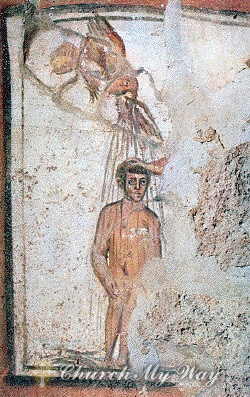
The Didache (chapters 7–8) teaches baptism “in the name of the Father and of the Son and of the Holy Spirit” in “living water”—that is, running water—preferably in a river or stream. If living water is unavailable, cold or warm standing water may be used; if neither is available, water may be poured three times on the head in the triune name. Both the baptizer and the candidate were to fast beforehand, and the Didache places baptism within a broader pattern of moral instruction, fasting, and prayer.
- What Is the Didache, and Why Does It Matter for Baptism?
- What Does the Didache Actually Say About Baptism?
- Why Does the Didache on Baptism Fast Before the Water?
- How Does the Didache Relate to the New Testament's Teaching on Baptism?
- What Did the Earliest Christian Writers Say About Baptism After the Didache?
- Was the Didache's Baptism by Immersion or Pouring?
- What Can the Didache on Baptism Teach the Church Today?
- Conclusion: The Enduring Witness of the Didache on Baptism
What Is the Didache, and Why Does It Matter for Baptism?
The Didache—its full title is the Teaching of the Lord through the Twelve Apostles to the Nations—is a short church manual discovered in 1873 by Philotheos Bryennios, the Greek Orthodox metropolitan of Nicomedia, in a manuscript at the Library of the Holy Sepulchre in Constantinople. The text itself is far older than that discovery. Most scholars date the Didache to the late first or early second century (roughly AD 50–120), with a strong majority placing its core material in the first century, possibly before the destruction of Jerusalem in AD 70. Its primitive character—no developed hierarchy, no fixed creeds, no mention of bishops as a distinct office beyond “bishops and deacons” in 15:1—points to a very early stage of church life.
The document divides naturally into four parts: the “Two Ways” moral catechesis (chapters 1–6), a ritual section on baptism, fasting, prayer, and the Eucharist (chapters 7–10), instructions on hospitality toward traveling prophets and teachers (chapters 11–13), and a closing section on Sunday assembly, bishops and deacons, and eschatological watchfulness (chapters 14–16). For our purposes, chapter 7 is the crown jewel—the earliest surviving baptismal rubric outside the New Testament itself.
Why does this matter? Because the Didache on baptism lets us hear the church’s practice before it became encrusted with later controversy. It is not a polemic against anyone. It is simply a pastor’s checklist, and that very ordinariness makes it historically priceless.
What Does the Didache Actually Say About Baptism?
Here is the text of Didache 7:1–4 in a faithful English rendering (based on the standard Greek critical text):
“Concerning baptism, baptize this way: Having first said all these things [i.e., the Two Ways teaching of chapters 1–6], baptize into the name of the Father, and of the Son, and of the Holy Spirit, in living water. But if you have no living water, baptize into other water; and if you cannot do so in cold water, do so in warm. But if you have neither, pour out water three times upon the head into the name of Father and Son and Holy Spirit. But before the baptism let the baptizer fast, and the baptized, and whoever else can; but you shall order the baptized to fast one or two days before.”
Several features stand out immediately. First, the trinitarian formula is fixed and non-negotiable—”into the name of the Father and of the Son and of the Holy Spirit”—echoing Matthew 28:19 almost verbatim. Second, the element is water, and the preferred form is immersion in running (“living”) water. Third, the Didache is remarkably practical and accommodating: it provides a descending scale of options for real-world conditions. Fourth, fasting precedes baptism for both parties. Fifth, the rite is preceded by catechesis—”having first said all these things” refers back to the moral instruction of the Two Ways.
The Priority of “Living Water”
“Living water” (hydōr zōn) is a biblical phrase with deep roots. In Jeremiah 2:13, God calls himself “the fountain of living waters.” In John 4:10–14, Jesus tells the Samaritan woman that he gives “living water” that becomes “a spring of water welling up to eternal life.” In John 7:37–39, he cries out at the Feast of Tabernacles, “If anyone thirsts, let him come to me and drink… out of his heart will flow rivers of living water”—which John explains as the Spirit. The Didache’s preference for running water is thus not arbitrary; it carries theological freight. Baptism into the triune name is a plunge into the living stream of God’s own life.
A Descending Scale of Pastoral Accommodation
The Didache’s four-tier hierarchy is worth laying out plainly, because it reveals a church that valued the sacrament’s substance over its circumstances:
- First choice: Immersion in living (running) water—a river, stream, or spring.
- Second choice: Immersion in standing water of any kind, if no running water is available.
- Third choice: Cold water is preferred over warm—likely reflecting the natural availability of cold water in rivers and cisterns, and possibly an early association of cold water with purity and vigor.
- Fourth choice (emergency): Pouring water three times on the head in the triune name, if no immersion is possible.
This is not a church obsessed with ritual precision. It is a church determined that no candidate be turned away for lack of a river. The mode bends; the name does not.
Why Does the Didache on Baptism Fast Before the Water?
The instruction to fast is one of the most distinctive elements of the Didache on baptism, and it is easy to pass over too quickly. “Before the baptism let the baptizer fast, and the baptized, and whoever else can; but you shall order the baptized to fast one or two days before” (7:4). Three observations are in order.
First, fasting here is not a meritorious work that earns baptism. It is preparation—a bodily posture of repentance and expectancy, like the fasting of Israel on the Day of Atonement (Leviticus 16:29–31) or the fasting of Nineveh at Jonah’s preaching (Jonah 3:5–9). It signals that something weighty is happening.
Second, the baptizer fasts too. This is striking. The one administering the sacrament is not a detached officiant but a fellow participant in the spiritual event. The whole community that “can” fast is drawn in. Baptism, in the Didache’s vision, is not a private transaction between a minister and a candidate; it is a churchly act of prayerful solidarity.
Third, the fast is tied to the Two Ways catechesis. The candidate has just been taught the way of life and the way of death (chapters 1–6). Fasting is the body’s “amen” to that teaching—a renunciation of the old way and a hunger for the new.
How Does the Didache Relate to the New Testament’s Teaching on Baptism?
The Didache does not invent baptism; it inherits it. Its trinitarian formula is a direct echo of the risen Christ’s command in Matthew 28:19: “Go therefore and make disciples of all nations, baptizing them in the name of the Father and of the Son and of the Holy Spirit.” Its insistence on water aligns with the whole New Testament witness—John the Baptist’s ministry (Mark 1:4–5), Jesus’ own baptism (Matthew 3:13–17), the Ethiopian eunuch’s confession and descent into water (Acts 8:36–38), and Peter’s Pentecost sermon (Acts 2:38–41).
The Didache’s preference for living water resonates with the New Testament’s rich water imagery. Paul describes baptism as burial and resurrection with Christ (Romans 6:3–4) and as the washing of regeneration (Titus 3:5). Peter speaks of baptism as an appeal to God for a good conscience through the resurrection of Jesus (1 Peter 3:21). The Didache’s running water—water that moves, that comes from somewhere and goes somewhere—is a fitting physical sign of these realities.
The fasting before baptism has New Testament precedent as well. Jesus fasted forty days before his public ministry (Matthew 4:1–2). The church at Antioch fasted before sending out Barnabas and Saul (Acts 13:2–3). Fasting and prayer regularly accompany momentous decisions and beginnings in Scripture.
What Did the Earliest Christian Writers Say About Baptism After the Didache?
The Didache is not an isolated witness. The generations immediately following it confirm and develop the same basic pattern. A comparative timeline helps situate the Didache on baptism within the wider stream of early Christian practice:
| Source & Date | Baptismal Practice Described | Key Emphasis |
|---|---|---|
| Didache (c. AD 50–120) | Triune formula; living water preferred; immersion or triple pouring; fasting before | Practical flexibility; catechesis and fasting precede |
| Justin Martyr, First Apology (c. AD 155) | Baptism after instruction and profession of faith; “illumination” | Voluntary faith; washing of repentance |
| Irenaeus of Lyons (c. AD 180) | Baptism “into the name of the Father, Son, and Holy Spirit” | Trinitarian faith as the rule of baptism |
| Tertullian, On Baptism (c. AD 200) | Immersion, triple immersion, pouring for the sick; fasting and prayer | Defense of water baptism; Spirit’s role |
| Apostolic Tradition (attrib. Hippolytus, c. AD 215) | Triple immersion after renunciations; anointing; bishop’s laying on of hands | Developed liturgical sequence |
Justin Martyr, writing about a century after the Didache’s core, describes baptism as the culmination of repentance and faith: candidates are brought to water, “washed” in the name of the triune God, and afterward join the assembly for common prayer (1 Apology 61). Tertullian’s On Baptism (c. AD 200) defends the necessity of water against a sect that rejected it, and he notes that “we are plunged” in water three times, “answering something more than the Lord has prescribed”—a hint that the triple immersion was already customary in his day. The Apostolic Tradition, traditionally associated with Hippolytus of Rome, preserves a fuller sequence: renunciation of Satan, anointing, threefold immersion with threefold confession, anointing, and the bishop’s hand-laying for the Spirit.
What emerges from this comparative view is a remarkable continuity. The trinitarian name, the element of water, and the close link between baptism and conversion are constant from the Didache onward. What develops is the surrounding liturgy—anointings, renunciations, the Spirit’s hand-laying—not the core. The Didache on baptism sits at the headwaters of this stream.
Was the Didache’s Baptism by Immersion or Pouring?
This is one of the most frequently asked questions about the Didache on baptism, and the honest answer is: both, in a fixed order of preference. The Didache is not a polemic for one mode. It prescribes immersion in living water as the norm, allows immersion in standing water, and permits triple pouring on the head as a fallback. The Greek verb underlying the immersion instructions is baptizein, from baptō, “to dip” or “to plunge”—the same verb used throughout the New Testament.
The triple pouring clause is instructive. It likely reflects situations where water was scarce or where the candidate was ill or infirm—a pastoral concession, not a replacement of the norm. The fact that the Didache specifies three times for the pouring mirrors the threefold pattern of the triune name and anticipates the triple immersion that Tertullian later describes. The church clearly cared about the name spoken over the water more than the precise geometry of the water itself.
This flexibility is not indifference. It is a theological priority: the sacrament’s power rests in God’s promise attached to the triune name, not in the volume of water or the architecture of the font. The Didache on baptism thus offers a model of liturgical seriousness without liturgical rigidity—a balance that would serve the church in every subsequent century.
What Can the Didache on Baptism Teach the Church Today?
The Didache’s baptismal chapter is short—four verses—but it carries several lessons that remain live for contemporary believers, whatever their tradition.
- Baptism belongs to the whole church, not a lone professional. The Didache has the baptizer fasting alongside the baptized and invites “whoever else can” to join. Baptism is a communal act of prayer and support.
- Preparation matters. The Two Ways catechesis and the pre-baptismal fast assume that baptism is the beginning of a transformed life, not a formality. Candidates were taught before they were washed.
- The name is the anchor. Water, mode, and circumstance all bend; the triune name does not. The church’s confidence rests in the One into whose name we are baptized.
- Practical flexibility is a virtue. The descending scale from river to stream to cistern to poured water shows a church that would rather baptize someone in a cup of water than turn them away for lack of a river.
These principles cut across denominational lines. A congregation that immerses in a river and a congregation that sprinkles from a font can both find their instinct in the Didache—the first in its preference for living water, the second in its provision for pouring when immersion is impossible. The document refuses to make an idol of either.
Conclusion: The Enduring Witness of the Didache on Baptism
The Didache on baptism is a small window into a large reality. It shows us a church that had received the risen Lord’s command in Matthew 28:19 and was working it out with pastoral wisdom: baptize in the name of the Father, Son, and Holy Spirit; prefer running water; adapt when you must; fast and pray beforehand; teach the candidate the way of life before you wash them in the water of life. It is not a systematic theology of baptism. It is something arguably more valuable—a snapshot of the church actually doing what the Lord commanded, in the ordinary conditions of first-century life.
For the modern reader, the Didache’s witness is both humbling and clarifying. Humbling, because the earliest Christians took baptism with a seriousness—catechesis, fasting, community prayer—that puts much casual practice to shame. Clarifying, because it reminds us where the center of gravity lies: not in the mode of water or the shape of the font, but in the triune name spoken over the water and the faith of the one going down into it. The Didache does not settle every later debate about baptism. It does something better: it shows us the stream at its source, running clear and living, and invites us to drink.
