📅 Last updated: 24.10.2026
Walk into the Roman catacombs beneath the Via Appia and you will meet a surprising sight: a young man carrying a ram across his shoulders, a sun-charioteer racing across a vaulted ceiling, a hero with a lion’s skin and a club. Early Christian art borrowed these images wholesale from the pagan world around it—and then quietly rewrote their meaning from the inside out. The result was not compromise but translation: a visual gospel preached in the only pictorial language the ancient Mediterranean knew.
The earliest Christian art (roughly 200–400 AD) deliberately adopted Greco-Roman pagan motifs—shepherd figures, the Orpheus musician, the sun god’s chariot, Hercules, peacocks, and vines—and reinterpreted them to communicate biblical truth. Rather than importing pagan religion, early Christians used familiar visual forms as a bridge for the gospel, a practice consistent with Paul’s missionary principle of becoming “all things to all people” (1 Corinthians 9:22).
- Why Did Early Christian Art Speak the Language of Paganism?
- How Early Christian Art Reinterpreted the Good Shepherd
- Orpheus, Hercules, and the Sun: Three Pagan Heroes Recast
- A Timeline of Early Christian Art and Its Pagan Borrowings
- What Did Common Pagan Symbols Mean to Christian Believers?
- Was This Borrowing Compromise or Genius?
- What Can Early Christian Art Teach the Church Today?
- Conclusion: The Gospel Wrote in Borrowed Letters
Why Did Early Christian Art Speak the Language of Paganism?
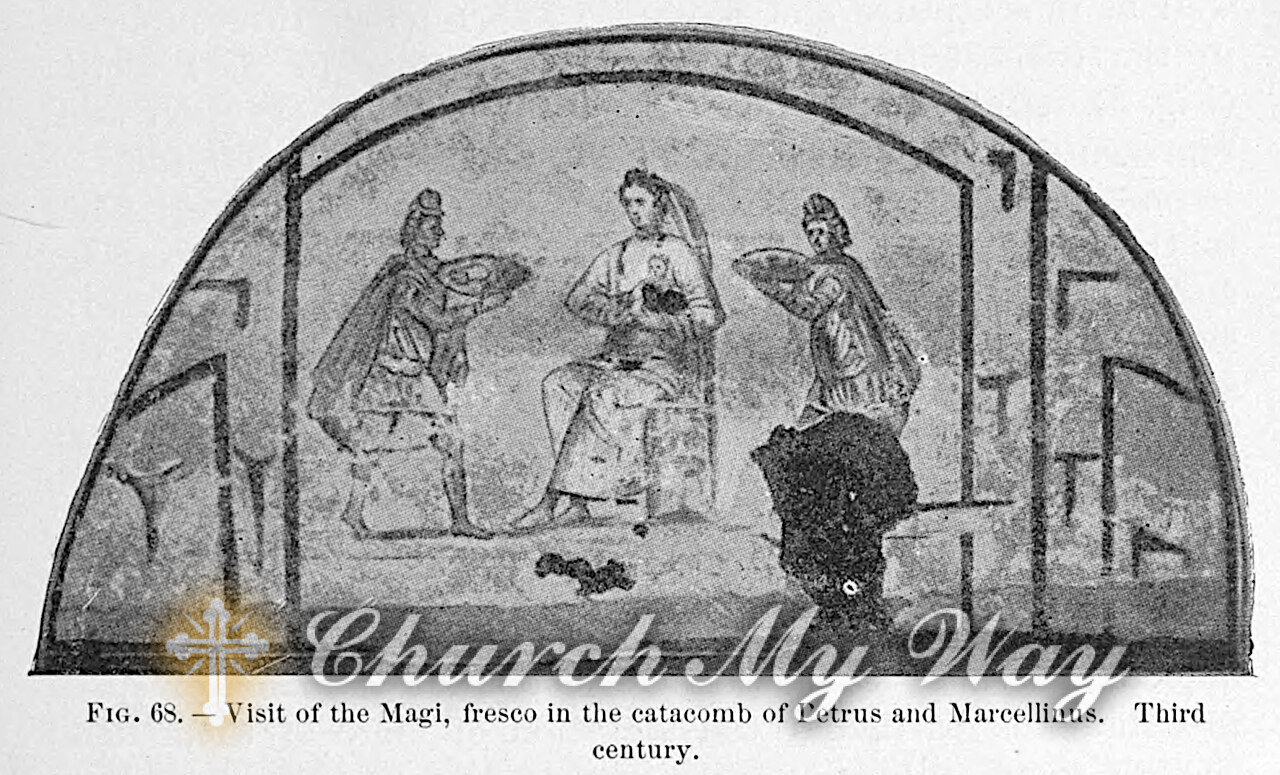
The first three centuries of the church produced almost no identifiable Christian art. The reasons were practical as much as theological. Christians were a small, often persecuted minority, and the second commandment’s prohibition of graven images (Exodus 20:4) made many believers wary of anything resembling idolatry. The catacomb frescoes that begin appearing around 200 AD mark a decisive shift—and they appear precisely where Christians felt free to paint: in burial chambers, not temples.
Those chambers were decorated by artisans trained in the Roman visual vocabulary. A fresco painter in third-century Rome had no “Christian style” to draw on; he had the iconographic toolkit of his trade—shepherds, banquets, mythic heroes, pastoral landscapes. The church did not reject that toolkit. It baptized it.
The Missionary Logic of Visual Translation
Paul articulated the underlying principle in 1 Corinthians 9:20–22: “To the Jews I became like a Jew, to win the Jews… I have become all things to all people so that by all possible means I might save some.” Early Christian art applies that logic to images. A Roman viewer already knew what a shepherd meant—care, protection, leadership. Already knew what a vine meant—life, fertility, abundance. Already knew what a peacock meant—immortality, because ancient belief held the bird’s flesh did not decay. The church took those readymade meanings and filled them with Christ.
This was not syncretism, the blending of religions. It was semiotic conversion: the same form, a new referent. The distinction matters enormously for how we read these images today.
How Early Christian Art Reinterpreted the Good Shepherd
The single most common image in early Christian art is the shepherd carrying a sheep. It appears in the Catacomb of Callixtus, in the Catacomb of Priscilla, on sarcophagi, on oil lamps, and eventually in the Mausoleum of Galla Placidia in Ravenna. To a Roman eye, the kriophoros (ram-bearer) was a stock pastoral figure, sometimes associated with the god Hermes as protector of flocks. Christians saw something else entirely.
The image fuses two biblical texts. First, Psalm 23:1—”The LORD is my shepherd”—a verse every Jewish believer knew by heart. Second, Jesus’ own words in John 10:11: “I am the good shepherd. The good shepherd lays down his life for the sheep.” In the catacomb paintings, the shepherd is often a beardless young man in Roman dress, carrying the lost sheep on his shoulders—a direct visual quotation of the parable in Luke 15:4–7, where the shepherd leaves the ninety-nine to find the one.
From Hermes to Christ in a Single Stroke
What changed in the transfer? Everything that mattered. The pagan ram-bearer depicted generic protection; the Christian shepherd depicted substitutionary sacrifice. Some catacomb shepherds stand beside a sheep entangled in briars or resting on a rock, and in a few instances the shepherd’s pose echoes the crucifixion posture—arms outstretched—centuries before crucifixion imagery itself became common. The form was borrowed; the theology was new.
Orpheus, Hercules, and the Sun: Three Pagan Heroes Recast
Three mythological figures recur in early Christian art with striking frequency, each repurposed for gospel proclamation.
Orpheus and the Power of the Word
In pagan myth, Orpheus charmed beasts, trees, and stones with his lyre. In the Catacomb of Domitilla and elsewhere, Christ appears in Orpheus’ pose—seated, playing an instrument, surrounded by attentive animals. The church was not suggesting Christ was a myth. It was making an argument: the true Orpheus is here. The one who tames the wild creation with his voice is the eternal Word through whom “all things were made” (John 1:3), the one of whom the psalmist wrote, “He spoke, and it came to be” (Psalm 33:9).
Hercules and the Hero Who Conquers
Hercules—Heracles to the Greeks—was the archetypal strong man who endured labors and descended to the underworld. Christian sarcophagi occasionally place Christ in Hercules’ iconographic role: the conquering hero who descends into death and returns victorious. The theological fit is exact. Colossians 2:15 describes Christ “having disarmed the powers and authorities… triumphing over them by the cross.” The pagan hero’s strength pointed to a real conquest the gospel claimed had already occurred.
Sol Invictus and the Light of the World
The most audacious borrowing appears in a third-century vault mosaic beneath St. Peter’s Basilica and in the Catacomb of the Julii: Christ depicted as the sun god, driving a chariot across the sky. Sol Invictus—the “Unconquered Sun”—was the official imperial cult of the late third century. Christians took its most recognizable image and applied it to Jesus, who declared in John 8:12, “I am the light of the world,” and whom the prophet Malachi foresaw as “the sun of righteousness” rising “with healing in its wings” (Malachi 4:2).
The timing was pointed. When the emperor Aurelian established Sol Invictus as state religion in 274 AD, Christians responded not with iconoclasm but with reclamation: the true unconquered Sun is not the emperor’s patron but the risen Christ.
A Timeline of Early Christian Art and Its Pagan Borrowings
The following table traces the key developments in how early Christian art appropriated and transformed classical imagery.
| Period | Key Development | Pagan Source Reinterpreted | Christian Meaning |
|---|---|---|---|
| c. 200–250 AD | First catacomb frescoes in Rome (Callixtus, Priscilla, Domitilla) | Good Shepherd (kriophoros) | Christ the Shepherd (John 10:11; Psalm 23) |
| c. 230–260 AD | Orpheus frescoes; baptismal scenes with pagan pastoral motifs | Orpheus charming the beasts | Christ the eternal Word (John 1:1–3) |
| c. 250–300 AD | Julii catacomb vault: Christ as sun-charioteer | Sol Invictus | Christ the light of the world (John 8:12) |
| c. 270–320 AD | Christian sarcophagi use Hercules and classical hero poses | Hercules as conquering hero | Christ triumphant over death (Colossians 2:15) |
| c. 313 AD | Edict of Milan; Christian art emerges into public view | Imperial iconography and court ceremony | Christ as King and Judge (Revelation 19:16) |
| c. 350–430 AD | Ravenna mosaics; crucifixion imagery begins to develop | Classical traditio legis and imperial motifs | Christ handing the Law to Peter and Paul |
What Did Common Pagan Symbols Mean to Christian Believers?
Beyond named heroes, early Christian art filled its spaces with ordinary classical symbols and gave each a gospel charge. These symbols appear on rings, lamps, tombstones, and mosaic floors—the everyday objects of ancient Christian life.
- The peacock: Ancient naturalists believed the peacock’s flesh was incorruptible. Christians adopted the bird as a symbol of resurrection and eternal life, pointing to 1 Corinthians 15:42—”sown in corruption, raised in incorruption.”
- The vine and grapes: A staple of Dionysian imagery, the vine became Christ’s own self-designation in John 15:5: “I am the vine; you are the branches.” Eucharistic scenes in the Catacomb of Callixtus place grapes and bread directly in this frame.
- The fish (ichthys): A Greek acrostic—Iesous Christos Theou Huios Soter (“Jesus Christ, Son of God, Savior”)—converted a common marine motif into a confession of faith and a covert sign of identity.
- The anchor: A standard nautical symbol turned into a picture of hope, drawn directly from Hebrews 6:19: “We have this hope as an anchor for the soul, firm and secure.”
- The dove: Familiar from Roman decorative art, it became the emblem of the Holy Spirit descending at Jesus’ baptism (Matthew 3:16) and of the peace of Noah’s flood (Genesis 8:11).
None of these symbols carried pagan religious content into Christian worship. They were common visual grammar—the equivalent of using the alphabet of a non-Christian culture to write the name of Christ.
Was This Borrowing Compromise or Genius?
The question has been asked since the Renaissance, and it deserves a direct answer. The borrowing was neither naive nor syncretistic. It was a considered strategy with clear boundaries.
First, the content of pagan religion was always excluded. No Christian catacomb depicts Jupiter as a god to be worshiped, no Christian sarcophagus invokes Venus as a deity. The images were stripped of cultic function and repurposed as narrative and symbolic vehicles.
Second, the transformation was always visible. When Christ appears as Orpheus, he is not labeled Orpheus; the surrounding biblical scenes (Daniel in the lions’ den, the raising of Lazarus, the three Hebrews in the furnace) frame him as the God of Israel. The context controls the meaning.
Third, the church’s own theologians drew the line. Clement of Alexandria, writing around 200 AD in his Exhortation to the Greeks, explicitly criticized Christians who used pagan cult images while simultaneously urging the adoption of worthy symbols—the dove, the fish, the anchor, the ship. Tertullian and later Augustine argued similarly: forms can be redeemed; idols cannot be served. The practice of early Christian art reflects that settled conviction.
The Incarnational Principle at Work
There is a deeper theological logic here. The incarnation itself is the pattern: God took human flesh—a form already existing in the world—and filled it with divine personhood. Philippians 2:7 says Christ “emptied himself, taking the form of a servant.” Early Christian art did something analogous with images: it took forms already circulating in the culture and filled them with the person and work of Christ. The borrowing was not the church’s compromise with the world; it was the church’s imitation of the incarnation.
What Can Early Christian Art Teach the Church Today?
The catacomb painters left a working model for every generation that must communicate the gospel inside a culture it did not create. Several lessons stand out.
- Translate, don’t retreat. The early church did not wait for a purified visual culture before making art. It entered the existing visual language and converted it from within.
- Let context carry the meaning. The same shepherd image could serve paganism or the gospel depending on what surrounded it. Christians surrounded borrowed forms with biblical narrative, and the narrative governed the interpretation.
- Keep the theological center fixed. The images changed; the message did not. Every borrowed motif pointed to the person, death, and resurrection of Jesus Christ—the unchanging core Paul summarized in 1 Corinthians 15:3–4.
- Trust the form’s capacity for redemption. The church believed no visual language was too pagan to be redeemed, just as no person is too lost to be saved.
For believers today, the application is direct. The cultural forms around us—film, music, digital media, design—are not neutral, but neither are they beyond redemption. The question is not whether to use them but whether we will fill them with the same Christ-centered content the catacomb painters did.
Conclusion: The Gospel Wrote in Borrowed Letters
Early Christian art is one of the most remarkable acts of cultural translation in the history of the church. In dark underground chambers, artisans took the shepherd of Hermes and made him the Shepherd of Psalm 23. They took the musician Orpheus and made him the Word of John 1. They took the chariot of Sol Invictus and made it the light of John 8:12. They took the hero Hercules and made him the conqueror of Colossians 2:15. None of it compromised the gospel; all of it proclaimed it.
The lesson endures for every believer who wonders how to speak of Christ in a culture that does not share the church’s vocabulary. The answer of the catacombs is not to build a separate language but to enter the one already spoken—and to fill it with the name above every name. The early Christians did not invent a new visual world. They redeemed the one they had. That is still the church’s calling, and it is still the church’s privilege.
