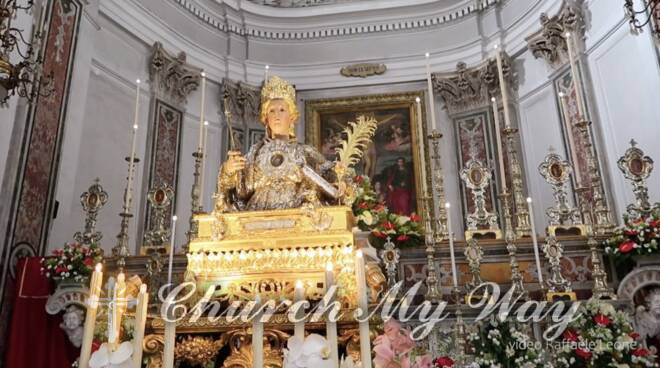
Minori celebrates its patron saint, St. Trofimena
Wednesday 13 July Minori, a tourist village in the center of the Amalfi coast, celebrates its patron saint, Trofimena Ve M, a damsel from Patti / Messina.
This date recalls the day of arrival – the return to Minori of the saints remains, coming from Benevento, after a stop in a church in the historic center of Salerno, returned because stolen by the Benevento prince, Ricardo.
Welcomed with great jubilation of the people who wanted to keep them, then, in an arch-safe place to preserve them from other unscrupulous acts of the usual malicious “nobles”.
Centuries ago, the minor newborn girls bore the name Trofimena in honor of the saint of whom the Minorese, and not only, were faithful, respectful, and fearful.
Then the habit vanished for more “, EXOTIC” names until he returned for a few years: in fact, there are many newborn girls to whom the observant parents impose the name of the Virgin TROFIMENA. Wherever you go and meet a woman named Trofimena, she must necessarily have either a birth relationship or the affection of some relative in Minori. Of course still this year solemn celebrations but with parsimony and attention to the resurgent health problem which, even if not obsessively, still upsets the habits of many citizens.
Many, myself included, would like to allocate the funds raised for the celebrations to humanitarian works and to strengthen the lacking and worrying local health.
Deepening the Devotion: The Living Legacy of Santa Trofimena
While the historical narrative of Santa Trofimena’s arrival is the cornerstone of the feast, the living traditions that have grown around her over centuries offer a richer, more textured understanding of her importance. The celebration is not merely a historical reenactment but a vibrant, multi-sensory experience that engages the entire community and its visitors in a profound dialogue between faith, culture, and identity. To witness the Festa di Santa Trofimena is to step into a living tapestry where every thread—from the floral decorations to the culinary specialties—has a story to tell.
Practical Tips for Experiencing the Festa
For travelers seeking to move beyond the role of passive observer and respectfully engage with the celebration, a little preparation goes a long way. Firstly, understand that the July 13th date is the climax, but festivities often begin days earlier with novenas (prayer services), musical concerts in the piazza, and the illumination of the town with decorative lights. Arriving a day or two prior allows you to feel the building anticipation. On the main day, secure a spot along the procession route early, but remember that for residents, this is a deeply spiritual moment; a position with a good view that doesn’t obstruct the family chapels or altars is considerate.
Secondly, dress appropriately. While the Amalfi Coast is a tourist hotspot, this is first and foremost a religious event. Modest attire is recommended, especially if you plan to enter the Basilica. Comfortable shoes are non-negotiable, as you will likely be standing or walking on ancient, uneven stone paths for hours. Finally, engage with locals politely. Asking simple questions like “Scusi, che ora inizia la processione?” (Excuse me, what time does the procession start?) shows interest. Avoid treating sacred moments, like the lifting of the statue, as a mere photo opportunity; observe when locals put away their phones and follow their lead.
A Common Mistake to Avoid
The most frequent misstep visitors make is conflating the celebration with a generic Italian street festival. The Festa di Santa Trofimena is not a sagra (food festival) or a secular historical pageant. The central focus is the veneration of the Saint’s relics and her spiritual protection over Minori. Therefore, prioritizing the search for a dinner table over witnessing the emotional ‘ntruono (the return of the statue to the basilica) misses the essence of the event. Similarly, while the atmosphere is joyful, it is punctuated by moments of solemn prayer and poignant hymn-singing. Maintaining a respectful volume and demeanor during these times is crucial. Don’t make the mistake of seeing the procession as a parade; it is a moving prayer.
Expert Insight: The Symbolism in the Details
According to cultural anthropologists who study Mediterranean patron saint festivals, every element of the Festa di Santa Trofimena is laden with meaning. The statue itself is a key artifact. The specific way she is dressed, often in rich fabrics and jewels donated as ex-votos (fulfillments of vows), represents the community’s gratitude. The act of carrying the heavy statue through the narrow streets is not just a display of strength but a ritual reaffirmation of the bearers’ (portatori) faith and their physical connection to their protector.
Furthermore, the maritime element is profound. The blessing of the sea, often part of the festivities, is not a quaint tradition but a vital economic and spiritual plea. For centuries, Minori’s prosperity was tied to the Mediterranean. Blessing the waters acknowledges this dependence and seeks the Saint’s intercession for the safety of fishermen and, now, the tourist boats. The fireworks over the sea are not just a spectacle; they are a symbolic offering of light and joy to the Saint, reflecting her glory over the community’s natural domain.
Fascinating Facts and Lasting Impressions
Beyond the well-known story, intriguing details abound. The Basilica di Santa Trofimena sits atop a Roman villa, and some scholars suggest the early Christian veneration of Trofimena may have strategically incorporated local pagan water-deity cults associated with the nearby Reginna Minor river. The saint’s very journey—from Sicily, to Salerno, to Benevento, and back to Minori—mirrors the complex political and religious networks of medieval Southern Italy.
The culinary tradition is also part of the feast. It is common for families to prepare a specific pasta dish, often with seafood from the blessed waters, or to share zeppole (fried dough pastries) after the procession. Seeking out these traditional foods, perhaps from a local home kitchen or a trattoria offering a “menu della festa,” completes the sensory experience. Ultimately, the most enduring impression for any visitor is likely to be the sight of the statue moving like a ship on a sea of uplifted hands through the candlelit streets, a powerful metaphor for a community steadfastly navigating the tides of history, held aloft by a shared, unwavering faith.
📅 Last updated: 21.12.2025
❓ Frequently Asked Questions
💬 Who is the patron saint of Minori, Italy?
The patron saint of Minori is Saint Trofimena. She was a young woman from Patti, Messina, whose remains are venerated in the town after being returned from Benevento centuries ago.
💬 When is the feast day of Saint Trofimena celebrated?
The feast day of Saint Trofimena is celebrated on July 13th in Minori. This date commemorates the return of her remains to the town after they were stolen.
💬 What is the origin of the name Trofimena?
The name Trofimena originates from the patron saint of Minori. Historically, many newborn girls in Minori were given this name, a tradition that faded but has seen a revival in recent years among observant families.
This post is also available in:
 Español (Spanish)
