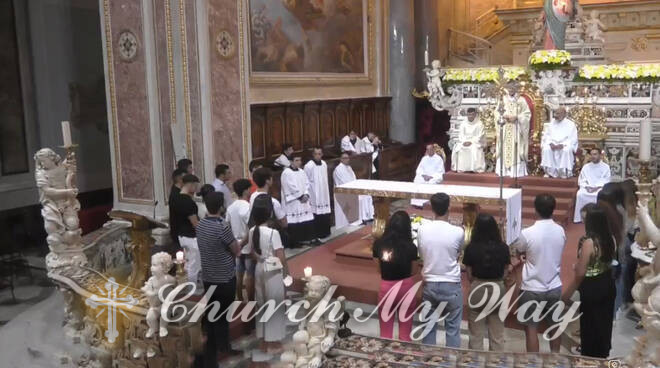
Piano di Sorrento, Don Pasquale blesses the boys who will face the final exams tomorrow: “We are waiting for you all to return winners”
Piano di Sorrento. Tomorrow morning, June 22, over 500 thousand students in the last year of high school will be engaged in writing in Italian and will start the final exam 2022 which, after the pandemic, returns with the two written tests in the presence plus the oral one. It is the famous night before exams, made of fear and emotion.
And tonight, in the Basilica of San Michele Arcangelo the end of the Eucharistic celebration Don Pasquale Irolla wanted to bless the children of the parish who tomorrow will face the first test of maturity. And so he made them go up to the altar and, before marking them one by one with a cross on their foreheads, he addressed these words to them: “We look at you on this night before exams. It is the night of passing from one age to another, from having everything comfortable to facing alone. We look into each other’s eyes to encourage you, to tell you that we await you all winners again.
This is the night you need to rest because tomorrow you will have a lot of energy to consume. Tomorrow all the notions will be released, the thoughts buried and unearthed for centuries within you so it is good that you now remove everything from notes, diagrams, and anything else to make your thoughts settle down because you are asked for a personal word. The baccalaureate exam is not remembering what is written in the book.
The vote will say nothing about your person. You can be a realized person and get 60 or a failure tomorrow and get 100 today and then get lost in college, go from love to love, and get lost.
The expectations that you feel behind the backs of our generation go and throw in the toilet because now what you are is emerging.
I wish you to come out bright. This is a birth, it is worth it, you will learn many things. Above all it is nice that from tonight onwards you begin to test yourselves because it is true that we are together on the altar, you are together as friends, but then there are moments when you are alone in life and it is the exams, they are the decisive choices.
Where God sustains you from the depths of your heart, inspiring you, giving you strength.
Certainly, I wish you that you can come out victors, play all that is buried within you, that desire for God that I wish you can emerge and be happy. And this calls for suffering, desire, constancy, and even play. The baccalaureate is a game. I bless you and I promise you that tonight I pray for you to review yourself until you come back here and say: “It was good, it went well” ».
Beyond the Blessing: Practical Wisdom for Exam Day
While the spiritual and emotional preparation offered by figures like Don Pasquale is invaluable, facing the final exams also requires a grounded, practical approach. The transition he speaks of—from comfort to independence—is mirrored in the shift from collective study to individual performance. To walk into that exam room feeling truly prepared, a few strategic steps can make all the difference.
Expert Advice for Peak Performance
Educational psychologists often emphasize the power of routine on high-stress days. Firstly, do not attempt to cram new information this late. As Don Pasquale suggested, let your thoughts settle. Your brain consolidates memory during rest, so a good night’s sleep is a more powerful tool than a last-minute review session. On the morning of the exam, eat a balanced breakfast with complex carbohydrates and protein for sustained energy, and arrive at school with a comfortable margin of time to avoid the cortisol spike that comes with rushing.
During the exam itself, a common and costly mistake is diving straight into writing. Experts unanimously advise spending the first 10-15 minutes carefully reading all prompts and options, then creating a brief, structured outline. This roadmap prevents meandering arguments and saves time in the long run. Remember, the examiners are looking for a coherent, well-argued “personal word,” not just a data dump. Allocate your time wisely per section and leave a window at the end for review and correction.
Interesting Facts & Historical Context
The Italian “Esame di Maturità” has a rich and evolving history that today’s students become a part of. Instituted in its modern form by Minister Giovanni Gentile in 1923, it was originally an exam reserved for the elite attending the *liceo classico*. The very name “Maturità” speaks to the philosophy behind it: it is meant to assess not just knowledge, but intellectual and personal maturity. The format has undergone numerous reforms, from the rigorous, multi-day “theme” exams of the past to the experimental models during the pandemic. This year’s return to the traditional written tests reconnects students with a long-standing academic rite of passage, a shared experience across generations that, despite the anxiety, creates a unique national bond.
Another fascinating element is the psychology of the “night before,” which is almost a cultural institution in itself. The mix of collective anxiety, last-minute gatherings, and symbolic gestures—like the blessing in Piano di Sorrento—serves a social function. It transforms individual stress into a communal experience, allowing students to feel supported not just by family, but by their entire community. This shared vulnerability can, paradoxically, be a source of strength.
Navigating the Aftermath: The Real Victory
Don Pasquale’s poignant remark that “the vote will say nothing about your person” is a crucial perspective to hold onto, especially after the exams conclude. The post-exam period can be anticlimactic, filled with nervous waiting and the pressure of university admissions. It’s important to remember that this exam is a milestone, not a definition. The true “win” lies in the skills honed during preparation: sustained focus, critical analysis, managing deadlines, and coping with pressure. These are the tools that will serve in university and beyond, regardless of the numerical outcome.
Finally, celebrate the effort, not just the result. The journey through five years of upper secondary school, particularly the last two years shadowed by a pandemic, demonstrates remarkable resilience. Whether the path leads to university, a professional institute, or the world of work, the experience of having faced this challenge head-on, supported by both faith and practical preparation, is itself a form of maturity. The community awaits not just “winners” by grade, but young adults who have grown through the process, ready to write the next chapter of their own stories with confidence and clarity.
📅 Last updated: 20.12.2025
❓ Frequently Asked Questions
💬 What is the “notte prima degli esami” (night before exams) in Italy?
In Italy, the “notte prima degli esami” refers to the night before the high school final exams (esame di maturità), a culturally significant moment of anxiety and anticipation for students. It is often marked by last-minute studying, gatherings with classmates, and in some communities, special events like blessings for the students.
💬 How did the Italian high school final exam (maturità) change in 2022?
In 2022, the Italian final exam returned to its traditional pre-pandemic format, reinstating two mandatory written tests in addition to the oral exam. This marked a shift from the simplified versions used during the COVID-19 pandemic, which often consisted of only an oral examination.
💬 What advice is given to students for the Italian written exam?
A key piece of advice is to move beyond simply memorizing notes and book content. Students are encouraged to settle their thoughts and focus on formulating a personal, original response, as the exam asks for their own critical analysis and expression.
