📅 Last updated: 21.11.2026
The Sistine Chapel ceiling, painted by Michelangelo Buonarroti between 1508 and 1512, is the most ambitious fresco cycle ever executed by a single artist — a 12,000-square-foot expanse of vaulting covered with more than 300 figures drawn from Genesis, the prophets, and the ancestors of Christ. Commissioned by Pope Julius II and painted almost entirely standing upright on scaffolding with his arm arched overhead, the ceiling transformed Western art and left the Church a visual catechism that still teaches, convicts, and consoles five centuries later.
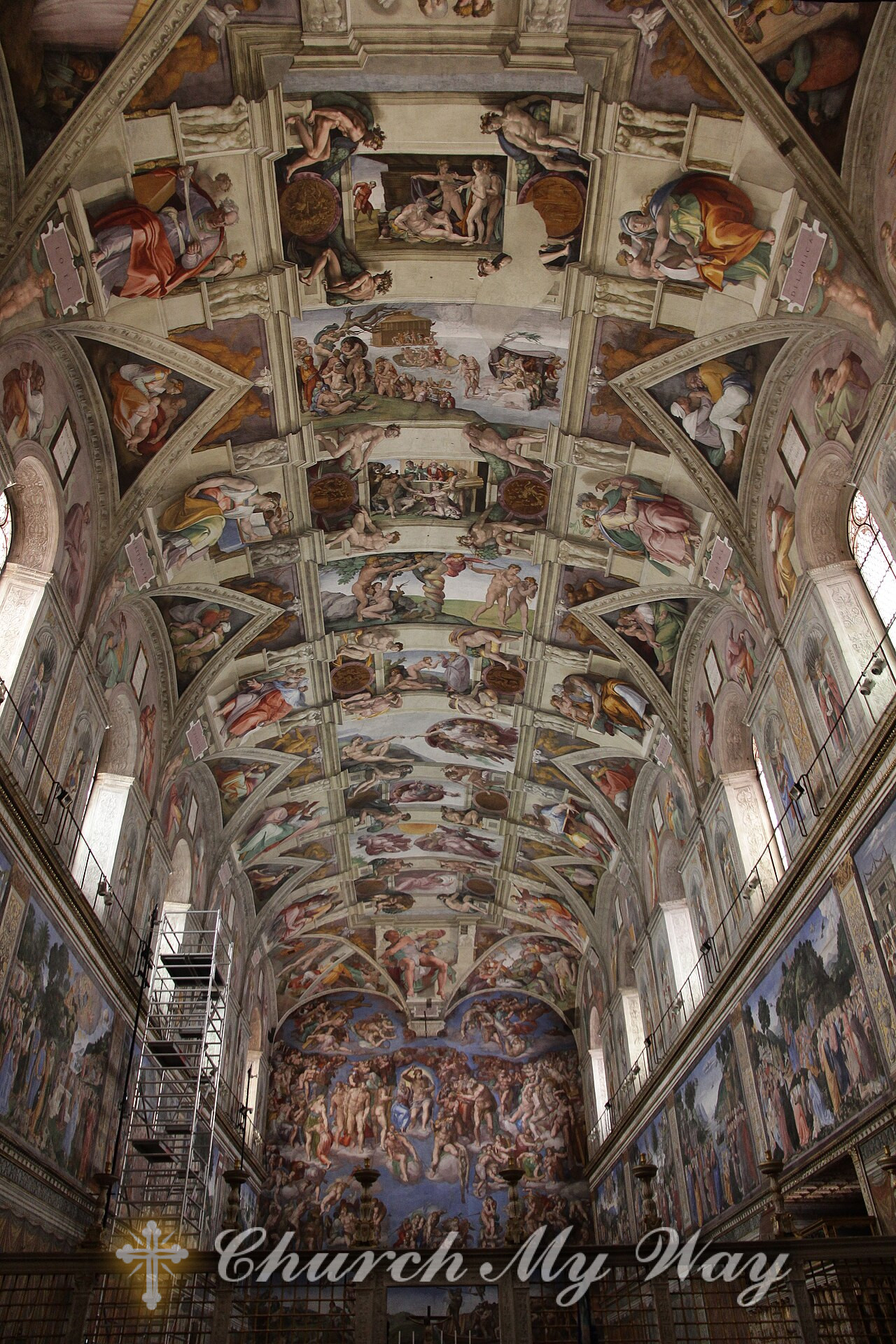
The Sistine Chapel ceiling is a fresco cycle painted by Michelangelo between 1508 and 1512 for Pope Julius II, covering roughly 12,000 square feet of the chapel’s vault with nine Genesis scenes at its center, flanked by prophets, sibyls, ancestors of Christ, and corner narratives. Michelangelo worked standing on a wooden scaffold with wet plaster and pigment, completing the first half in about two years and the second in under a year.
- What Is the Sistine Chapel Ceiling, and Why Does It Matter?
- How Did Michelangelo Come to Paint the Sistine Chapel Ceiling?
- How Was the Sistine Chapel Ceiling Painted? The Technique and the Teams
- What Does the Sistine Chapel Ceiling Actually Depict? A Tour of the Program
- Timeline of the Sistine Chapel Ceiling
- What Is the Theology of the Sistine Chapel Ceiling?
- What Was the Sistine Chapel Ceiling's Impact on Art and the Church?
- How Can Modern Believers Read the Sistine Chapel Ceiling?
- What Does the Sistine Chapel Ceiling Teach Us About Faith and Art?
- Frequently Asked Questions About the Sistine Chapel Ceiling
- A Lasting Perspective: Why the Sistine Chapel Ceiling Still Speaks
What Is the Sistine Chapel Ceiling, and Why Does It Matter?
The chapel itself predates the ceiling by half a century. Pope Sixtus IV built it between 1473 and 1481 as the papal chapel of the Vatican Palace — hence “Sistine” — and it was consecrated on the Feast of the Assumption, August 15, 1483. Its side walls were frescoed by a team of Quattrocento masters: Perugino, Botticelli, Ghirlandaio, Rosselli, and Signorelli. Above their work stretched a plain blue vault sprinkled with gold stars, painted in the 1480s by Piermatteo d’Amelia. For roughly twenty-five years, that starry sky was the ceiling.
Julius II changed that. Elected in 1503, the “Warrior Pope” was a patron of almost Napoleonic self-conception, and he wanted a ceiling worthy of the see he was rebuilding. According to Michelangelo’s own later account in a letter to his friend Giovanni Francesco Fattucci (1523), the pope first asked him to paint the twelve apostles in the lunettes, with the vault left in its ornamental star pattern. Michelangelo countered with a far vaster scheme: the whole vault, an architectural framework painted in illusion, populated with the story of creation and fall. The pope consented, and the project grew into something neither man could have fully foreseen.
Its significance is threefold. Artistically, it broke the scale of what one painter could attempt and redefined the human figure as an instrument of theological expression. Theologically, it is a coherent program — not a random anthology of Bible stories — that moves from creation to the birth of Christ. Historically, it marks a hinge between the restrained harmonies of the early Renaissance and the expressive power of the High Renaissance and Mannerism. For the Church, it remains a permanent, public proclamation of Scripture in pigment.
How Did Michelangelo Come to Paint the Sistine Chapel Ceiling?
Michelangelo (1475–1564) did not want the job. He considered himself a sculptor first — his David had been unveiled in Florence in 1504, and he had just begun work on a tomb for Julius II in 1505 that he believed would be his masterpiece. Painting fresco, a medium that demands rapid execution on wet lime plaster, was not his specialty in 1508. His early biographer Ascanio Condivi, writing with Michelangelo’s cooperation, records that the artist tried to decline and even suggested that Raphael be given the commission instead. Julius was not a man who accepted no.
The usual story that Michelangelo painted lying on his back is a legend. He designed his own scaffold — a wooden platform on brackets projecting from the walls, not resting on the floor — and worked standing, head tilted back, brush and pigment held overhead. He left a famous comic sonnet to Fattucci describing the physical torment: “My beard toward Heaven, I feel the back of my brain / Upon my neck… I am bent like a Syrian bow.” Fresco painting is unforgiving; pigment must be applied to fresh lime plaster that dries within hours, so each day’s work — a giornata — had to be planned, drawn on paper (a cartone), transferred by pouncing, and completed before the plaster set.
How Was the Sistine Chapel Ceiling Painted? The Technique and the Teams
The ceiling is buon fresco — true fresco — meaning the pigment was applied to wet lime plaster and became chemically part of the wall as the lime cured and formed calcium carbonate. Michelangelo could not correct mistakes without chipping away the plaster and starting again; he did so, notably, on the first three Genesis panels, which were redone after the plaster grew moldy from too much water in the mix. This is why the earliest scenes — the Sacrifice of Noah, the Flood, and the Drunkenness of Noah — show a more crowded, smaller-figured style than the later, more monumental panels. Scholars like Fabrizio Mancinelli and the Vatican Museums’ restoration team (1980–1994) documented these changes in detail.
Michelangelo did not work alone. He brought a team of assistants, mostly Florentine painters, from Florence in 1508 — among them Francesco Granacci, Giuliano Bugiardini, and several garzoni (apprentices). He dismissed most of them within months, dissatisfied with their work, and kept a smaller core, including the talented Jacopo l’Indaco (Jacopo Torni). Michelangelo designed every figure; his assistants executed secondary elements, prepared plaster, and mixed pigments. The sheer logistics — the color palette, the scaffold design, the sequence of painting from the entrance wall toward the altar wall — required a project manager as much as a painter.
What Does the Sistine Chapel Ceiling Actually Depict? A Tour of the Program
The painted architecture divides the vault into zones. Along the central spine, framed by painted cornices and separated by five pairs of thrones, are nine rectangular panels from Genesis. Reading from the altar end (the east) back toward the entrance (the west) — the direction a cardinal or pope would face when entering — the sequence runs:
The Nine Central Panels
- The Separation of Light from Darkness — the opening act of creation, God in a swirling, almost abstract form.
- The Creation of the Sun, Moon, and Plants — God shown twice, from front and back, commanding the cosmos.
- The Separation of Land from Sea — the waters divided, the first habitable earth.
- The Creation of Adam — the most famous image in Western art: God’s outstretched finger meeting Adam’s, the divine spark of Genesis 2:7 (“the LORD God formed the man from the dust of the ground and breathed into his nostrils the breath of life”).
- The Creation of Eve — Eve drawn from Adam’s side, God’s hand raised in blessing (Genesis 2:21–22).
- The Fall and Expulsion from Eden — the serpent, the fruit, and the angel driving the pair out (Genesis 3).
- The Sacrifice of Noah — the first altar after the flood (Genesis 8:20).
- The Flood — humanity’s desperation, the ark on the horizon.
- The Drunkenness of Noah — the patriarch’s shame and his sons’ covering (Genesis 9:20–23).
The Flanking Figures
Around the central panels, Michelangelo placed the great prophetic voices of Scripture. In the spandrels and pendentives — the triangular and curved spaces at the vault’s edges — sit seven Old Testament prophets: Isaiah, Jeremiah, Ezekiel, Daniel, Joel, Zechariah, and Jonah. Alongside them are five sibyls — the Cumaean, Delphic, Erythraean, Persian, and Libyan — pagan prophetesses whom Christian tradition, following Virgil’s Fourth Eclogue and early Christian apologists, read as foreshadowing Christ’s birth. The pairing is deliberate: the whole world, Jewish and Gentile, spoke of a coming Redeemer.
Between the windows, in the lunettes, are the ancestors of Christ — the genealogy of Matthew 1:1–17 rendered as families of ordinary, weary-looking people. In the four corner spandrels, the great deliverance stories of the Old Testament appear: David and Goliath, Judith and Holofernes, the Brazen Serpent, and Haman’s downfall — all types of salvation through divine intervention. Around the central panels, smaller nude figures (the ignudi) hold garlands of oak, the della Rovere emblem of Julius II, and frame the sacred history with classical grace.
Timeline of the Sistine Chapel Ceiling
| Date | Event | Significance |
|---|---|---|
| 1473–1481 | Construction and frescoing of the Sistine Chapel under Sixtus IV | The chapel’s walls are painted by Perugino, Botticelli, and others; ceiling is a starry vault |
| 1503 | Julius II elected pope | Patronage of the ceiling becomes possible |
| 1508 | Michelangelo commissioned; work begins | Scaffold erected; first Genesis panels painted |
| 1509–1510 | First half completed (Noah cycle and flanking figures) | Plaster problems force reworking of early panels |
| 1511–1512 | Second half completed (Creation and Fall) | Faster pace; more monumental figures |
| October 31, 1512 | Ceiling unveiled for All Saints’ Eve | Public revelation of the finished vault |
| 1536–1541 | Michelangelo paints The Last Judgment on the altar wall | Later, darker counterpart to the ceiling |
| 1980–1994 | Vatican restoration of the ceiling | Removes centuries of grime and varnish; restores original color |
What Is the Theology of the Sistine Chapel Ceiling?
The ceiling is not decoration; it is doctrine in fresco. Its central axis tells the story of sin and its remedy. Creation gives way to fall; the fall gives way to the flood and the covenant with Noah; and the whole sequence points forward to the Incarnation, which is why the ancestors of Christ — the human chain of Matthew’s genealogy — ring the vault’s lower edge. The prophets and sibyls announce the coming of the Messiah; the deliverance scenes in the corners prefigure the salvation He brings. Read together, the program is a visual rendering of the arc Paul summarizes in Romans 5:12–19: sin entered through one man, and grace came through one man, Jesus Christ.
The Creation of Adam deserves particular attention because it captures the ceiling’s theological heart. God the Father, borne by a swirling mantle of wind and angels, reaches toward Adam, who reclines on the earth, languid and newly made. Their fingers do not quite touch — a gap that has fascinated interpreters for centuries. Whether Michelangelo intended it as a deliberate breath of suspense or as a compositional necessity, the image holds the moment of Genesis 2:7: dust receiving life. Adam’s posture — passive, receptive — is a portrait of grace. He does not grasp at God; God comes to him.
The prophets are equally instructive. Jeremiah slumps in shadowed grief, his hand on his chin, his eyes downcast — the “weeping prophet” who lamented Jerusalem’s fall (Jeremiah 1:4–10; Lamentations). Isaiah turns toward the altar, listening to the seraph’s cry of “Holy, holy, holy” (Isaiah 6:1–8). Ezekiel, mouth open, receives the scroll (Ezekiel 2:8–3:3). Jonah reclines beneath the gourd vine, a reluctant prophet who becomes a type of Christ’s resurrection (Matthew 12:39–41). Each figure is a distinct personality, not a generic saint — Michelangelo read his Scripture closely and painted it as lived experience.
What Was the Sistine Chapel Ceiling’s Impact on Art and the Church?
The ceiling changed the direction of Western art. Before 1512, the High Renaissance had been dominated by the balanced, harmonious compositions of Raphael and Leonardo. Michelangelo’s vault introduced a new muscularity, a new freedom in foreshortening and anatomy, and a new emotional register. Raphael, who reportedly saw the first half of the ceiling while it was still in progress, adjusted his own work in the Vatican Stanze in response. Later painters — Pontormo, Rosso Fiorentino, and the Mannerists — took Michelangelo’s contorted figures as their starting point. By the time he painted The Last Judgment on the altar wall (1536–1541), the ceiling had already become the benchmark against which all monumental painting was measured.
For the Church, the ceiling was a catechetical instrument in an age before mass literacy. A worshipper standing in the chapel could look up and see the whole sweep of salvation history, from the first breath of life to the promise of a Redeemer. It was also a statement of papal authority: Julius II, the patron, had summoned the greatest living artist to make the see of Rome the center of Christendom’s visual culture. The ceiling survived the sack of Rome (1527), the Counter-Reformation’s anxieties about nudity (which led to Daniele da Volterra’s later additions of drapery to the Last Judgment, not the ceiling), and the long centuries of candle smoke and grime. The 1980–1994 restoration, controversial at the time for its bright results, revealed colors Michelangelo’s contemporaries would have recognized — a reminder that even great art can be obscured by the accretions of time.
How Can Modern Believers Read the Sistine Chapel Ceiling?
The ceiling rewards slow, scriptural looking. It is easy to photograph the Creation of Adam and move on, but the vault is meant to be read as a sequence, the way a medieval congregation read a stained-glass window. A few practical approaches:
- Read the Genesis panels in order, from the altar end back toward the entrance, and note how the figures grow larger and more monumental as the story moves from creation to fall — Michelangelo’s own theological pacing.
- Pair each prophet with his biblical text — Isaiah 6, Jeremiah 1, Ezekiel 2, Daniel 7, Joel 2, Zechariah 3, Jonah 1–4 — and notice how the painted posture matches the prophetic message.
- Look for the ancestors of Christ in the lunettes and remember Matthew 1: the genealogy that leads to the manger is a chain of ordinary, flawed people, not heroes.
- Stand in the chapel and read Romans 5 alongside the vault: the ceiling is a visual argument for the grace Paul describes.
What Does the Sistine Chapel Ceiling Teach Us About Faith and Art?
Michelangelo was not a theologian by training, but he was a serious reader of Scripture — his sonnets and letters show a lifelong engagement with Dante, the Psalms, and Pauline theology, and his later years were marked by a deepening, sometimes anguished, piety. The ceiling reflects that: it is not sentimental, and it does not flatter. Adam is languid; the prophets are burdened; the flood is terrifying. Yet the whole vault bends toward hope. The God who reaches toward Adam is the God who, in the words of John 3:16, so loved the world that He gave His only Son. The ceiling’s final word, read from the altar, is not judgment but promise.
There is also a lesson in the making of it. Michelangelo began the ceiling reluctantly, worked through illness, plaster failures, and a pope who pressured him to finish faster, and produced something that has outlasted every empire that surrounded it. The artist’s own sonnet to Fattucci, complaining of his twisted neck and paint-spattered face, is a reminder that great works of faith are usually made in ordinary, uncomfortable obedience — not in moments of inspiration but in daily, patient labor. The ceiling is a monument to that labor, and to the Scripture it serves.
Frequently Asked Questions About the Sistine Chapel Ceiling
How long did Michelangelo take to paint the Sistine Chapel ceiling?
About four years, from 1508 to 1512. The first half, covering the Noah cycle and the flanking prophets and sibyls, took roughly two years; the second half, the Creation and Fall panels, was completed in under a year as Michelangelo’s confidence and technique accelerated.
Did Michelangelo paint the ceiling lying down?
No. He stood upright on a wooden scaffold he designed himself, head tilted back, working overhead. The “lying on his back” story is a later legend, contradicted by his own sonnet describing his physical strain.
How many figures are on the Sistine Chapel ceiling?
More than 300 individual figures, including the nine central Genesis panels, seven prophets, five sibyls, the ancestors of Christ in the lunettes, the ignudi, and the corner deliverance scenes.
Was the Sistine Chapel ceiling painted on wet or dry plaster?
It is true fresco — buon fresco — painted on wet lime plaster, which binds the pigment permanently to the wall as it cures. This required rapid, planned work and explains why Michelangelo reworked some early panels.
A Lasting Perspective: Why the Sistine Chapel Ceiling Still Speaks
Five centuries after its unveiling on the eve of All Saints’ Day in 1512, the Sistine Chapel ceiling remains a singular achievement: a work of art that is also a work of theology, a commission that became a confession. It was painted by a reluctant sculptor who complained about his aching neck and then produced the most influential fresco cycle in history. It survived war, restoration, and the scrutiny of millions of visitors, and it still does what it was made to do — lift the eyes of the worshipper from the floor of a chapel to the story of creation, fall, and redemption.
For the believer, the ceiling is a reminder that Scripture is not confined to the page. It can be painted, sung, carved, and lived. When Michelangelo set the finger of God reaching toward the finger of Adam, he was translating Genesis 2:7 into color and form. When he set Jeremiah in shadow and Isaiah in light, he was reading the prophets as men who carried the weight of their message. The vault does not replace the Bible; it sends the viewer back to it. That is the mark of faithful Christian art — it does not compete with the Word but serves it, and points beyond itself to the God who spoke the world into being and then, in the fullness of time, came to redeem it.
