📅 Last updated: 14.10.2026
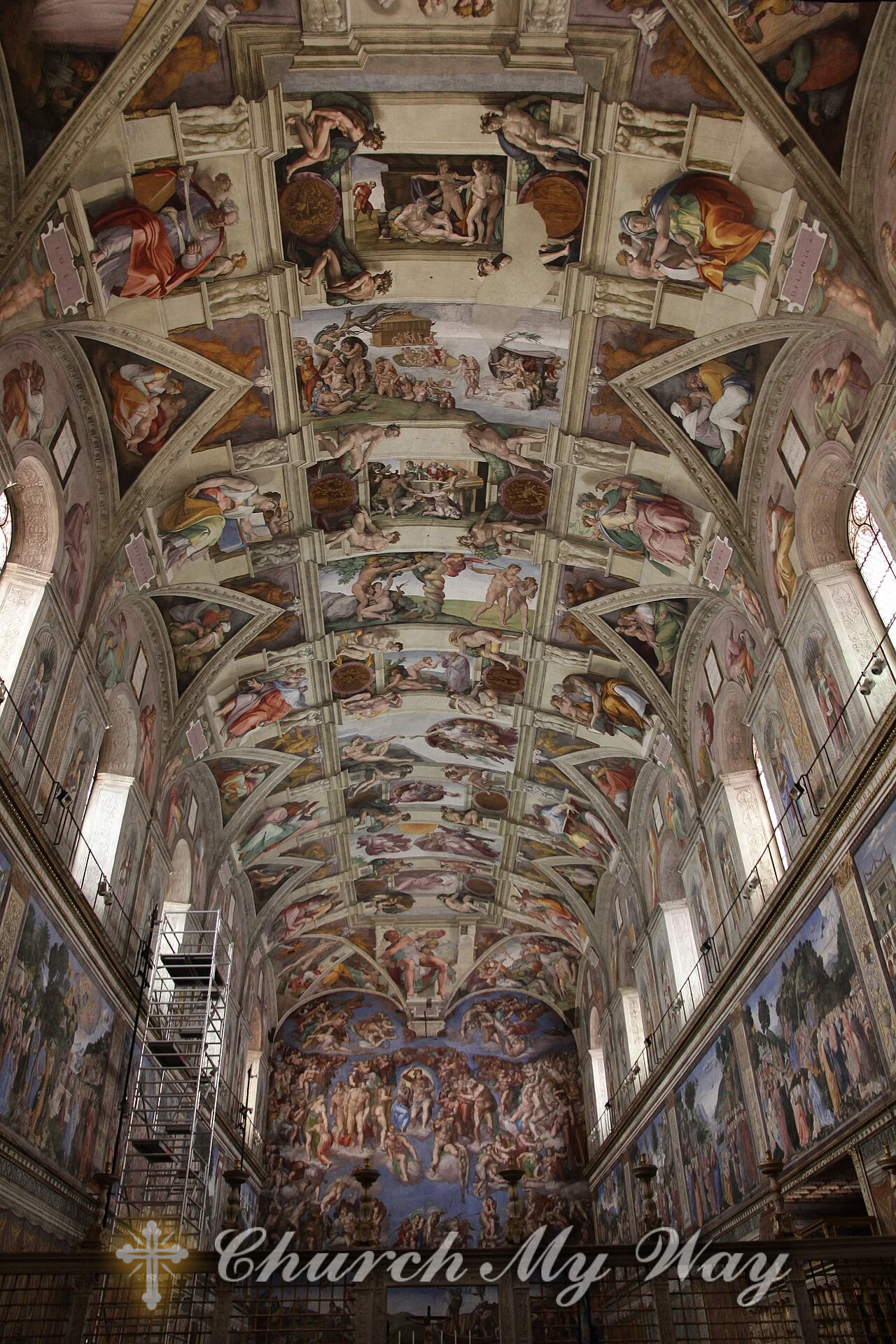
Sistine Chapel theology is the study of the doctrinal program Michelangelo Buonarroti embedded in the ceiling and altar wall of the papal chapel between 1508 and 1541—a visual catechism of creation, fall, covenant, redemption, and final judgment drawn directly from Scripture and Catholic tradition. The ceiling (1508–1512) narrates salvation history from Genesis to the ancestors of Christ, while the Last Judgment (1536–1541) confronts every viewer with the risen Christ as judge and redeemer. Together they form one of the most sustained theological arguments ever painted.
Sistine Chapel theology holds that Michelangelo’s frescoes are not decoration but doctrine: the ceiling presents humanity’s creation, fall, and need for salvation through nine Genesis scenes and the prophets and sibyls who foretold Christ, while the Last Judgment completes the arc by portraying Christ as both merciful Savior and righteous Judge. The program affirms that history moves under divine providence toward resurrection and accountable hope.
- Why the Sistine Chapel Is a Theological Document, Not Just Art
- What Are the Nine Central Scenes of the Sistine Chapel Ceiling?
- Who Are the Prophets and Sibyls, and Why Do They Matter?
- How the Spandrels, Pendentives, and Ancestors Fit the Sistine Chapel Theology
- What Is the Theology of Michelangelo's Last Judgment?
- How Sistine Chapel Theology Interprets Scripture Through Image
- What Sistine Chapel Theology Means for Believers Today
- Frequently Asked Questions About Sistine Chapel Theology
- A Lasting Perspective: Reading the Chapel as Scripture in Color
Why the Sistine Chapel Is a Theological Document, Not Just Art
Most visitors look up and see anatomy, color, and scale. Michelangelo intended them to see an argument. Pope Julius II commissioned the ceiling in 1508, and the artist—who considered himself a sculptor, not a painter—initially resisted. What emerged over four years was not a random anthology of biblical highlights but a structured sequence with a beginning, a center, and an end.
The chapel itself shaped the meaning. Built for Sixtus IV between 1473 and 1481, it was the pope’s private chapel and the site of conclaves. Its walls already carried frescoes by Botticelli, Perugino, Ghirlandaio, and Rosselli depicting the lives of Moses and Christ—the two covenants running in parallel. Michelangelo’s ceiling completed that scheme by supplying the prehistory: the origins of the human race and the lineage that would produce the Messiah.
This is why art historians and theologians speak of a single iconographic program rather than isolated masterpieces. The ceiling answers a question the wall frescoes raise: who is this Christ, and why did the world need him?
What Are the Nine Central Scenes of the Sistine Chapel Ceiling?
Down the spine of the vault, framed by painted architectural ribs, Michelangelo placed nine narrative panels drawn from Genesis. They are traditionally grouped in three triads, and the grouping is theologically deliberate.
The Three Triads of Genesis
The first triad concerns creation: God separating light from darkness, God separating the waters and creating the firmament, and God separating land from sea and creating plant life. The second triad concerns humanity and its fall: the creation of Adam, the creation of Eve, and the temptation and expulsion from Eden. The third triad concerns the consequences of sin and the survival of hope: the sacrifice of Noah, the flood, and the drunkenness of Noah.
The movement is unmistakable. God creates by ordering and separating; humanity undoes that order by disobedience; and after judgment, a remnant endures. The sequence anticipates the entire biblical narrative of redemption without ever leaving the first book of Moses.
The Creation of Adam and the Theology of the Image of God
The Creation of Adam is the most reproduced image in Western art, and its theology is exact. Genesis 1:26–27 records that God said, “Let us make man in our image, after our likeness.” Michelangelo renders that moment not as physical manufacture but as transmission—the Creator’s outstretched finger nearly touching the newly formed man’s hand, with the spark of life about to pass between them. Adam is fully formed yet inert until God imparts life, echoing Genesis 2:7: “then the LORD God formed the man of dust from the ground and breathed into his nostrils the breath of life, and the man became a living creature.”
The near-touch is the visual signature of imago Dei theology: human dignity is received, not self-generated. Whatever else the Renaissance said about human potential, Michelangelo placed its source outside the human frame.
The Fall and Its Aftermath
The temptation panel compresses Genesis 3 into a single field, showing the serpent, the taking of the fruit, and the expulsion in one sweep. The theological claim matches Romans 5:12: “sin came into the world through one man, and death through sin.” The ceiling does not soften the fall into metaphor. It presents it as the hinge on which human history turns—and the reason a Savior will be necessary.
Who Are the Prophets and Sibyls, and Why Do They Matter?
Flanking the Genesis panels, seated on painted thrones, are seven Hebrew prophets and five classical sibyls. This pairing is one of the boldest theological moves in the chapel.
The prophets—Isaiah, Jeremiah, Ezekiel, Daniel, Joel, Zechariah, and Jonah—represent the covenant line that spoke within Israel. Their presence on the ceiling ties directly to the wall frescoes of Moses below and to the New Testament claim that the prophets anticipated Christ. Isaiah 7:14 supplies the classic text: “Therefore the Lord himself will give you a sign. Behold, the virgin shall conceive and bear a son.”
The sibyls—Persian, Erythraean, Cumaean, Delphic, and Libyan—were pagan oracles whom ancient and medieval Christian writers, following figures such as Lactantius and Augustine, read as unwitting witnesses to the same truth. The Erythraean Sibyl, for instance, was widely cited in the Middle Ages for verses interpreted as predicting a coming judgment. Michelangelo’s inclusion of them does not relativize Scripture; it universalizes the reach of providence. God’s preparation for the gospel extended beyond one nation.
This is the same logic Paul uses at Athens in Acts 17:22–31, where he tells pagan philosophers that the unknown god they already venerate is the one now proclaimed. The ceiling makes that argument in paint.
How the Spandrels, Pendentives, and Ancestors Fit the Sistine Chapel Theology
The corners, arches, and triangular spandrels carry figures often overlooked: the ancestors of Christ listed in Matthew’s genealogy, along with the deliverance stories of David and Goliath, Judith and Holofernes, and the bronze serpent.
Matthew 1:1–17 traces Jesus’ lineage through named generations—Abraham, Isaac, Jacob, David, and onward. Michelangelo paints these ancestors not as heroic portraits but largely as ordinary families, some weary, some distracted, some asleep. The point is incarnational: the Messiah enters a real human line, with all its ordinariness.
The deliverance scenes reinforce the pattern of rescue. In Numbers 21:8–9, Moses lifts up a bronze serpent in the wilderness and whoever looks at it lives; Jesus applies that image to himself in John 3:14–15. Judith’s beheading of Holofernes (Judith 13) and David’s defeat of Goliath (1 Samuel 17) are stories of the weak overcoming the strong through divine aid. Placed high above the chapel, they function as small-print commentary on the large narrative: God saves by unexpected means.
What Is the Theology of Michelangelo’s Last Judgment?
Nearly a quarter century after finishing the ceiling, Michelangelo returned to paint the altar wall. Completed in 1541 under Pope Paul III, the Last Judgment occupies the entire wall behind the altar—the first thing a celebrant faces.
Christ as Judge and Redeemer
At the center stands Christ, not the gentle shepherd of popular imagination but a muscular, risen figure with arm raised. Below and around him, the dead rise, the saved ascend, and the damned are drawn downward. The theological anchor is Matthew 25:31–46, where the Son of Man separates the nations as a shepherd separates sheep from goats, and Revelation 20:11–15, where the books are opened.
Michelangelo’s Christ is not wrathful for its own sake. His raised hand echoes the creative gesture of the ceiling’s Creation of Adam—the same power that gives life now calls it to account. The visual rhyme is intentional. Creation and judgment are acts of the same Lord.
Mary, the Saints, and the Communion of Saints
Mary sits beside Christ, her posture subdued, her gaze downward. Around them are apostles and martyrs holding the instruments of their deaths—Peter’s keys, Bartholomew’s flayed skin, Lawrence’s gridiron. Revelation 6:9–11 describes the martyrs beneath the altar crying out for justice; Michelangelo places them in the air around the Judge. The communion of saints is not an abstraction here. It is a crowd.
The Controversy Over Nudity and the Council of Trent
The fresco’s unclothed figures provoked immediate objection. Critics such as Pietro Aretino and later Cardinal Carafa attacked the work as indecorous. In 1564, shortly after the Council of Trent issued its decree on sacred images, Daniele da Volterra and others were commissioned to paint drapery over the offending anatomy—earning him the nickname Il Braghettone, “the breeches-maker.”
The Council of Trent’s 1563 decree affirmed that images of Christ, Mary, and the saints are to be honored, not worshiped, and that they serve to instruct the faithful—precisely the function Michelangelo’s program already served. The dispute was about propriety, not doctrine.
| Period | Work | Patron | Theological Focus |
|---|---|---|---|
| 1473–1481 | Wall frescoes (Moses and Christ cycles) | Sixtus IV | Law and Gospel in parallel |
| 1508–1512 | Ceiling | Julius II | Creation, fall, covenant, prophecy |
| 1515–1519 | Tapestries (Raphael cartoons) | Leo X | Apostolic mission |
| 1536–1541 | Last Judgment | Paul III | Resurrection, judgment, mercy |
| 1564–1565 | Drapery additions | Pius IV | Decorum after Trent |
How Sistine Chapel Theology Interprets Scripture Through Image
The ceiling and altar wall were painted in an era when most worshipers could not read Latin Scripture, let alone own a Bible. Images carried doctrinal weight. Pope Gregory the Great had articulated the principle centuries earlier: images are the books of the illiterate, teaching what text teaches.
Michelangelo’s choices reflect that responsibility. He does not invent episodes; he selects and sequences them. The nine Genesis panels omit the Tower of Babel and the call of Abraham, concentrating instead on creation, fall, and flood—the three movements that explain why redemption is needed. The prophets and sibyls supply the promise. The Last Judgment supplies the outcome.
Read alongside Scripture, the chapel becomes a coherent curriculum:
- Genesis 1–3 establishes creation, human dignity, and the fall.
- Genesis 6–9 shows judgment and preservation through Noah.
- Isaiah, Jeremiah, Ezekiel, Daniel announce a coming deliverer.
- Matthew 1 and 25 connect the lineage of Jesus to the final separation of nations.
- Revelation 20 supplies the framework for the altar wall.
This is not proof-texting. It is the liturgical logic of the chapel itself, where the Mass is celebrated beneath a painted summary of the whole economy of salvation.
What Sistine Chapel Theology Means for Believers Today
The frescoes were made for a specific place and purpose, but their claims are not confined to the sixteenth century. Several applications follow directly from the program.
Human Dignity Is Received, Not Earned
Adam’s near-touch in the Creation of Adam grounds human worth in God’s initiative. Genesis 1:27 is not a slogan about potential; it is a statement about origin. Every person bears an image that was given, not achieved.
Sin Is Real and Consequential
The fall panels do not permit a purely optimistic anthropology. Romans 3:23 states that “all have sinned and fall short of the glory of God.” Michelangelo paints that condition before he paints its remedy, and the order matters.
Judgment Is Certain, and Mercy Is Offered
The Last Judgment is not designed to produce terror alone. Christ’s raised arm is the same arm that gave life on the ceiling. Hebrews 9:27 says it is appointed for man to die once and after that comes judgment—but John 3:17 adds that God sent the Son not to condemn the world but that the world might be saved through him. The altar wall holds both truths in tension.
History Has a Direction
The chapel’s arrangement—creation, fall, prophecy, incarnation implied on the walls, final judgment—asserts that history is not cyclical or random. It moves toward a consummation. That conviction shaped how generations of Christians read their own lives, and it remains a corrective to the assumption that the present order is all there is.
Frequently Asked Questions About Sistine Chapel Theology
Did Michelangelo design the theological program himself?
The degree of his personal authorship is debated. He consulted theologians, and the program likely reflects input from papal advisers and possibly the Augustinian theologian Egidio da Viterbo. What is not disputed is that Michelangelo executed the scheme with unusual coherence and made deliberate visual connections—most notably between the creative gesture on the ceiling and the judicial gesture on the altar wall.
Why are pagan sibyls in a Christian chapel?
Because patristic and medieval tradition read them as Gentile witnesses to divine truth. Their inclusion parallels Paul’s argument in Acts 17 and the broader Christian claim that all nations were prepared for the gospel.
Is the Last Judgment meant to frighten or comfort?
Both, depending on the viewer’s position. For the oppressed and the martyred, the judgment is vindication. For the complacent, it is warning. Michelangelo gives the saved and the damned equal visual weight, refusing to resolve the tension the way a simpler propaganda piece would.
A Lasting Perspective: Reading the Chapel as Scripture in Color
Stand in the Sistine Chapel and look up, then turn around. You have moved from Genesis to Revelation in a single room. The ceiling begins with light separated from darkness and ends with the ancestors of Christ waiting for a promise. The altar wall begins with Christ risen and ends with the books opened. Between those two poles lies the whole biblical story, and Michelangelo painted it so that a worshiper who could read nothing could still understand everything essential.
Sistine Chapel theology is finally pastoral. It answers the questions the human heart actually asks: Where did I come from? Why is the world broken? Is there a deliverer? Will there be justice? The answers are not argued in a treatise. They are laid out in plaster and pigment across five thousand square feet, and they have been teaching the faithful for more than five centuries. The same God who breathed life into Adam on the ceiling will one day call every life to account—and the same Christ who judges is the Christ who saves. That is the doctrine the chapel was built to declare, and it has not aged a day.
