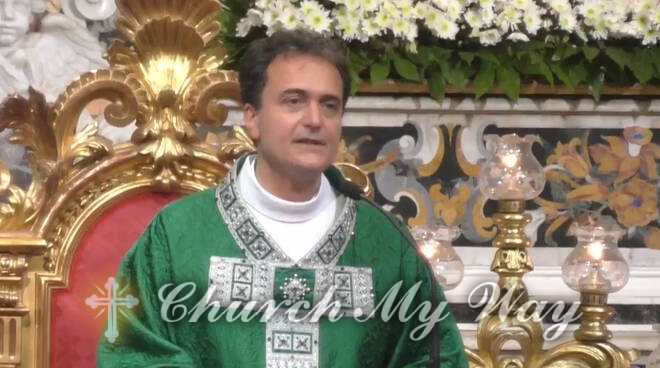
Piano di Sorrento, the moving homily of Don Pasquale Irolla: “I do not deserve happiness”
Piano di Sorrento. The homily delivered during the Holy Mass on Tuesday 14 June by Don Pasquale Irolla in the Basilica of San Michele Arcangelo was beautiful: “In the first months of my life, I spent quite a few days between life and death. I have never listened to those situations in detail, but what is certain is that God saved me through the faith of my mother who saved me from death by placing a fragment of a host consecrated by her tongue on my forehead.
This event of death and resurrection will have left within me duplicity of imprints in my psyche and in my soul. The negative footprint is probably this: “I don’t deserve to live, I had to die”. But this “killer” thought has probably turned into this: “I don’t deserve happiness”. When happiness comes, I probably say, “It’s not mine.” This thought, this psychic predisposition, was probably defeated and destroyed (I don’t know if she is still alive) with the experience of the call where Jesus faced this negative mentality then projected onto life and called me.
The disciples are at night and they have failed. At a certain point, the net is filled with fish and they think: “It’s impossible”. Fortunately and by grace a voice appears: “It is the Lord, it is true, it is for you”. I think this is the experience of salvation.
I classify this obscure thought under the title of “original sin”. Each of us has an original sin, true or presumed, which is at the origin and according to which – according to strange deductions of our mind – we do not deserve happiness.
Sometimes this thought is also undermined in those who voluntarily terminate the pregnancy, in those who have separated, and in those who have had a transplant. Shocking events but each of us has a thought that comes from an original sin that God has conquered, that Jesus has defeated by descending into hell and tearing us away from despair.
The poet writes Salinas: “And sudden, unexpected, fortuitous, happiness. Alone because she wanted, she came. So vertical, so unexpected grace, so surprise gift, that I can’t believe it’s for me. I look around, and I search. Whose will it be? Will, she is from that island that escaped from the atlas, which passed me dressed as a girl? Will she not have fallen on a day of this month that begins?
Or is it the one I saw tremble beyond hope, in the depths of a voice that said to me: No? But it doesn’t matter now. She stays with me, she drags me. She uproots me from doubt. He smiles, possible; she pretends to be mine. I will go, I will go with her to love us, to live to tremble for the future. And I will love her so much, that when her master comes to ask for her, when they lead her, docile to her, to her fate, she will turn back to look at me. And I will see that it is now mine, finally ”.
I am consoled and consoled that even the poet, faced with such a vertical and unexpected grace, asks himself: “But maybe someone lost it and I took it by mistake”. And then he chases her, catches her, and keeps the doubt that it’s not hers. Each of us has happiness in our hands and thinks he has stolen it from someone, that he does not deserve it.
But, even if they come to ask for it, she will turn around and I will realize that she is mine. Who knows, perhaps at the point of death this grace that we feared to steal from someone else, will remain attached to our hands, she will turn around and a voice will say: “It is the Lord, it is true, she is yours, finally” ».
Beyond the Homily: Integrating the Message into Daily Life
Don Pasquale Irolla’s profound reflection on the subconscious barriers to joy offers more than theological insight; it presents a framework for personal examination. The idea of an “original sin,” whether true or presumed, that whispers we are unworthy of happiness is a powerful key to understanding self-sabotage. To move from intellectual understanding to lived experience requires intentional practice.
Practical Steps to Challenge Unworthiness
The first, and often most difficult, step is to identify the specific narrative. One must listen to their internal dialogue, especially during moments of success or peace. When a promotion arrives, a relationship deepens, or a moment of pure contentment settles in, what is the immediate, fleeting thought? Writing these down strips them of their hidden power. A practical tip is to keep a “joy journal,” noting not only moments of happiness but the resistance that accompanied them. This creates a map of one’s unique “unworthiness” triggers.
A common mistake is to combat this negative core belief with sheer positive affirmation. Telling oneself “I deserve happiness” while the deeper psyche holds the opposite conviction can create further internal conflict. Expert advice from therapeutic circles suggests a gentler approach: acknowledge the old thought with compassion, as one might a frightened child, and then consciously choose a new action. For instance, upon feeling “This success isn’t mine,” one could respond internally: “That is my old story. Today, I will accept this compliment fully.”
The Role of Community and Grace
Don Pasquale’s reference to the disciples in the boat highlights a crucial element: we often cannot overcome this alone. The voice of a friend, a spiritual guide, or a therapist who can say, “It is true, it is for you,” is invaluable. Isolation allows the negative narrative to echo unchallenged. Building a community that reflects grace and truth back to us is not a luxury but a necessity for healing. Furthermore, the concept of grace itself—a gift fundamentally undeserved by definition—is the ultimate antidote to a mentality of unworthiness. It operates outside the economy of merit.
An interesting psychological fact aligns with this spiritual view: the phenomenon of “imposter syndrome,” common in high achievers, directly mirrors the “I don’t deserve happiness” belief. It confirms that this is a human, not merely a religious, struggle. The healing journey involves integrating the truth that our worth is not contingent on our perfection, our past, or our productivity. As Don Pasquale so movingly testified, it is about allowing an external, loving voice to shatter the internal prison, much like the unexpected, bountiful net that transforms a night of failure into a morning of revelation.
📅 Last updated: 26.12.2025
❓ Frequently Asked Questions
💬 What did Don Pasquale Irolla mean by “I do not deserve happiness”?
He was describing a deep-seated negative belief stemming from a childhood trauma, where he felt unworthy of life after surviving a near-death experience. He classified this destructive thought pattern as a personal form of “original sin” that was challenged by his religious calling.
💬 How did Don Pasquale Irolla’s mother save him as a baby?
According to his homily, his mother saved him by placing a fragment of a consecrated host on his forehead while he was critically ill. He attributes his survival to this act of faith, which he believes led God to save him from death.
💬 Where and when did Don Pasquale Irolla give the homily about not deserving happiness?
He delivered this moving homily during Holy Mass on Tuesday, June 14, at the Basilica of San Michele Arcangelo in Piano di Sorrento, Italy. The talk reflected on his personal struggles with worthiness and the experience of divine salvation.
This post is also available in:
 Español (Spanish)
