📅 Last updated: 13.10.2026
Early Christian art was not merely decoration for hidden sanctuaries; it was theology in pigment, stone, and mosaic—a visual proclamation of the gospel when most believers could not read and when public confession could cost them their lives. Before the church possessed a canon of church councils or a settled liturgy, it possessed images: a shepherd carrying a lamb, a fish drawn in a catacomb, a woman holding a child. These images did more than illustrate the story of Jesus. In measurable, historically traceable ways, they helped shape how the gospel was told, remembered, and transmitted across the Roman world.
Early Christian art, emerging in the catacombs and house churches of the second and third centuries, translated the gospel into visual form for a largely illiterate, persecuted community. Through symbols, frescoes, sarcophagi, and later basilica mosaics, it preserved and popularized key biblical narratives—creation, deliverance, incarnation, crucifixion, and resurrection—shaping how Christians understood and retold the story of Jesus for centuries.
- Why Did the Earliest Christians Begin Making Art?
- What Symbols Did Early Christian Art Use, and What Did They Mean?
- How Early Christian Art Moved from Catacomb to Basilica
- A Timeline of Early Christian Art and Its Development
- Did Early Christian Art Change the Gospel, or Preserve It?
- How Early Christian Art Shaped Doctrine and Devotion
- What Can Modern Believers Learn from Early Christian Art?
- Conclusion: The Gospel in Line and Color
Why Did the Earliest Christians Begin Making Art?
For the first century and a half of Christian history, evidence of distinctively Christian art is thin. The apostolic church inherited a Jewish suspicion of graven images rooted in the second commandment (Exodus 20:4–5), and it expected the imminent return of Christ. The earliest believers met in homes, as the greetings of Romans 16:5 and the house-church references in 1 Corinthians 16:19 suggest, and their gatherings left few artistic traces.
That changed as the faith spread among Greek and Roman populations and as the delay of the Parousia required the church to build institutions, bury its dead with dignity, and teach new converts. Three pressures drove the emergence of a Christian visual culture:
- Burial and remembrance. Roman custom honored the dead with painted tombs and carved sarcophagi. Christians adapted the form, filling catacomb cubicula with scenes of deliverance and hope.
- Catechesis for the illiterate. The vast majority of the ancient population could not read. Images became a teaching medium, functioning alongside the oral proclamation of the gospel.
- Identity and resistance. Under intermittent persecution—under Decius (250), Valerian (257–260), and the Great Persecution of Diocletian (303–311)—Christians needed signs of belonging that were recognizable to insiders but opaque to hostile outsiders.
The Roman catacombs, especially those along the Appian Way such as the Catacombs of Callixtus and the Catacombs of Priscilla, preserve the oldest surviving body of this material. The earliest datable Christian wall paintings appear in the late second and early third centuries. Their subject matter is not random. It clusters around salvation: God rescuing his people from death.
What Symbols Did Early Christian Art Use, and What Did They Mean?
The first Christian images were largely symbolic rather than narrative. They communicated doctrine in compressed form, the way a creed compresses a confession.
The Good Shepherd
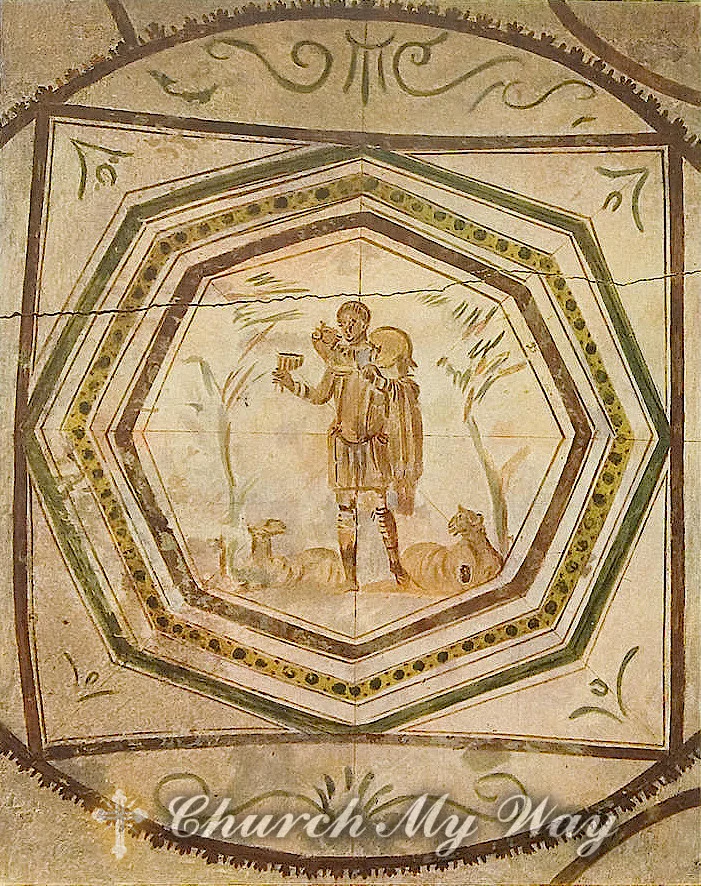
The most common image in the catacombs is a beardless young man carrying a sheep on his shoulders. It draws directly on Jesus’ parable in John 10:11—”I am the good shepherd. The good shepherd lays down his life for the sheep”—and on the shepherd imagery of Psalm 23 and Luke 15:4–7. For a community facing martyrdom, the image declared that Christ does not abandon his flock in the valley of the shadow of death.
The Fish, the Anchor, and the Orante
The Greek word for fish, ichthys, served as an acrostic for “Jesus Christ, Son of God, Savior” (Iēsous Christos Theou Yios Sōtēr). The anchor, drawn from Hebrews 6:19—”We have this hope as an anchor for the soul, firm and secure”—appeared on tombs and rings. The orante, a figure with arms outstretched in prayer, represented the soul at peace with God and echoed 1 Timothy 2:8.
Jonah, Daniel, and the Three Youths
Old Testament deliverance stories dominate the earliest cycles: Jonah swallowed and vomited up by the great fish (Jonah 1–2), Daniel unharmed among the lions (Daniel 6), and Shadrach, Meshach, and Abednego walking in the furnace (Daniel 3). Jesus himself had pointed to Jonah as the sign of his death and resurrection (Matthew 12:39–40). Early Christian art read these narratives typologically, as previews of Christ’s victory over the grave and of the believer’s own resurrection.
How Early Christian Art Moved from Catacomb to Basilica
The turning point was the Edict of Milan in 313, issued by Constantine and Licinius, which granted Christians legal protection and the right to recover confiscated property. Within a generation, Christianity moved from the margins to the imperial court, and its art changed accordingly.
Catacomb frescoes gave way to monumental architecture. Constantine commissioned the original St. Peter’s Basilica over the traditional burial site of the apostle, and the Church of the Holy Sepulchre in Jerusalem, dedicated around 335. Churches needed decoration on a grand scale, and mosaic became the medium of choice—durable, luminous, and capable of covering vast curved surfaces.
The subjects also shifted. Where the catacombs emphasized private hope and deliverance, the basilicas proclaimed public triumph. Christ appeared enthroned, robed in gold, flanked by apostles. The Christus Victor motif—Christ as cosmic king—dominated the apse. In Santa Pudenziana in Rome, a mosaic from around 400 shows Christ seated in majesty, holding a book, with the cities of Jerusalem and Bethlehem behind him.
The Crucifixion: A Late Arrival
One of the most striking facts about early Christian art is how rarely it depicted the crucifixion. The earliest surviving depiction of the crucifixion in a clearly Christian context is the Alexamenos graffito, a mocking caricature from roughly 200 showing a man worshipping a donkey-headed figure on a cross. Christians were slow to depict the cross itself, likely because crucifixion remained a shameful instrument of execution in living memory, and because the church preferred to emphasize resurrection and victory.
The first devotional crucifixion image appears on the wooden doors of Santa Sabina in Rome, carved around 430, showing Christ between the two thieves in a restrained, almost serene composition. The full emotional, suffering Christ on the cross would not dominate Western art until the medieval period. This trajectory matters: early Christian art shaped the gospel story by choosing which parts of it to foreground at which moments in the church’s life.
A Timeline of Early Christian Art and Its Development
| Period | Setting | Dominant Forms | Key Themes |
|---|---|---|---|
| c. 100–200 | House churches, Roman society | Minimal distinct Christian art; symbolic marks and rings | Hope, resurrection, identity |
| c. 200–313 | Catacombs, burial chambers | Frescoes, sarcophagi, engraved gems | Good Shepherd, Jonah, Daniel, baptism, deliverance |
| 313–400 | Public basilicas after Milan | Mosaics, monumental architecture | Christ enthroned, apostolic succession, triumph |
| 400–600 | Imperial and pilgrimage churches | Apse mosaics, illuminated manuscripts, ivory | Crucifixion, Mary as Theotokos, liturgical cycles |
Did Early Christian Art Change the Gospel, or Preserve It?
This is the central question, and it deserves a direct answer. Early Christian art did not invent new doctrine, but it did make editorial choices that shaped which parts of the gospel story received visual emphasis—and therefore which parts were most vividly remembered by ordinary believers.
Consider what the images selected. They favored:
- Rescue over judgment. Jonah, Daniel, and the three youths all depict God saving his people from certain death. The message aligned with 1 Corinthians 15:3–4, the earliest creedal summary: “Christ died for our sins according to the Scriptures… he was buried… he was raised on the third day.”
- Incarnation and maternity. The Catacomb of Priscilla contains what many scholars regard as the earliest image of the Virgin Mary nursing the infant Jesus, dated to the second or third century. It visually anchored the reality of the incarnation against docetic teaching that denied Christ’s true humanity (1 John 4:2–3).
- Baptism as entry. Scenes of Peter striking the rock to bring forth water, drawn from Exodus 17 and later Christian tradition, appeared frequently and were read as types of baptism—connecting the gospel to the sacramental life of the community.
The function was catechetical and liturgical. When a believer descended into the narrow corridors of the Catacombs of Callixtus and saw Jonah emerging from the sea creature, the story of Jesus’ own words about the sign of Jonah (Matthew 12:40) came alive. The image did not replace the preached word; it embedded it in memory.
The Role of Sarcophagi
Carved marble sarcophagi from the third and fourth centuries, such as the Sarcophagus of Junius Bassus (c. 359), present densely packed narrative programs. The Bassus sarcophagus arranges ten scenes in two registers, including the sacrifice of Isaac, Daniel in the lions’ den, and Christ before Pilate. These were not merely grave markers; they were public theological statements, proclaiming the deceased’s hope in resurrection through a compressed biblical narrative.
How Early Christian Art Shaped Doctrine and Devotion
Art and theology developed in conversation. The great Christological controversies of the fourth and fifth centuries—Arianism, Nestorianism, and the debates that produced the Council of Nicaea (325) and the Council of Chalcedon (451)—were fought partly over images.
If Christ is truly God, he can be depicted with a halo and enthroned in majesty. If Christ is truly man, he can be shown as an infant at his mother’s breast and as a corpse on a cross. The visual tradition helped stabilize the church’s two-nature confession by making it concrete. The Christ Pantocrator image, which emerged in the Byzantine world and spread widely, presented Christ as both judge and merciful savior, holding the Gospels in one hand and blessing with the other—an image that echoed the confession of John 1:14, “The Word became flesh and made his dwelling among us.”
Devotion followed doctrine. The veneration of Mary grew alongside the proliferation of images of the Theotokos, especially after the Council of Ephesus in 431 affirmed her title as “God-bearer.” Pilgrimage sites such as the Church of the Nativity in Bethlehem and the Church of the Annunciation in Nazareth incorporated mosaics and icons that shaped how pilgrims experienced the gospel narratives geographically.
What Can Modern Believers Learn from Early Christian Art?
The visual culture of the early church offers practical wisdom for a generation saturated with images yet often biblically illiterate.
- Images teach. The catacomb painters understood that faith is formed by what the eye sees. Churches that use art, iconography, and architecture intentionally are continuing a practice the earliest Christians began.
- Symbols unify. The fish, the anchor, and the shepherd gave scattered believers a shared visual vocabulary. In a fragmented age, shared confession matters more than shared aesthetics.
- Emphasis reflects belief. The early church emphasized resurrection because it lived under the threat of death. What a community chooses to depict reveals what it actually trusts.
The Reformers of the sixteenth century wrestled with the same questions the catacomb Christians faced: how much image is faithful, and how much becomes idolatry. The early church’s answer was neither iconoclasm nor indiscriminate image-making, but a disciplined use of visual theology rooted in Scripture.
Conclusion: The Gospel in Line and Color
Early Christian art did not compete with the gospel; it served it. From the crude scratches on catacomb walls to the shimmering gold of Ravenna’s mosaics, the earliest Christians used every available medium to declare that God had entered history, died, and risen. They painted the shepherd because they trusted the shepherd. They carved Jonah because they believed in resurrection. They crowned Christ in the apse because they confessed him as Lord.
That same impulse remains. Every generation must decide how to hand on the story of Jesus in forms that reach the whole person—mind, heart, and eye. The early church answered with images that still speak across seventeen centuries. Their witness invites us to ask what our own art, architecture, and visual testimony are saying about the Savior we claim to follow.
