📅 Last updated: 10.11.2026
The Martyrdom of Polycarp stands as the earliest surviving authentic account of a Christian martyrdom outside the New Testament, a document so influential that the ancient church read it aloud in worship services alongside Scripture. Written by the church at Smyrna shortly after the bishop’s death around AD 155–167, it preserves the words and witness of an eighty-six-year-old disciple of the apostle John who refused to curse Christ and instead blessed the fire that consumed him.
The Martyrdom of Polycarp is a second-century letter composed by the church of Smyrna recounting the arrest, trial, and execution of their elderly bishop Polycarp, a direct disciple of the apostle John. Arrested during a period of local persecution, Polycarp refused to deny Christ before the Roman proconsul and was burned alive in the stadium of Smyrna, likely around AD 155–167. His death became the model for later martyrdom accounts and shaped how Christians understood faithful witness unto death.
- Who Was Polycarp of Smyrna?
- Historical Context: Why Were Christians Persecuted?
- The Martyrdom of Polycarp: Narrative of Arrest and Trial
- Death in the Stadium: Fire, Spear, and Scent of Bread
- The Martyrdom of Polycarp in Historical Perspective
- What the Martyrdom of Polycarp Teaches About Faithful Witness
- Common Questions About the Martyrdom of Polycarp
- Why the Martyrdom of Polycarp Still Matters
Who Was Polycarp of Smyrna?
Polycarp served as bishop of Smyrna, a prosperous port city on the Aegean coast of Asia Minor (modern Izmir, Turkey). The early church historian Irenaeus, who as a young man heard Polycarp teach, records that the bishop had been appointed by apostles and had personal contact with the apostle John, “who had leaned on the Lord’s breast.” Irenaeus also recalls watching Polycarp in his youth, describing him as a man of consistent character who could recount John’s conversations and the miracles Jesus performed.
This apostolic connection matters enormously for understanding the Martyrdom of Polycarp. Here was not a distant legend but a living link to the generation that walked with Jesus. When Polycarp stood before a Roman tribunal, he carried the accumulated memory of the apostolic age. His death became the bridge between the New Testament witness and the church’s later experience of persecution.
Polycarp also appears in the New Testament itself. In Revelation 2:8–11, Jesus addresses the church at Smyrna through John, warning of coming suffering: “Do not be afraid of what you are about to suffer. I tell you, the devil will put some of you in prison to test you, and you will suffer persecution for ten days. Be faithful, even to the point of death, and I will give you life as your victor’s crown” (Revelation 2:10). Few congregations received a more direct prophetic word about martyrdom—and few fulfilled it more literally.
The Letter to the Philippians and Polycarp’s Early Ministry
Around AD 110, Polycarp wrote his own letter to the church at Philippi, likely shortly after Ignatius of Antioch passed through Smyrna on his way to execution in Rome. That letter reveals a pastor steeped in Scripture, quoting Paul and 1 Peter repeatedly, urging believers toward steadfast faith and practical holiness. The same man who wrote those measured pastoral words would later refuse to recant under threat of death.
Historical Context: Why Were Christians Persecuted?
Christians in the second century faced sporadic, localized persecution rather than empire-wide systematic campaigns. The correspondence between Pliny the Younger and Emperor Trajan around AD 112 established a precedent: Christians should not be hunted down, but if accused and convicted, they could be punished for obstinacy, with citizens of Rome given the option of sacrificing to the gods and being released. This created a volatile situation where mob pressure often drove prosecutions.
In Smyrna, the Martyrdom of Polycarp describes exactly this dynamic. The crowds in the stadium shouted for Polycarp’s death. The proconsul pressed the bishop to swear by Caesar’s genius and declare “Away with the atheists”—a charge leveled at Christians because they rejected the Roman gods. Refusal was treated as political defiance, not merely religious dissent.
Several factors made Christians targets:
- Religious exclusivity: Christians refused to sacrifice to Roman gods or honor the emperor’s divine genius, which many Romans saw as undermining social order and inviting divine wrath.
- Social suspicion: Christian gatherings were misunderstood—rumors of cannibalism (from the Eucharist) and incest (from calling each other “brother” and “sister”) circulated widely.
- Economic disruption: In cities like Ephesus, Christian rejection of idolatry threatened trades connected to pagan temples, as seen in the silversmiths’ riot of Acts 19:23–41.
- Mob violence: Local hostility could force magistrates to act, even when Roman officials preferred restraint.
This context helps explain why Polycarp’s calm defiance carried such weight. He was not merely defending a private belief; he was publicly rejecting the religious framework that held Roman society together, and he did so without violence or rebellion.
The Martyrdom of Polycarp: Narrative of Arrest and Trial
The account, likely written within a year of Polycarp’s death and preserved in a letter from the church at Smyrna to the church at Philomelium, unfolds with striking narrative detail. Persecution had already claimed several believers, including the Phrygian Quintus, who had volunteered for martyrdom but recanted when he saw the beasts. The author explicitly warns against seeking martyrdom rashly—a pointed correction to enthusiasm.
Betrayal and Arrest
Polycarp, warned of his danger, withdrew to a country estate outside the city, where he spent his time in prayer for the whole church. When soldiers arrived to arrest him, he refused to flee further, saying, “The will of God be done.” He ordered food and drink for his captors and asked for an hour to pray. The account records that he prayed aloud for two hours, so filled with grace that some of the soldiers began to regret their mission.
Even in the moment of betrayal—by a household servant, according to the text—Polycarp’s response echoed Christ. He did not resist, did not curse his betrayer, and did not plead for his life. The parallel to Jesus in Gethsemane is deliberate; the author frames Polycarp’s death as an imitation of the Lord’s Passion.
The Proconsul’s Interrogation
Brought into the stadium amid uproar, Polycarp was urged by the proconsul to have respect for his age and to say, “Swear by the fortune of Caesar; repent, and say, ‘Away with the atheists.'” The crowd of pagans was meant by that phrase. Polycarp, according to the account, gestured toward the hostile crowd and said, “Away with the atheists”—turning the demand against the idolaters themselves.
The proconsul persisted: “Swear, and I will release you; revile Christ.” Polycarp’s reply is among the most quoted sentences in early Christian literature:
“Eighty-six years I have been his servant, and he has done me no wrong. How can I blaspheme my King who saved me?”
When the proconsul threatened wild beasts and fire, Polycarp answered that fire burns for an hour and is extinguished, but the fire of coming judgment is eternal. He invited the official to bring whatever punishment he wished. The proconsul, unable to break him, sent a herald to announce three times, “Polycarp has confessed that he is a Christian.”
Death in the Stadium: Fire, Spear, and Scent of Bread
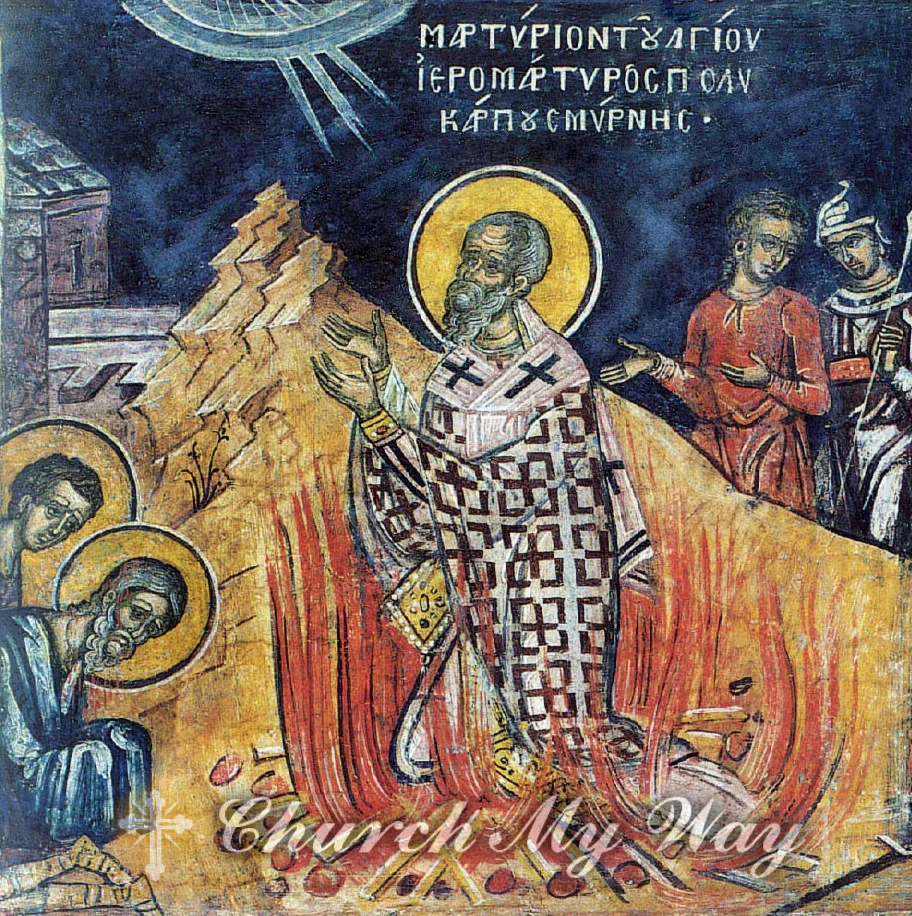
The crowd—both Jews and pagans, the account notes, in a detail that reflects the raw social tensions of the city—demanded that Polycarp be burned alive. They gathered wood from workshops and baths with such zeal that the pyre was assembled quickly. Polycarp removed his own garments and sandals, and when they prepared to nail him to the stake, he said, “Leave me as I am; for he who gives me power to endure the fire will grant me also to remain in the fire unshaken, even without your securing me with nails.”
They bound him instead, and Polycarp prayed a lengthy prayer that echoes the language of the liturgy: thanksgiving for being counted worthy of the cup of Christ, for the resurrection to eternal life, and for the communion of the Holy Spirit. The account describes the fire behaving strangely—flame billowing like a sail around the body, and the martyr’s flesh giving off a fragrance like baking bread or precious incense. When the executioner finally stabbed him with a dagger, so much blood flowed that it extinguished the fire, and the crowd marveled at the difference between unbelievers and the elect.
The author of the Martyrdom of Polycarp is careful to note that the Christians were not permitted to take the body, lest they begin to worship the martyr. The bones were later collected and buried, and the church resolved to commemorate the day of his death as a “birthday” into eternal life. This is one of the earliest documented references to the annual remembrance of a martyr.
The Martyrdom of Polycarp in Historical Perspective
Dating the Martyrdom of Polycarp remains debated. The text places the death during the proconsulship of Statius Quadratus, which most scholars assign to either AD 155–156 or 166–167. The earlier date is favored by many historians, though some argue for the later period during the reign of Marcus Aurelius. Either way, the document is among the earliest post-apostolic Christian writings outside the New Testament canon.
| Event | Approximate Date | Significance |
|---|---|---|
| Polycarp born | c. AD 69–70 | Lived 86 years, spanning the apostolic and sub-apostolic eras |
| Revelation to Smyrna written | c. AD 90–95 | Christ warns the church of coming persecution and calls for faithfulness unto death |
| Polycarp’s letter to Philippians | c. AD 110–115 | Demonstrates his pastoral ministry and scriptural grounding |
| Martyrdom of Polycarp | c. AD 155–167 | First recorded Christian martyrdom outside the New Testament |
| Irenaeus writes of Polycarp | c. AD 180–190 | Confirms Polycarp’s link to the apostle John and his enduring reputation |
Authenticity and Textual Transmission
Scholars generally regard the core narrative of the Martyrdom of Polycarp as authentic, though some manuscripts include later additions, such as a postscript by a certain Pionius and legendary elements in the martyrdom of Germanicus. The letter’s self-conscious framing—”we write to you, brothers, concerning the martyrs”—and its pastoral purpose mark it as a genuine early Christian document rather than later hagiography. Eusebius quotes it extensively in his Church History (Book IV), confirming its circulation by the early fourth century.
What the Martyrdom of Polycarp Teaches About Faithful Witness
The document is more than a historical record; it is a theological argument about how Christians should face suffering. The author draws explicit parallels between Polycarp and Christ: both were betrayed, both were arrested, both stood before a judge, both refused to recant, and both died in a manner that the community interpreted as sacrificial. Yet the text also insists that Polycarp is not Christ—he is a martyr, a witness, not a savior. The distinction is crucial for understanding early Christian devotion.
Imitating Christ Without Usurping Him
The Martyrdom of Polycarp describes the martyr as a “imitator of Christ,” language drawn from Paul’s letters (1 Corinthians 11:1; Philippians 2:5–11). The author is careful to say that Polycarp was not worshiped but remembered as an example. This balance shaped Christian martyrdom theology for centuries: martyrs are honored, not adored; their deaths participate in Christ’s victory without adding to it.
Courage Rooted in Long Obedience
Polycarp’s famous declaration—”Eighty-six years I have been his servant, and he has done me no wrong”—reveals that his courage was not a sudden burst of heroism but the fruit of a lifetime of faithfulness. The man who refused to curse Christ at eighty-six was the same man who had urged the Philippians toward steadfastness decades earlier. His death was the final note in a long song of obedience.
This offers a practical challenge for believers today. Martyrdom is rarely a single dramatic decision; it is the cumulative result of daily choices to trust and obey. The church father Tertullian later wrote that “the blood of the martyrs is seed,” and Polycarp’s life illustrates why: a witness formed over decades cannot be easily broken in an hour.
The Church’s Response: Grief and Hope
The Martyrdom of Polycarp ends with the church’s determination to remember. They buried the bones and resolved to gather at the tomb to celebrate the anniversary of his death, “both to honor the memory of those who have struggled and to train and prepare those who will struggle in the future.” This is one of the earliest descriptions of what would become the practice of commemorating martyrs—a practice that shaped the church’s calendar and its theology of the communion of saints.
For modern readers, the document invites reflection on how we remember our own spiritual forebears. The cloud of witnesses in Hebrews 12:1 is not a vague metaphor; it is a specific community of people whose lives and deaths teach us how to run the race.
Common Questions About the Martyrdom of Polycarp
Was Polycarp a disciple of the apostle John?
Yes, according to Irenaeus, who as a young man heard Polycarp teach and later wrote that Polycarp had been instructed by the apostles and had conversed with John. This makes Polycarp a direct link between the apostolic generation and the second-century church.
Why was Polycarp executed?
Polycarp was executed for refusing to sacrifice to the Roman gods and curse Christ. His refusal was interpreted as political defiance in addition to religious dissent, and the crowd’s hostility pressured the Roman proconsul to condemn him to death by fire.
Is the Martyrdom of Polycarp in the Bible?
No. It is a post-apostolic Christian letter, written by the church at Smyrna, not a book of Scripture. It is valuable as an early historical and theological document but is not part of the biblical canon.
What does Polycarp’s death teach about martyrdom?
It teaches that martyrdom is not sought for its own sake, that courage grows from long obedience, and that the martyr’s death bears witness to Christ rather than to the martyr’s own strength. The document warns against volunteering for martyrdom while honoring those who endure it faithfully.
Why the Martyrdom of Polycarp Still Matters
In an age when religious freedom is contested in many parts of the world, the Martyrdom of Polycarp remains a living document. It reminds believers that faithfulness to Christ can cost everything, and it demonstrates that such faithfulness is possible because Christ himself sustains his people. The letter’s closing doxology—”To him be glory, honor, majesty, and eternal power, from generation to generation. Amen”—is not a pious flourish but a confession forged in fire.
Polycarp’s witness also challenges comfortable Christianity. The bishop of Smyrna did not die for a political cause, a cultural identity, or a personal grievance. He died because he would not deny the Lord who had kept him for eighty-six years. That is the heart of the Martyrdom of Polycarp: a life spent in service of Christ, crowned by a death that testified to the resurrection. The church at Smyrna wrote their account so that others might run the same race, and the document still calls readers to do exactly that—to hold fast to Christ, to love his church, and to trust that the fire of this world cannot touch the life he gives.
