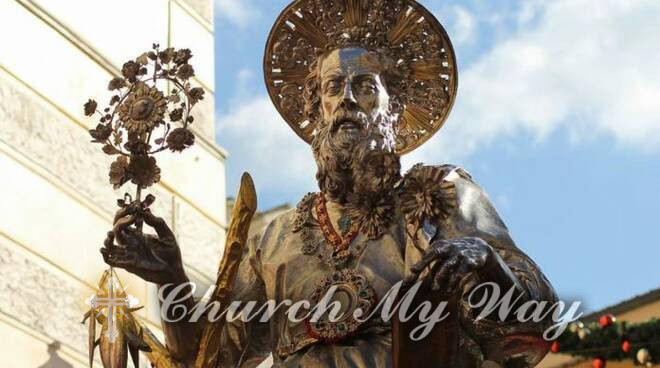
Amalfi today celebrates Sant’Andrea: the program
Amalfi today celebrates Sant’Andrea: the program. The procession returns through the streets of the city. Amalfi is ready to honor its patron saint Andrea and, this year, after the two-year stop caused by the pandemic, the procession returns through the streets of the city.
Today, June 27, the leading city of the Coast that takes its name is therefore ready to welcome the faithful and tourists on the occasion of this great feast in honor of the Apostle Andrew who, on June 27, 1544, with a miraculous prodigy, a sudden storm, sank the fleet of the Saracen pirate Kair-Ad-Din who wanted to conquer Amalfi.
FESTIVAL OF THE PATRONAGE OF SANT’ANDREA – PROGRAM
Sunday 26 June: Eve of the Feast
8.00 – 9.30: Holy Masses
8.00 am: Tour of the “Città di Minori” band concert
10.30: Exhibition of the venerated statue of St. Andrew and Holy Mass
18.00: Tour of the band concert
7.00 pm: Second Vespers
7.30 pm: Holy Mass celebrated by HE Most Rev. Orazio Soricelli, Archbishop of Amalfi – Cava de ‘Tirreni and rite of Manna
9.30 pm: Performance of the band concert in Piazza Duomo
Monday 27 June – Feast of St. Andrew the Apostle
7.00 – 8.00 – 9.00: Holy Masses
8.30 am: Tour of the band concert
10.30 am: Pontifical Mass celebrated by HE Most Rev. Michele Fusco, Bishop of Sulmona – Valva, animated by the Schola Cantorum “Cantate Domino – Aloysiana”
10.30: Matinè of the band concert in Piazza Spirito Santo
12.00: Festive sound of all the bells of the churches in the city
18.00: Tour of the band concert
6.30 pm: Holy Mass
20.00: Procession through the streets of the city
11.00 pm: Fireworks display by the Senatore company from Cava de ‘Tirreni
Wednesday 29 June – Solemnity of Saints Peter and Paul
7.00 pm: Second Vespers
7.30 pm: Holy Mass and reposition of the venerated silver bust
Beyond the Procession: Experiencing the Heart of the Feast
While the printed program outlines the “when,” truly immersing yourself in the Feast of Sant’Andrea requires understanding the “how” and the “why.” This celebration is far more than a sequence of religious events; it is the living, breathing soul of Amalfi made manifest. To move from spectator to participant, a shift in perspective is essential. The procession is the climax, but the entire day builds towards it with a palpable, communal energy that transforms the ancient streets into a vibrant tapestry of devotion, history, and local identity.
Practical Tips for the Discerning Visitor
Navigating the feast successfully requires some local know-how. First and foremost, abandon all hope of a car. The entire historic center becomes a pedestrian zone, and access roads are heavily restricted. Your best approach is to arrive early by public transport—the SITA bus or ferry—and embrace walking. Wear comfortable, sturdy shoes; the procession route involves steep, narrow staircases and uneven cobblestones that are challenging in heels. For the evening events, especially the procession and fireworks, claim your spot along the route or on the marina at least 90 minutes early. Locals often bring a small, foldable stool. Remember, this is a religious event first: respectful attire (covering shoulders and knees) is expected, especially if you wish to enter the Duomo.
A Common Mistake to Avoid
One of the most frequent missteps visitors make is focusing solely on the 8:00 PM procession and the fireworks. In doing so, they miss the profound spiritual and historical core of the day: the Messa Pontificale (Pontifical Mass) at 10:30 AM. This is not merely another service. It is a magnificent liturgical spectacle, filled with ancient chants, the solemnity of a bishop celebrating, and the full power of the “Cantate Domino” choir echoing through the cathedral. The atmosphere here, charged with devout anticipation, offers a much deeper understanding of what the patron saint means to the Amalfitani than the more crowded evening events can provide. Arrive early to witness the cathedral in all its festive glory.
The Expert’s Insight: Understanding the “Rito della Manna”
Many observe the “Rite of the Manna” on the eve of the feast without grasping its profound significance. As Monsignor Soricelli blesses the ampoules, he is invoking a tradition tied to the very tomb of the Apostle. The “manna” is a mysterious, fragrant liquid said to exude from the marble of St. Andrew’s tomb beneath the cathedral crypt. Historically collected and distributed as a sacred relic, it is believed to have miraculous properties. An expert in Amalfitan history would note that this rite is a direct, tangible link to the 13th century, when the saint’s relics were brought from Constantinople. Witnessing this rite is to witness a medieval tradition alive and well, a moment where science, faith, and legend beautifully intersect. It’s a quieter, more contemplative highlight amidst the festive noise.
Fascinating Facts: The Bells, the Bust, and the Sea
Look beyond the main events, and you’ll discover layers of symbolic meaning. The festive sound of all the city’s bells at noon on the 27th is not just a nice ring. It is a sonic re-enactment of the historic alarm and subsequent jubilation that followed the miraculous storm in 1544, a wave of sound washing over the city just as the stormy sea once did. Furthermore, the venerated silver bust processed through town contains a piece of the saint’s skull, a sacred cargo carried by the devoted portatori. Notice how the procession always culminate at the marina. This is intentional: St. Andrew is not only the patron of the city but also the patron of fishermen. The blessing towards the Tyrrhenian Sea is a plea for protection and bounty, acknowledging the source of both Amalfi’s ancient maritime power and its daily sustenance. Even the fireworks display over the water is symbolic, reflecting the heavenly “fire” of the saint’s protection against invaders.
The Culinary Dimension of the Feast
No Italian celebration is complete without its culinary traditions, and Sant’Andrea is no exception. While not on the official program, local families and restaurants often feature special dishes. Given the saint’s connection to fishing, look for “scialatielli ai frutti di mare” (fresh pasta with seafood) or simply prepared fresh fish as a tribute. For a sweet treat, seek out the classic delizia al limone, a lemon-flavored pastry that embodies the flavors of the Coast. Dining in Amalfi on the feast day requires planning; restaurants book up quickly, so reservations are absolutely essential. Consider a late lunch after the Pontifical Mass or a very late dinner following the fireworks to navigate the crowds more smoothly. Embracing these flavors is to taste the celebration itself.
📅 Last updated: 20.12.2025
❓ Frequently Asked Questions
💬 What is the festival of Sant’Andrea in Amalfi?
The Festival of Sant’Andrea is the annual celebration honoring Amalfi’s patron saint, the Apostle Andrew. It commemorates the miraculous event of June 27, 1544, when a sudden storm, attributed to the saint, destroyed a pirate fleet threatening the city.
💬 What is the program for the Sant’Andrea festival in Amalfi?
The program spans two days, June 26 and 27, and includes multiple Holy Masses, band concerts throughout the city, vespers, and the exhibition of the venerated statue of Saint Andrew. The main Pontifical Mass is held at 10:30 AM on June 27th.
💬 Why is Sant’Andrea important to Amalfi?
Sant’Andrea (Saint Andrew) is the patron saint of Amalfi, credited with miraculously saving the city from a pirate invasion in 1544. The annual festival celebrates this protection and is a major religious and cultural event for the city.
This post is also available in:
 Español (Spanish)
